

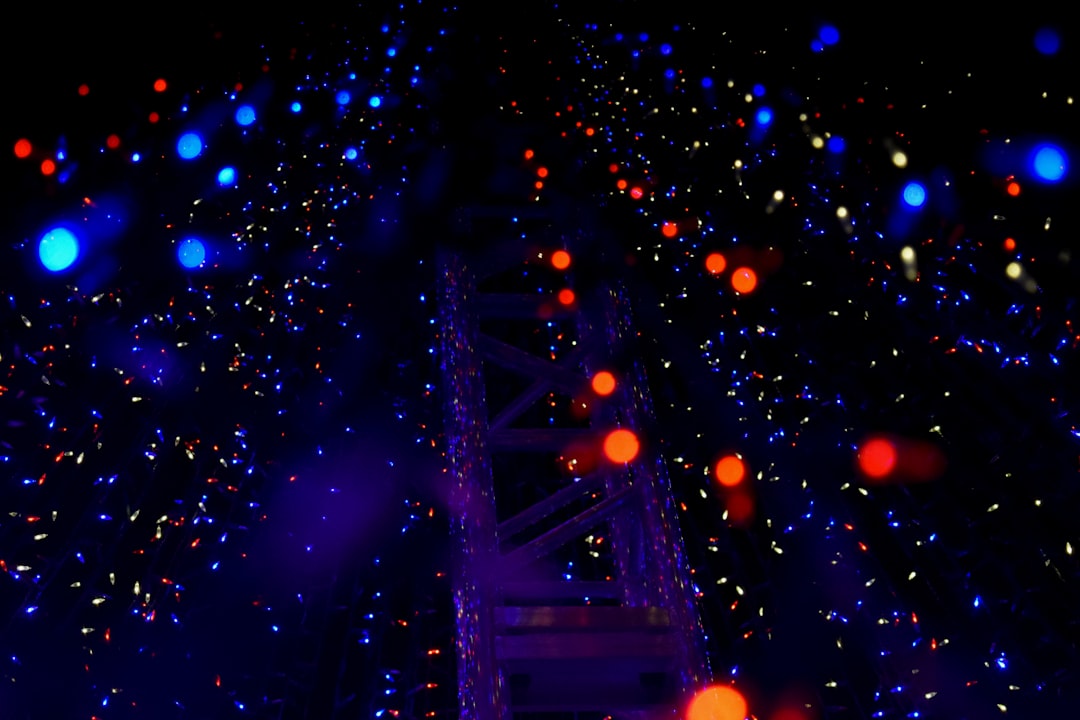
Meow Wolf’s House of Eternal Return: Inside Santa Fe’s 33,000-Square-Foot Art Portal
Walk through the front door of a Victorian house on Rufina Circle and you’re inside someone’s living room — mail on the counter, family photos on the wall, a fridge that hums. Open the refrigerator, though, and you step out of the house entirely, into a forest of glowing mushrooms the size of streetlamps. That’s the trick Meow Wolf’s House of Eternal Return has been pulling on visitors since 2016, and it’s still the closest thing Santa Fe has to a portal.
The building that started as a bowling alley
The address is 1352 Rufina Circle, in the low-slung industrial pocket south of Cerrillos Road, roughly 15 minutes from the Plaza by car. The 33,000-square-foot space was originally Silva Lanes, a bowling alley that had sat vacant since 2008. Meow Wolf’s founding artists had been staging temporary installations around Santa Fe for years, but they had nowhere permanent to work at scale.
George R. R. Martin — who has lived in Santa Fe since the late 1970s — stepped in and pledged roughly $2.7 million to purchase and renovate the building, leasing it to the collective at a rate they could actually afford. The city of Santa Fe contributed $50,000, and a crowdfunding campaign added another $100,000. Over the next two years, more than 100 artists filled the shell with rooms, tunnels, secret passages, and hand-built objects. It opened to the public on March 18, 2016.
What’s actually inside
The literal center of the exhibit is a full-scale two-story Victorian house — the home of the fictional Selig-Pastore family, who have vanished. You can walk into every room. The kitchen leads to a normal-looking pantry that opens into a dimension of neon crystals. A dryer in the laundry room is a passage. A fireplace is a passage. A bookshelf in a child’s bedroom slides sideways to reveal a stairway that shouldn’t be there.
Around and beyond the house is what the artists call the multiverse — 70+ rooms of interactive sculpture, soundscape, and light. A giant glowing mastodon skeleton you can play like an instrument. A hallway of hanging lights that respond to your movement. A treehouse. An aquarium the size of a small van. Kids run through all of it at full speed; adults tend to stop and stare.
The mystery, if you want to follow it
Under the sensory experience there’s a narrative you can piece together at your own pace. The Selig-Pastore family conducted a forbidden experiment involving something called The Anomaly — an attempt to reach across dimensions and bring back a deceased family member. The experiment went sideways and the family disappeared. The story is told entirely through objects: letters on the kitchen counter, home movies playing on a den television, journals in a teenager’s bedroom, a hamster in a cage.
You can skip the whole story and just wander. Plenty of visitors do — the visual density is enough for a two-hour visit even if you never open a drawer. But if you do sit down and read the letters, the exhibit reveals a second layer that most people miss on a first pass. This is why locals go back multiple times.
How long is a visit, and when should you go?
Plan on 90 minutes minimum. Two to three hours is common. Some people spend four. Tickets are timed entry, and the exhibit gets crowded on weekend afternoons — if you can go on a weekday morning or a weekday evening, you’ll have more room to explore rooms alone, which changes the experience considerably.
The venue also hosts live music in the main hall — it has been named one of the top small music venues in the United States, and touring acts stop through often. Check the concert calendar if you’re visiting for a few days.
Is Meow Wolf good for kids?
Yes, with two caveats. Kids generally love it — there’s climbing, crawling, buttons, lights, and secret passages built at kid scale. That said, some rooms are dark and disorienting, and there are strobe effects in a couple of spots. A very young child (under 4) or a child sensitive to sensory overload may want to skip a few rooms. Meow Wolf publishes an accessibility guide that flags the specific effects.
How it fits into a Santa Fe trip
Meow Wolf is the counterweight to the Plaza. Most Santa Fe visitors spend their first day on adobe streets — the Cathedral, Canyon Road galleries, the Palace of the Governors — and it’s easy to leave with a very specific mental picture of the city: historic, brown, quiet. House of Eternal Return is what the same city looks like from a different angle. The artists who built it are Santa Feans; the building is a Santa Fe bowling alley; the money came from a Santa Fe novelist. It’s not an outlier grafted onto the city — it’s an argument about what the city already is.
The 2017 Thea Award from the Themed Entertainment Association put House of Eternal Return on the same list as major museum installations and theme parks. In the ten years since it opened, Meow Wolf has expanded to Las Vegas, Denver, Grapevine, and Houston — but the Santa Fe original is still the one built by the artists themselves, in the space they raised the money for. Webster Santa Fe treats it as one of the essential stops for any visitor with a full afternoon to spend. For more places worth planning a trip around, browse our Discoveries directory.


Get in Touch
Let's connect and discuss how we can help you enrich your Santa Fe experience.
