Adobe is a discipline, not a finish. That sentence is the single most useful framing we have given a buyer in fifty years of working in Santa Fe, and it explains, more than any other line, why the houses that endure here behave differently from the houses that surround them in any other American luxury market. The buyer who understands adobe as a discipline ends up with a house that will outlast them. The buyer who understands it as a finish ends up with a renovation cycle and a slow learning curve.
What follows is a primer on what adobe homes actually are, how the regional vernacular evolved, what stewardship requires, and what to look for when you are buying one. It is the conversation we have most often with buyers who arrive in Santa Fe on the strength of a feeling about the architecture and want to translate that feeling into a serious purchase.
What an adobe home actually is
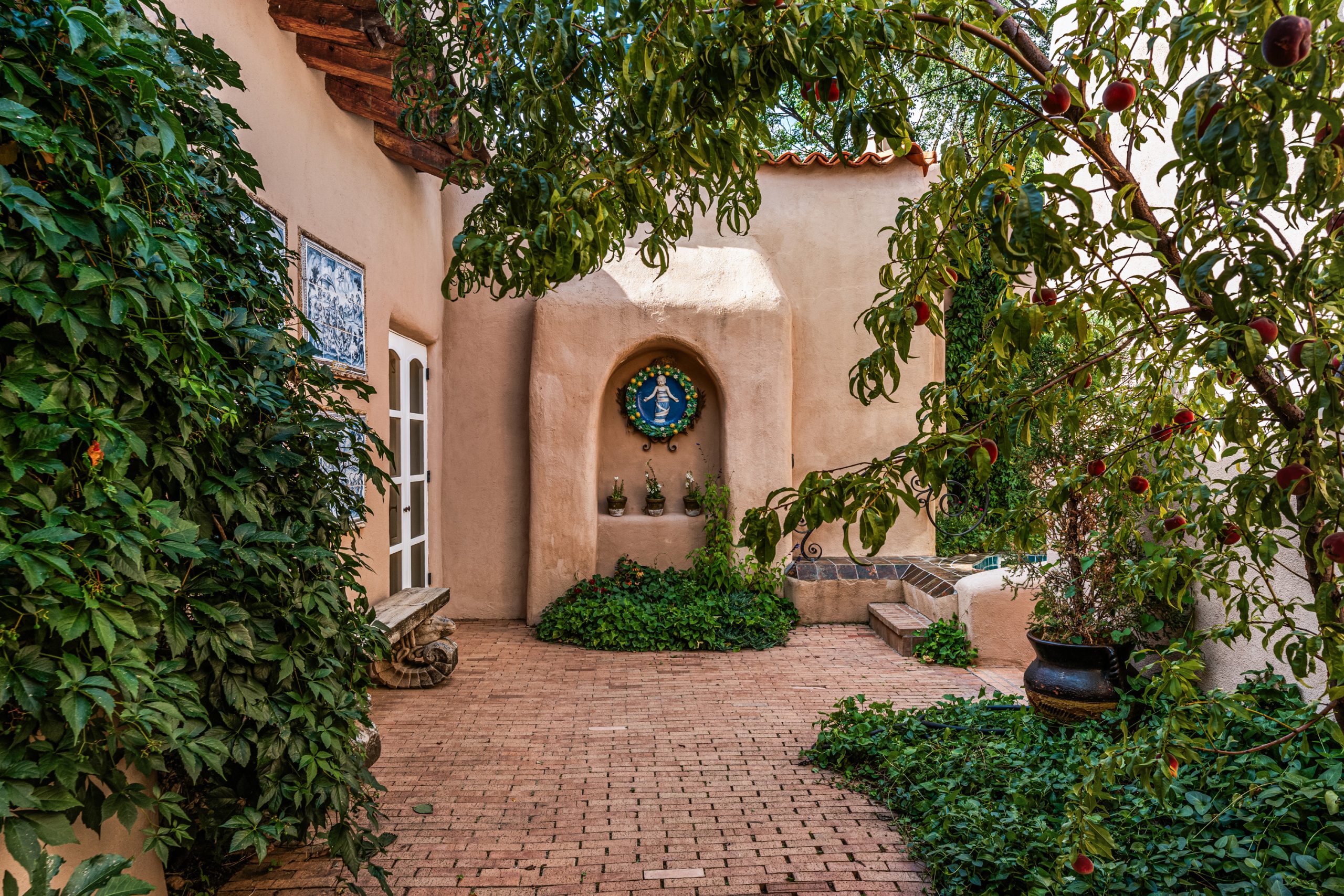
An adobe home, in the technical sense, is a structure whose load-bearing exterior walls are built from sun-dried earthen bricks bound with straw and water. The bricks are typically formed in wood molds, dried in the sun for a week or more, and laid up in mud mortar to a wall thickness that, in traditional Santa Fe construction, runs eighteen to twenty-four inches. The walls are then sealed with a lime plaster or, more often in the older tradition, a hand-troweled mud coat (enjarrado) that is renewed periodically as part of the house’s ongoing maintenance.
The structural language that follows from those walls is consistent across the regional vernacular. Ceilings are framed with vigas (round, peeled timber beams) overlaid with latillas (thinner, peeled or split sticks laid perpendicular or in a herringbone pattern to the vigas) and sometimes finished with a layer of earthen fill. Floors are often flagstone, brick, or finished concrete in older houses; saltillo and wide-plank wood in later ones. Fireplaces are kiva (corner-built, beehive-shaped, often plastered into the wall as a sculpted form). Portales (covered exterior porches and walkways) wrap one or more sides of the house and mediate the transition between interior and walled garden.
The most consequential distinction for any prospective buyer is between true adobe and what is, in practice, the larger category in the regional market: stuccoed-over frame or concrete block construction, styled to look adobe. The exterior reads similar at a glance. The performance, the longevity, the thermal mass, the maintenance discipline, and (over a long horizon) the resale all behave differently. This is the question to ask first when you are evaluating a house in Santa Fe, and we treat it as the foundational question in any showing.
Pueblo REVIVAL, Territorial, and Spanish Pueblo Revival
The three dominant architectural styles in Santa Fe are Pueblo Revival, Territorial, and Spanish Pueblo Revival. The names are sometimes used loosely; they refer to specific design vocabularies, and the differences are meaningful when you are buying.
Pueblo Revival developed in the early twentieth century as a deliberate revival of the indigenous Pueblo and Spanish-colonial earthen architecture of the region. The dominant figures (John Gaw Meem most consequentially, and Isaac Hamilton Rapp before him) drew on Acoma, Taos, and the older Spanish-colonial mission tradition to formalize a regional language: massed stepped forms, rounded parapets, vigas exposed at the wall plane, recessed windows, exposed lintels, and a refusal of any classical or Anglo-vernacular trim. The style was codified into Santa Fe’s planning identity by the 1957 Historic Styles Ordinance, which governs new construction within the Historic Districts to this day.
Territorial is older as a style on the ground, evolving in the late nineteenth century as Anglo influences (milled lumber, brick coping, double-hung windows) began to layer onto the Spanish-colonial adobe base. The defining markers are brick-coped parapets, milled wood trim around windows and doors (often painted white), pediments above openings, and frequently a second story (which is rare in Pueblo Revival). Territorial adobes read more architecturally formal than Pueblo Revival, and the style’s history as an Anglo-Hispano hybrid carries through into the houses today.
Spanish Pueblo Revival is the hybrid that emerges when Pueblo Revival massing is combined with the more elaborate woodwork of the Spanish-colonial tradition: hand-carved corbels, zapatas (decorative wooden brackets), more articulated portales, and hand-troweled plaster finishes that lean toward sculpture rather than smoothness. This is the most ornate of the three, and it is the register most commonly seen in the high-end Eastside compounds.
For buyers, the practical takeaway is that all three styles are present in Santa Fe inventory, the price premiums move differently across them, and the architectural distinctions are not interchangeable.
The architects who shaped Santa Fe adobe
The names worth knowing, on the residential side, are John Gaw Meem and Betty Stewart.
John Gaw Meem worked in Santa Fe from the 1920s into the 1950s, and his name is the closest thing to an architectural signature the regional market has. The Laboratory of Anthropology, the renovation and expansion of La Fonda on the Plaza, and a long roster of private residential commissions across the Eastside and the wider region carry his hand. A verified Meem provenance on a private residence is one of the most durable premiums in Santa Fe real estate; the houses do not lose value, the documentation tightens over time as scholarship matures, and the buyers who recognize the name are the ones willing to pay for it.
Betty Stewart followed in the Meem lineage in the latter half of the twentieth century. Her residential body of work is, for the most part, on the Eastside and in Tesuque. Her compounds are characterized by a sculptural intimacy with the regional vernacular: hand-troweled plaster, deliberately imperfect surfaces, an instinct for siting that is difficult to describe and immediately apparent on the property. Stewart provenance has appreciated steadily as her body of work became finite, and the houses tend to be held longer than typical Eastside inventory.
A small number of contemporary stewards continue to work in the vernacular at a high level. Their houses are not yet historic, but they are built with the same materials, the same wall thicknesses, and the same architectural discipline, and the best of them will carry provenance forward in the way Meem and Stewart did. We are happy to make introductions when a buyer is at that point in the conversation.
What stewardship of an adobe actually requires
The discipline of adobe is not optional, and it is not punishing, but it is real. The houses that have been standing for a hundred and fifty years or more are the ones whose stewards understood the discipline. The houses that have failed are the ones whose stewards did not.
The exterior. Mud-coated walls require renewal on a cycle that depends on exposure (south- and west-facing walls weather faster than north and east) and on the surrounding microclimate. In a typical Santa Fe exposure, a re-mud or re-stucco cycle of every five to ten years is realistic; some walls last longer, some shorter. The work is craft work, performed by enjarradoras and specialist builders who know the regional tradition. It is not generalist contractor work.
The roof and parapets. Flat roofs (the regional norm) require attention to drainage, and canales (the projecting drain spouts that carry water off the roof) need annual inspection. Standing water on a parapet is the principal failure mode; addressed early, it is routine maintenance, addressed late, it is a structural intervention. Snow loads are not a major concern at Santa Fe’s elevation, but melt cycles around penetrations are.
Interior systems inside historic walls. Heating, electrical, and plumbing inside an eighteen-to-twenty-four-inch adobe wall require specialists. Routing and chasing in adobe is a different problem from routing in frame construction, and the cost of doing it correctly the first time is meaningfully lower than the cost of redoing it. The right contractors are local, known, and book ahead.
Cost expectations. We give cost ranges in conversation with specific buyers and specific properties because the variables (house size, prior stewardship, age of the systems, current condition of the exterior coat) move the answer. (Verify a defensible 2026 cost-per-square-foot range with the team’s preferred local builders before publication.) What we will say in print is that buyers should plan for an annual maintenance budget on a historic adobe that exceeds the budget on a comparable frame house, and that the difference, on a long horizon, is more than recovered in the durability and value retention of the property.
Moisture is the principal enemy of an adobe wall. It is also the easiest thing to manage if the stewardship is consistent. We have walked through 200-year-old houses that are bone dry inside thick walls and look architecturally exactly as they did the day they were finished. The discipline rewards attention.
Buying an adobe: what to look for
Five questions, in the order we ask them.
Provenance. Who designed it, who built it, and who has stewarded it? A verifiable architect attribution (Meem, Stewart, a contemporary working in the lineage) is meaningful, but the more durable question is the chain of stewardship. Houses that have been held by serious owners and maintained on cycle present differently from houses that have been flipped.
True adobe versus styled-frame. The question to ask, plainly: are the load-bearing exterior walls adobe, or are they framed and stuccoed? A seller’s broker should be able to answer immediately and supply documentation. If the answer is unclear, treat the property as styled-frame until proven otherwise.
Historic district status. Is the property within the Historic Districts overlay? If so, exterior changes (additions, fenestration, color, even some landscape elements) are reviewed by the Historic Districts Review Board. The HDRB review is not punitive, but it is real, and a buyer’s plans for the property should be tested against it before close.
Lot orientation and water rights. Inside city limits, water is mostly on the municipal system and the question is straightforward. Outside city limits (Tesuque, parts of La Tierra, the surrounding county), water rights, well permits, and acequia status are all live considerations that affect both the buy and the future use of the property.
Condition of the systems and the exterior. When was the last re-mud or re-stucco? When was the roof last inspected, and the canales last rebuilt? When were the heating and electrical systems updated, and by whom? These are not deal-breakers either way; they are calibration questions that tell you what the first eighteen months of ownership will look like.
The Webster Estates view
We have worked with adobe owners in Santa Fe for fifty plus years, on every part of the cycle: designing, building, stewarding, restoring, and selling. The houses that endure here are the ones whose stewards understood the discipline. The houses that do not endure are not the houses that failed; they are the houses that were never approached as the architectural objects they actually are.
Adobe rewards the buyer who arrives with patience and an open mind, and who recognizes that the discipline of the building is not separate from the life inside it. We are happy to walk anyone through that conversation, in our offices or at a property.
If you would like to talk about adobe specifically, or about a house you are considering, reply to this post or come find us on The Plaza at 54½ Lincoln Avenue, above the Plaza Café.
With our regards from The Plaza, The Webster Estates Team
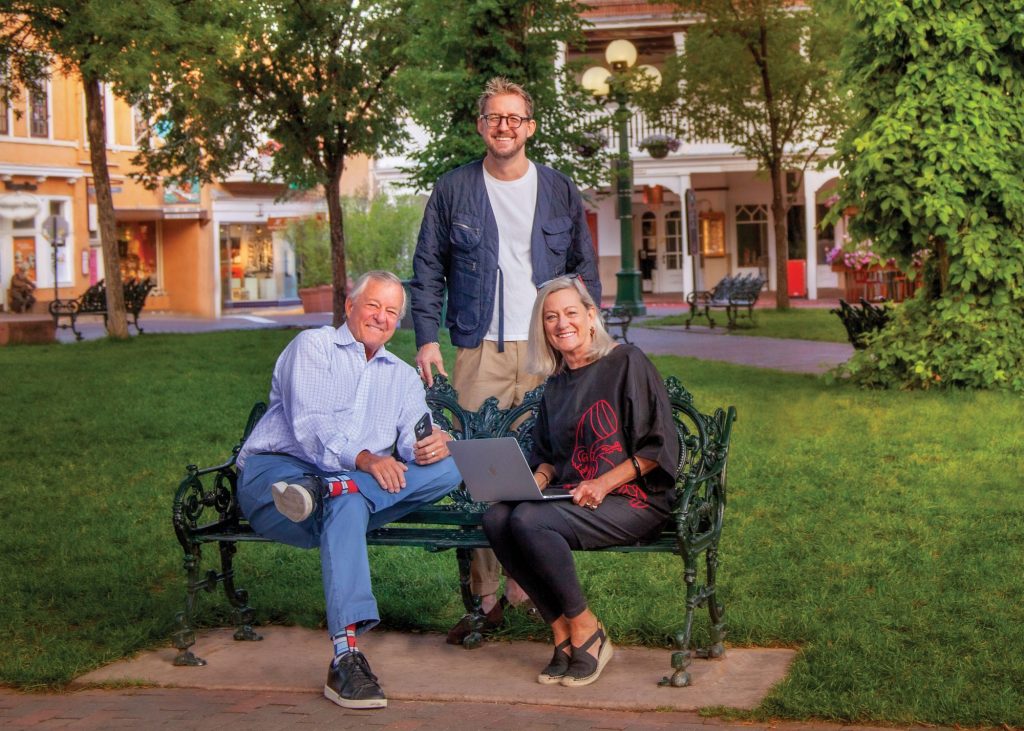
Chris Webster · Patti Webster · Christopher Webster III · Paisley Mason Webster
Webster Estates is the real estate brokerage arm of Webster Santa Fe, a team of Associate Brokers at Sotheby’s International Realty. The team has operated from 54½ Lincoln Avenue on The Plaza since 1976. Read our companion launch posts on the WSJ Q1 2026 ranking and on Santa Fe neighborhoods, or browse current listings.
About Webster Santa Fe: Webster Santa Fe is a family-owned operation with multiple businesses headquartered at 54½ Lincoln Avenue on The Plaza. Webster Collection, the fine art gallery, was established in 1972. Webster Estates, the real estate team affiliated with Sotheby’s International Realty, has operated since 1976. W Department, the curated international fashion boutique at wdepartment.com, was established in 2020. Chris, Patti, Christopher, and Paisley Webster are the four principals of all the business operations.
Frequently asked questions
What is an adobe home? An adobe home is a structure whose load-bearing exterior walls are built from sun-dried earthen bricks bound with straw and water, laid up in mud mortar, and finished with a lime or mud-coat plaster. In traditional Santa Fe construction, walls are eighteen to twenty-four inches thick, ceilings are framed with viga-and-latilla, and fireplaces are typically kiva-style. True adobe construction is distinct from the larger market category of stuccoed-over frame construction styled to look adobe; the two perform differently over a long horizon, and the distinction matters when buying.
What is the difference between Pueblo Revival and Territorial style? Pueblo Revival, developed in the early twentieth century and codified by Santa Fe’s 1957 Historic Styles Ordinance, is characterized by massed stepped forms, rounded parapets, exposed vigas, recessed windows, and a refusal of classical or Anglo-vernacular trim. Territorial, older as a style on the ground, layers Anglo influences onto the Spanish-colonial adobe base: brick-coped parapets, milled wood trim (often painted white) around windows and doors, pediments, and frequently a second story. Territorial reads more architecturally formal; Pueblo Revival reads more sculptural and indigenous to the region.
How much does it cost to maintain an adobe home in Santa Fe? Annual maintenance costs on a historic adobe in Santa Fe exceed the equivalent on a comparable frame house. The variables that move the answer are house size, prior stewardship, age of mechanical and electrical systems, and current condition of the exterior coat. The principal recurring item is the re-mud or re-stucco cycle on weather-exposed exterior walls, typically every five to ten years depending on exposure. Webster Estates can provide defensible 2026 cost-per-square-foot ranges in conversation with specific properties; the work should be performed by specialist builders who know the regional tradition, not generalist contractors.
Are adobe homes a good investment? Adobe homes in Santa Fe, particularly historic adobes within the Historic Districts overlay and houses with verified architect provenance (John Gaw Meem and Betty Stewart most notably), have shown strong long-term value retention. The Wall Street Journal’s Q1 2026 luxury market ranking placed Santa Fe first nationally, with luxury prices up 11.3 percent year-over-year against a national luxury tier down 2.9 percent. Adobe inventory is structurally constrained; the supply of historic-district properties does not expand, and the categories of architect-attributed and provenance-rich adobes have appreciated more durably than lookalike contemporary inventory across cycles.
Who was John Gaw Meem? John Gaw Meem (1894 to 1983) was the architect most responsible for codifying the Pueblo Revival residential vernacular that defines historic Santa Fe today. He worked in Santa Fe from the 1920s into the 1950s, and his commissions include the Laboratory of Anthropology, the renovation and expansion of La Fonda on the Plaza, and a long roster of private residences across the Eastside and the wider region. A verified Meem provenance on a private residence is one of the most durable premiums in Santa Fe real estate.
What is the Santa Fe Historic Districts Review Board? The Historic Districts Review Board (HDRB) is the city body that reviews exterior changes to properties within Santa Fe’s Historic Districts overlay. The board’s authority derives from the 1957 Historic Styles Ordinance and subsequent updates, and its review covers additions, fenestration, exterior materials, color, and certain landscape elements. The HDRB is not a punitive body; its purpose is to maintain the architectural coherence of the historic neighborhoods. Buyers planning exterior changes to a historic-district property should test their plans against HDRB guidance before close.
{
“@context”: “https://schema.org”,
“@type”: [
“RealEstateAgent”,
“LocalBusiness”
],
“@id”: “https://webstersantafe.com/real-estate/#organization”,
“name”: “Webster Estates”,
“alternateName”: “Webster Estates at Sotheby’s International Realty”,
“url”: “https://webstersantafe.com/real-estate/”,
“logo”: “https://webstersantafe.com/wp-content/uploads/webster-estates-logo.png”,
“telephone”: “+1-505-954-9500”,
“email”: “[email protected]”,
“foundingDate”: “1976”,
“parentOrganization”: {
“@type”: “Organization”,
“name”: “Sotheby’s International Realty”
},
“address”: {
“@type”: “PostalAddress”,
“streetAddress”: “54 1/2 Lincoln Avenue”,
“addressLocality”: “Santa Fe”,
“addressRegion”: “NM”,
“postalCode”: “87501”,
“addressCountry”: “US”
},
“geo”: {
“@type”: “GeoCoordinates”,
“latitude”: 35.6878,
“longitude”: -105.9378
},
“areaServed”: [
{
“@type”: “City”,
“name”: “Santa Fe”
},
{
“@type”: “AdministrativeArea”,
“name”: “Santa Fe County, New Mexico”
}
],
“openingHoursSpecification”: [
{
“@type”: “OpeningHoursSpecification”,
“dayOfWeek”: [
“Monday”,
“Tuesday”,
“Wednesday”,
“Thursday”,
“Friday”,
“Saturday”
],
“opens”: “10:00”,
“closes”: “17:00”
}
],
“sameAs”: [
“https://www.instagram.com/webstersantafe/”,
“https://www.facebook.com/webstersantafe/”
],
“employee”: [
{
“@type”: “Person”,
“name”: “Chris Webster”,
“jobTitle”: “Associate Broker”
},
{
“@type”: “Person”,
“name”: “Patti Webster”,
“jobTitle”: “Associate Broker”
},
{
“@type”: “Person”,
“name”: “Christopher Webster III”,
“jobTitle”: “Associate Broker”
},
{
“@type”: “Person”,
“name”: “Paisley Mason Webster”,
“jobTitle”: “Associate Broker”
}
]
}
{
“@context”: “https://schema.org”,
“@type”: “FAQPage”,
“mainEntity”: [
{
“@type”: “Question”,
“name”: “What is an adobe home?”,
“acceptedAnswer”: {
“@type”: “Answer”,
“text”: “An adobe home is a structure whose load-bearing exterior walls are built from sun-dried earthen bricks bound with straw and water, laid up in mud mortar, and finished with a lime or mud-coat plaster. In traditional Santa Fe construction, walls are eighteen to twenty-four inches thick, ceilings are framed with viga-and-latilla, and fireplaces are typically kiva-style. True adobe construction is distinct from the larger market category of stuccoed-over frame construction styled to look adobe; the two perform differently over a long horizon and the distinction matters when buying.”
}
},
{
“@type”: “Question”,
“name”: “What is the difference between Pueblo Revival and Territorial style?”,
“acceptedAnswer”: {
“@type”: “Answer”,
“text”: “Pueblo Revival, developed in the early twentieth century and codified by Santa Fe’s 1957 Historic Styles Ordinance, is characterized by massed stepped forms, rounded parapets, exposed vigas, recessed windows, and a refusal of classical or Anglo-vernacular trim. Territorial, older as a style on the ground, layers Anglo influences onto the Spanish-colonial adobe base: brick-coped parapets, milled wood trim (often painted white) around windows and doors, pediments, and frequently a second story. Territorial reads more architecturally formal; Pueblo Revival reads more sculptural and indigenous to the region.”
}
},
{
“@type”: “Question”,
“name”: “How much does it cost to maintain an adobe home in Santa Fe?”,
“acceptedAnswer”: {
“@type”: “Answer”,
“text”: “Annual maintenance costs on a historic adobe in Santa Fe exceed the equivalent on a comparable frame house. The variables that move the answer are house size, prior stewardship, age of mechanical and electrical systems, and current condition of the exterior coat. The principal recurring item is the re-mud or re-stucco cycle on weather-exposed exterior walls, typically every five to ten years depending on exposure. Webster Estates can provide defensible 2026 cost-per-square-foot ranges in conversation with specific properties; the work should be performed by specialist builders who know the regional tradition, not generalist contractors.”
}
},
{
“@type”: “Question”,
“name”: “Are adobe homes a good investment?”,
“acceptedAnswer”: {
“@type”: “Answer”,
“text”: “Adobe homes in Santa Fe, particularly historic adobes within the Historic Districts overlay and houses with verified architect provenance (John Gaw Meem and Betty Stewart most notably), have shown strong long-term value retention. The Wall Street Journal’s Q1 2026 luxury market ranking placed Santa Fe first nationally, with luxury prices up 11.3 percent year-over-year against a national luxury tier down 2.9 percent. Adobe inventory is structurally constrained, the supply of historic-district properties does not expand, and the categories of architect-attributed and provenance-rich adobes have appreciated more durably than lookalike contemporary inventory across cycles.”
}
},
{
“@type”: “Question”,
“name”: “Who was John Gaw Meem?”,
“acceptedAnswer”: {
“@type”: “Answer”,
“text”: “John Gaw Meem (1894 to 1983) was the architect most responsible for codifying the Pueblo Revival residential vernacular that defines historic Santa Fe today. He worked in Santa Fe from the 1920s into the 1950s, and his commissions include the Laboratory of Anthropology, the renovation and expansion of La Fonda on the Plaza, and a long roster of private residences across the Eastside and the wider region. A verified Meem provenance on a private residence is one of the most durable premiums in Santa Fe real estate.”
}
},
{
“@type”: “Question”,
“name”: “What is the Santa Fe Historic Districts Review Board?”,
“acceptedAnswer”: {
“@type”: “Answer”,
“text”: “The Historic Districts Review Board (HDRB) is the city body that reviews exterior changes to properties within Santa Fe’s Historic Districts overlay. The board’s authority derives from the 1957 Historic Styles Ordinance and subsequent updates, and its review covers additions, fenestration, exterior materials, color, and certain landscape elements. The HDRB is not a punitive body; its purpose is to maintain the architectural coherence of the historic neighborhoods. Buyers planning exterior changes to a historic-district property should test their plans against HDRB guidance before close.”
}
}
]
}
{
“@context”: “https://schema.org”,
“@type”: [
“RealEstateAgent”,
“LocalBusiness”
],
“@id”: “https://webstersantafe.com/real-estate/#organization”,
“name”: “Webster Estates”,
“alternateName”: “Webster Estates at Sotheby’s International Realty”,
“url”: “https://webstersantafe.com/real-estate/”,
“telephone”: “+1-505-954-9500”,
“email”: “[email protected]”,
“foundingDate”: “1976”,
“parentOrganization”: {
“@type”: “Organization”,
“name”: “Sotheby’s International Realty”
},
“address”: {
“@type”: “PostalAddress”,
“streetAddress”: “54 1/2 Lincoln Avenue”,
“addressLocality”: “Santa Fe”,
“addressRegion”: “NM”,
“postalCode”: “87501”,
“addressCountry”: “US”
},
“geo”: {
“@type”: “GeoCoordinates”,
“latitude”: 35.6878,
“longitude”: -105.9378
},
“areaServed”: [
{
“@type”: “City”,
“name”: “Santa Fe”
},
{
“@type”: “AdministrativeArea”,
“name”: “Santa Fe County, New Mexico”
}
],
“openingHoursSpecification”: [
{
“@type”: “OpeningHoursSpecification”,
“dayOfWeek”: [
“Monday”,
“Tuesday”,
“Wednesday”,
“Thursday”,
“Friday”,
“Saturday”
],
“opens”: “10:00”,
“closes”: “17:00”
}
],
“sameAs”: [
“https://www.instagram.com/webstersantafe/”,
“https://www.facebook.com/webstersantafe/”
],
“employee”: [
{
“@type”: “Person”,
“name”: “Chris Webster”,
“jobTitle”: “Associate Broker”
},
{
“@type”: “Person”,
“name”: “Patti Webster”,
“jobTitle”: “Associate Broker”
},
{
“@type”: “Person”,
“name”: “Christopher Webster III”,
“jobTitle”: “Associate Broker”
},
{
“@type”: “Person”,
“name”: “Paisley Mason Webster”,
“jobTitle”: “Associate Broker”
}
]
}