

How to think about Santa Fe neighborhoods
Santa Fe rewards the buyer who chooses a neighborhood before a house. In most markets, the prudent advice is the opposite: find the right house, and the neighborhood will sort itself out. Santa Fe does not work that way. Each district here has an architectural and cultural character that does not transfer, and the difference between an Eastside walled compound and a Las Campanas golf-course home is not a matter of taste preference. They are different lives.
This guide covers the neighborhoods that, on our reading, carry a serious real estate identity at the luxury tier: the Historic Eastside and Canyon Road, the Plaza district, Tesuque, Las Campanas, La Tierra, Northside Santa Fe (which gathers Circle Drive, Brownell Howland Road, Tano Road, and Sierra del Norte), and Monte Sereno. Webster Estates works city-wide and county-wide; the team’s job, when a buyer comes through the door, is to listen first and advise second. What follows is the advice, distilled. Think of it as the conversation we have most often with someone who is new to the city and trying to learn it quickly.
A note on prices. The figures we give per neighborhood are 2026 ranges, drawn from current MLS activity and the team’s own working knowledge. They move with the market. Treat them as orientation, not as quotes.
The Historic Eastside and Canyon Road
The Historic Eastside is the answer most often given when someone asks where the most desirable houses in Santa Fe are, and the answer is correct. The neighborhood lies east of The Plaza, climbs gently toward the foothills of the Sangre de Cristos, and contains the densest concentration of pre-1912 adobe compounds, John Gaw Meem residential commissions, and Betty Stewart-attributed houses anywhere in the city. Most of the Eastside falls within the Historic Districts overlay, which means exterior changes are reviewed by the Historic Districts Review Board (HDRB) and the supply of contributing structures is, in any practical sense, fixed.
Architecturally, the Eastside is Pueblo Revival and Spanish Pueblo Revival in the dominant register, with pockets of Territorial. Walls are thick. Vigas are real. The streets are narrow, often unpaved by intention, and walking the neighborhood at evening is one of the rituals that explains, to a buyer, why Santa Fe is what it is.
Price tier in 2026: roughly $2.5M to $15M+ for restored historic compounds, with verified Meem or Stewart provenance pushing well into the upper range. Smaller historic adobes in need of stewardship can be found in the lower seven figures.
Buyer profile: someone who wants to live inside the city’s architectural and cultural history, walk to The Plaza, and accept the discipline that comes with stewarding an HDRB-protected property.
Canyon Road
Canyon Road is the cultural artery of the Eastside, and it is worth treating on its own terms. In the public imagination, it is the gallery street: roughly a hundred galleries within a half-mile stretch, and a procession of sculpture, plein air, contemporary, and Native American work that anchors Santa Fe’s claim as the country’s third-largest art market. It is also a residential street, and the houses tucked behind the galleries, along with the houses on the side streets that run off it (Acequia Madre, Camino del Monte Sol, Garcia Street), are some of the most architecturally distinguished in the city.
The architectural register is the same as the broader Eastside (Pueblo Revival and Spanish Pueblo Revival, with Territorial accents), but the streetscape is more public. Expect more foot traffic, particularly during gallery openings on Friday evenings, the Santa Fe Indian Market in August, and the holiday Farolito Walk. Many buyers who consider Canyon Road eventually choose Acequia Madre or Camino del Monte Sol for the same architecture with quieter frontage. The distinction is residential-first (the Eastside’s interior streets) versus a working art street with residences along it (Canyon Road proper).
Price tier in 2026: roughly $2M to $10M+ for houses on Canyon Road and its side streets, with the side-street inventory often pricing within the same band as the broader Eastside.
Buyer profile: someone who wants to live inside the cultural life of Santa Fe rather than near it. The buyer who walks to gallery openings and to dinner at Geronimo or The Compound, and who is content with the rhythm of a working art street outside the door.
The Eastside, taken together with Canyon Road, is the answer for the buyer who chose Santa Fe because of what makes it Santa Fe. Learn more about historic homes in this neighborhood.
The Plaza district
The Plaza district is a small but consequential category: residences within a few blocks of the Plaza itself, often above or behind commercial storefronts, often historic, almost always rare on the market. Some are condominium conversions of older buildings. A few are full residential compounds tucked behind walls that read commercial from the street.
The architectural character is mixed: Territorial, Pueblo Revival, and a small but real number of historic Anglo-vernacular structures that pre-date the 1957 Historic Styles Ordinance. Walking distance to everything is the defining attribute. The Plaza, the Palace of the Governors, the New Mexico Museum of Art, the Lensic, and most of the city’s restaurant culture are inside a five-minute walk.
Price tier in 2026: highly variable; a Plaza-adjacent condominium might list in the high six figures, while a full residential compound on a Plaza-block parcel can move into the eight-figure range. Inventory is the binding constraint.
Buyer profile: a primary or part-time resident who values being able to walk to dinner without driving, and who places a premium on integration with the working life of the city. Often a buyer who has tried Eastside or Tesuque first and decided that the urban tempo is what they want.
Tesuque
Tesuque lies just north of city limits, unincorporated, set in the cottonwood-shaded valley along the Tesuque River. It is its own place, with its own market, its own zoning, and a long history as the address of choice for buyers who want a more pastoral version of the Santa Fe life. Lot sizes are larger than in the Eastside. Walls are still thick. Trees are taller and older.
The architectural character ranges from historic adobe compounds (some pre-statehood) through Meem-era residential to a small but growing contemporary cohort. The constraint, as ever, is that distinctive Tesuque inventory is genuinely scarce; the village is small, the protected agricultural and acequia land does not subdivide, and the houses that come to market are often handed down rather than turned over.
Price tier in 2026: roughly $2M to $20M+, with the upper range capturing the village’s historic estates and the larger ranchettes on its perimeter. Mid-range Tesuque inventory in the $2M to $5M band exists and moves quickly.
Buyer profile: the buyer who wants Santa Fe’s cultural proximity (a fifteen-minute drive to The Plaza) with more land, more privacy, and the rural register that the Eastside cannot offer. Often a returning seasonal buyer who has rented in Tesuque first.
Las Campanas
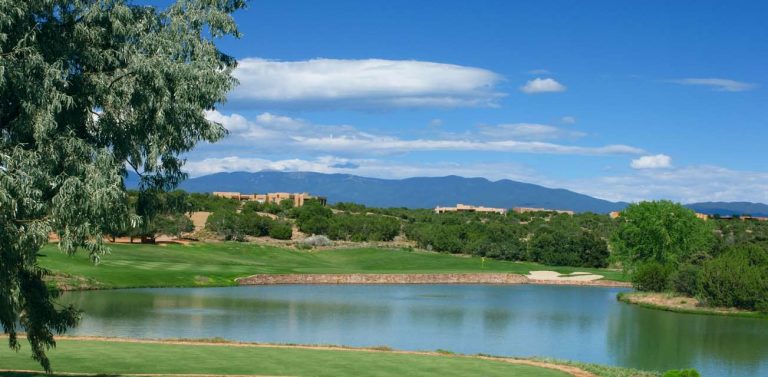
Las Campanas is the city’s principal private golf community, set west of Santa Fe in the high desert with views toward the Sangre de Cristos and the Jemez range. It is a master-planned community on a scale that does not exist elsewhere in Santa Fe County, anchored by The Club at Las Campanas, two Jack Nicklaus Signature golf courses, an equestrian center, a tennis and fitness facility, and a hacienda-style clubhouse. Lots range from one-acre village parcels to multi-acre estate sites with view easements.
The architectural character is contemporary Northern New Mexico vernacular: Pueblo Revival massing, often with more glass and more open volume than a historic Eastside compound, designed for indoor-outdoor living and view capture. The community is gated and patrolled.
Price tier in 2026: roughly $1.5M to $8M+ for completed homes; estate-tier custom builds on the larger lots can exceed $10M.
Buyer profile: the buyer who wants the country-club life and the architectural language of Santa Fe in the same purchase. Strong fit for buyers relocating from comparable communities elsewhere (Naples, Scottsdale, the Carolinas), and for full-time residents who want a turnkey, amenity-rich life rather than the maintenance discipline of a historic adobe.
Las Campanas is the closest thing in Santa Fe to a single-decision purchase: choose the community, then choose the lot or house. Learn more about Las Campanas listings.
La Tierra
La Tierra sits west of Santa Fe, between the city and Las Campanas, a covenanted community of large-lot estates (typically three to twelve acres) set in piñon and juniper country. The covenants govern lot density, exterior materials, and the overall low-impact character of the development; lots are generously separated, and the community reads as rural rather than suburban.
The architectural character is contemporary Pueblo Revival and Northern New Mexico vernacular, with a small minority of more contemporary builds. La Tierra rewards architects who understand the regional palette; the houses that wear well here are the ones that disappear into the landscape.
Price tier in 2026: roughly $1.8M to $6M, with the upper range reflecting custom builds on the larger parcels.
Buyer profile: the buyer who wants Las Campanas-scale privacy without the country club, and who prefers a landscape-first house to an amenity-first life. Often a buyer drawn from the Eastside who needs more land than the historic district can provide.
Northside Santa Fe
Northside Santa Fe is the broad foothills district that gathers some of the city’s most prestigious addresses: Circle Drive, Brownell Howland Road, Tano Road, and Sierra del Norte. The district climbs north of downtown toward the foothills, and it is characterized by very large lots, panoramic views (the city to the south, the Galisteo Basin, and the Jemez range to the west), and a quietness that the Eastside cannot offer.
Circle Drive and Brownell Howland Road carry some of the earliest grand residences in Santa Fe; many of the parcels began as pre-statehood land grants, and the compounds standing on them today are layered, often with a historic core and decades of careful additions. Tano Road is the famous spine of the district, connecting some of the largest estate parcels in the county and a procession of architect-designed houses set behind long private drives. Sierra del Norte, set higher into the foothills above Hyde Park Road, leans more contemporary: view-anchored builds sited specifically for the seasonal light, with snow more present in winter than at lower elevations.
The architectural character of the district as a whole spans the full Northern New Mexico register. Historic compounds on Circle Drive and Brownell Howland sit in adobe and Pueblo Revival idioms with Territorial accents. Sierra del Norte and the more recently built parcels along Tano Road carry a contemporary Pueblo Revival language, with strong contemporary builds among them. What unifies the district is scale, view, and the specific quietness of being above the city while remaining ten to fifteen minutes from The Plaza.
Price tier in 2026: roughly $3M to $30M+ at the upper end, with the trophy estates on Brownell Howland, Circle Drive, and the largest Tano Road parcels carrying the upper range. Mid-range Northside inventory typically falls in the $2.5M to $7M band.
Buyer profile: the buyer who wants elevation, view, and privacy on a serious scale, and who is willing to trade the walk-to-Plaza convenience of the Eastside for a more landscape-driven life. Often a buyer who has spent time in mountain communities elsewhere, or who is acquiring a legacy compound on one of the city’s named streets.
Monte Sereno
Monte Sereno sits north of Tesuque, minutes from the Santa Fe Opera grounds, and the opera is the first thing to know about it. For seasonal residents who plan their summers around the opera (June through August), Monte Sereno is functionally next-door; for full-time residents, the opera is a regular cultural anchor rather than a once-a-summer drive. The proximity matters more than a map alone suggests.
The architectural character is the second thing to know. Unlike the Eastside or Tesuque, Monte Sereno is a newer subdivision (developed primarily from the late 1990s onward), and the houses are overwhelmingly contemporary. Northern New Mexico vernacular massing is still the dominant register, but with substantially more glass, more open volume, and more indoor-outdoor living than a historic adobe permits. Buyers who want the Santa Fe palette without the discipline of a historic property find it here.
The third thing to know is the views. The community is sited specifically for view capture. Most parcels frame the Sangre de Cristos to the east, the Jemez to the west, and the open mesa-and-arroyo landscape between. Sunset is the daily event.
Lot sizes are generally one to five acres. The community is gated. Price tier in 2026: roughly $2M to $8M+.
Buyer profile: full-time or seasonal residents drawn to the opera and the cultural calendar, who want a contemporary house with a view rather than a historic adobe and an HDRB review process. Strong fit for buyers who have rented during opera season and decided to stay.
How to choose between them
The honest framework is shorter than the list. Three questions, in order:
- Do you want to walk to The Plaza, or drive to it? If the answer is walk, your shortlist is the Historic Eastside, Canyon Road, and the Plaza district. Everything else is a different kind of life.
- Do you want a house, or a community? If you want a house, with its own character, sited on its own terms, and independent of any planned environment, your shortlist is the Eastside, Canyon Road, Tesuque, La Tierra, and the Northside. If you want a community, with amenities, covenants, gates, and a defined social life, your shortlist is Las Campanas and Monte Sereno. Monte Sereno occupies a useful middle position: gated and curated like Las Campanas, but oriented around views and the opera rather than golf and a club.
- Are you stewarding history, or are you building forward? If you are stewarding history, the Eastside, Canyon Road, Tesuque, the Plaza district, and the historic compounds on the Northside (Circle Drive, Brownell Howland) are the categories with genuine historic inventory. If you are building forward, La Tierra, Sierra del Norte, Las Campanas, and Monte Sereno offer more contemporary stock and more buildable opportunity.
Most buyers find that two of the three answers point to the same neighborhood. When the third does not, that is usually the signal that the buyer is testing two different lives, and the work of the next conversation is to sort which one they actually want.
If you would like to talk about any of these neighborhoods, or about a specific house in one of them, reply to this post or come find us at 54½ Lincoln Avenue, above the Plaza Café.
With our regards from The Plaza, The Webster Estates Team
Chris Webster · Patti Webster · Christopher Webster III · Paisley Mason Webster
Webster Estates is the real estate brokerage arm of Webster Santa Fe, a team of Associate Brokers at Sotheby’s International Realty. The team has operated from 54½ Lincoln Avenue on The Plaza since 1976. Read our companion launch posts on the WSJ Q1 2026 ranking and on adobe homes in Santa Fe, or browse current listings.
About Webster Santa Fe: Webster Santa Fe is a family-owned operation with multiple businesses headquartered at 54½ Lincoln Avenue on The Plaza. Webster Collection, the fine art gallery, was established in 1972. Webster Estates, the real estate team affiliated with Sotheby’s International Realty, has operated since 1976. W Department, the curated international fashion boutique at wdepartment.com, was established in 2020. Chris, Patti, Christopher, and Paisley Webster are the four principals of all the business operations.
Frequently asked questions
What is the most desirable neighborhood in Santa Fe? The Historic Eastside is the most consistently sought-after neighborhood in Santa Fe at the luxury tier. It contains the densest concentration of pre-1912 adobe compounds and architect-attributed homes (John Gaw Meem and Betty Stewart provenance most notably), lies within the Historic Districts overlay, and offers walking access to The Plaza and Canyon Road. Buyers who prioritize architectural history, walkability, and cultural integration shortlist the Eastside first; buyers who prioritize land, view, or amenities typically look to Tesuque, Las Campanas, the Northside, or Monte Sereno.
Where do most luxury home buyers in Santa Fe choose to live? The answer divides cleanly. Buyers who want to live inside the city’s architectural and cultural history concentrate in the Historic Eastside, Canyon Road, and the Plaza district. Buyers who want country-club amenities and turnkey contemporary builds concentrate in Las Campanas. Buyers who want privacy on larger lots concentrate in Tesuque, La Tierra, and the Northside. Buyers oriented around the opera and contemporary view homes concentrate in Monte Sereno. Webster Estates works across all of them.
What is the difference between the Historic Eastside and Canyon Road? The Eastside is residential first; Canyon Road is the gallery street that also has residences. Both lie within the Historic Districts overlay and share the Pueblo Revival and Spanish Pueblo Revival architectural register. The practical differences are public foot traffic (much higher on Canyon Road, particularly during gallery openings, Indian Market, and the holiday Farolito Walk) and street rhythm (the Eastside’s interior streets are residential and quiet by character). Many buyers who consider Canyon Road eventually choose its quieter side streets (Acequia Madre, Camino del Monte Sol, Garcia Street) for the same architecture with more privacy.
Is Tesuque a good place to buy a home in Santa Fe? Tesuque is unincorporated and lies just north of city limits, with larger lot sizes, a pastoral cottonwood-shaded character, and a fifteen-minute drive to The Plaza. It suits buyers who want Santa Fe’s cultural proximity with more land and privacy than the Historic Eastside can offer. Distinctive inventory is scarce; the village is small, protected agricultural and acequia land does not subdivide, and historic Tesuque estates are often handed down rather than turned over. The 2026 price tier ranges from roughly $2M to $20M+.
What is Las Campanas? Las Campanas is Santa Fe’s principal private golf community, west of the city, anchored by The Club at Las Campanas with two Jack Nicklaus Signature golf courses, an equestrian center, tennis, and a hacienda-style clubhouse. The community is gated, master-planned on a scale that does not exist elsewhere in Santa Fe County, and architecturally consistent in a contemporary Northern New Mexico vernacular. It suits buyers who want country-club life and the architectural language of Santa Fe in a single, turnkey purchase. The 2026 price tier ranges from roughly $1.5M to $10M+.
What is Northside Santa Fe, and where are Circle Drive, Brownell Howland, and Tano Road? Northside Santa Fe is the foothills district north of downtown that gathers Circle Drive, Brownell Howland Road, Tano Road, and Sierra del Norte. It contains some of the most prestigious addresses in the city: Circle Drive and Brownell Howland hold many of Santa Fe’s earliest grand residences, often on pre-statehood land grants, while Tano Road is the spine connecting some of the largest estate parcels in the county. Sierra del Norte, higher in the foothills, leans more contemporary. The district is characterized by very large lots, panoramic views, and quietness, with prices ranging from roughly $2.5M into the $30M+ range for trophy estates.
What is Monte Sereno? Monte Sereno is a gated community north of Tesuque, minutes from the Santa Fe Opera grounds. It is newer than most Santa Fe neighborhoods (developed primarily from the late 1990s onward), and the architectural character is overwhelmingly contemporary, with Northern New Mexico vernacular massing rendered in more glass and open volume than a historic adobe permits. The community is sited for view capture (Sangre de Cristos to the east, Jemez to the west), and lot sizes generally run one to five acres. It suits buyers oriented around the opera and the cultural calendar who want a contemporary house and a view rather than a historic adobe. The 2026 price tier ranges from roughly $2M to $8M+.
Where can I find historic adobe homes in Santa Fe? The densest concentration of historic adobe homes lies in the Historic Eastside, with a meaningful secondary cluster on Canyon Road and its side streets (Acequia Madre, Camino del Monte Sol). Tesuque holds a smaller number of pre-statehood adobe compounds, some among the most distinguished in the region. The Northside contributes its own historic inventory: several of the early grand compounds on Circle Drive and Brownell Howland Road carry adobe cores and significant pre-statehood provenance. The Plaza district contains a handful of residential historic adobes integrated with commercial buildings. For buyers focused specifically on adobe, our companion guide, Adobe Homes in Santa Fe, covers history, types, and stewardship in depth.
{
“@context”: “https://schema.org”,
“@type”: [
“RealEstateAgent”,
“LocalBusiness”
],
“@id”: “https://webstersantafe.com/real-estate/#organization”,
“name”: “Webster Estates”,
“alternateName”: “Webster Estates at Sotheby’s International Realty”,
“url”: “https://webstersantafe.com/real-estate/”,
“logo”: “https://webstersantafe.com/wp-content/uploads/webster-estates-logo.png”,
“telephone”: “+1-505-954-9500”,
“email”: “[email protected]”,
“foundingDate”: “1976”,
“parentOrganization”: {
“@type”: “Organization”,
“name”: “Sotheby’s International Realty”
},
“address”: {
“@type”: “PostalAddress”,
“streetAddress”: “54 1/2 Lincoln Avenue”,
“addressLocality”: “Santa Fe”,
“addressRegion”: “NM”,
“postalCode”: “87501”,
“addressCountry”: “US”
},
“geo”: {
“@type”: “GeoCoordinates”,
“latitude”: 35.6878,
“longitude”: -105.9378
},
“areaServed”: [
{
“@type”: “City”,
“name”: “Santa Fe”
},
{
“@type”: “AdministrativeArea”,
“name”: “Santa Fe County, New Mexico”
}
],
“openingHoursSpecification”: [
{
“@type”: “OpeningHoursSpecification”,
“dayOfWeek”: [
“Monday”,
“Tuesday”,
“Wednesday”,
“Thursday”,
“Friday”,
“Saturday”
],
“opens”: “10:00”,
“closes”: “17:00”
}
],
“sameAs”: [
“https://www.instagram.com/webstersantafe/”,
“https://www.facebook.com/webstersantafe/”
],
“employee”: [
{
“@type”: “Person”,
“name”: “Chris Webster”,
“jobTitle”: “Associate Broker”
},
{
“@type”: “Person”,
“name”: “Patti Webster”,
“jobTitle”: “Associate Broker”
},
{
“@type”: “Person”,
“name”: “Christopher Webster III”,
“jobTitle”: “Associate Broker”
},
{
“@type”: “Person”,
“name”: “Paisley Mason Webster”,
“jobTitle”: “Associate Broker”
}
]
}
{
“@context”: “https://schema.org”,
“@type”: “FAQPage”,
“mainEntity”: [
{
“@type”: “Question”,
“name”: “What is the most desirable neighborhood in Santa Fe?”,
“acceptedAnswer”: {
“@type”: “Answer”,
“text”: “The Historic Eastside is the most consistently sought-after neighborhood in Santa Fe at the luxury tier. It contains the densest concentration of pre-1912 adobe compounds and architect-attributed homes (John Gaw Meem and Betty Stewart provenance most notably), lies within the Historic Districts overlay, and offers walking access to The Plaza and Canyon Road. Buyers who prioritize architectural history, walkability, and cultural integration shortlist the Eastside first; buyers who prioritize land, view, or amenities typically look to Tesuque, Las Campanas, the Northside, or Monte Sereno.”
}
},
{
“@type”: “Question”,
“name”: “Where do most luxury home buyers in Santa Fe choose to live?”,
“acceptedAnswer”: {
“@type”: “Answer”,
“text”: “The answer divides cleanly. Buyers who want to live inside the city’s architectural and cultural history concentrate in the Historic Eastside, Canyon Road, and the Plaza district. Buyers who want country-club amenities and turnkey contemporary builds concentrate in Las Campanas. Buyers who want privacy on larger lots concentrate in Tesuque, La Tierra, and the Northside. Buyers oriented around the opera and contemporary view homes concentrate in Monte Sereno. Webster Estates works across all of them.”
}
},
{
“@type”: “Question”,
“name”: “What is the difference between the Historic Eastside and Canyon Road?”,
“acceptedAnswer”: {
“@type”: “Answer”,
“text”: “The Eastside is residential first; Canyon Road is the gallery street that also has residences. Both lie within the Historic Districts overlay and share the Pueblo Revival and Spanish Pueblo Revival architectural register. The practical differences are public foot traffic (much higher on Canyon Road, particularly during gallery openings, Indian Market, and the holiday Farolito Walk) and street rhythm (the Eastside’s interior streets are residential and quiet by character). Many buyers who consider Canyon Road eventually choose its quieter side streets (Acequia Madre, Camino del Monte Sol, Garcia Street) for the same architecture with more privacy.”
}
},
{
“@type”: “Question”,
“name”: “Is Tesuque a good place to buy a home in Santa Fe?”,
“acceptedAnswer”: {
“@type”: “Answer”,
“text”: “Tesuque is unincorporated and lies just north of city limits, with larger lot sizes, a pastoral cottonwood-shaded character, and a fifteen-minute drive to The Plaza. It suits buyers who want Santa Fe’s cultural proximity with more land and privacy than the Historic Eastside can offer. Distinctive inventory is scarce; the village is small, protected agricultural and acequia land does not subdivide, and historic Tesuque estates are often handed down rather than turned over. The 2026 price tier ranges from roughly $2M to $20M+.”
}
},
{
“@type”: “Question”,
“name”: “What is Las Campanas?”,
“acceptedAnswer”: {
“@type”: “Answer”,
“text”: “Las Campanas is Santa Fe’s principal private golf community, west of the city, anchored by The Club at Las Campanas with two Jack Nicklaus Signature golf courses, an equestrian center, tennis, and a hacienda-style clubhouse. The community is gated, master-planned on a scale that does not exist elsewhere in Santa Fe County, and architecturally consistent in a contemporary Northern New Mexico vernacular. It suits buyers who want country-club life and the architectural language of Santa Fe in a single, turnkey purchase. The 2026 price tier ranges from roughly $1.5M to $10M+.”
}
},
{
“@type”: “Question”,
“name”: “What is Northside Santa Fe, and where are Circle Drive, Brownell Howland, and Tano Road?”,
“acceptedAnswer”: {
“@type”: “Answer”,
“text”: “Northside Santa Fe is the foothills district north of downtown that gathers Circle Drive, Brownell Howland Road, Tano Road, and Sierra del Norte. It contains some of the most prestigious addresses in the city: Circle Drive and Brownell Howland hold many of Santa Fe’s earliest grand residences, often on pre-statehood land grants, while Tano Road is the spine connecting some of the largest estate parcels in the county. Sierra del Norte, higher in the foothills, leans more contemporary. The district is characterized by very large lots, panoramic views, and quietness, with prices ranging from roughly $2.5M into the $30M+ range for trophy estates.”
}
},
{
“@type”: “Question”,
“name”: “What is Monte Sereno?”,
“acceptedAnswer”: {
“@type”: “Answer”,
“text”: “Monte Sereno is a gated community north of Tesuque, minutes from the Santa Fe Opera grounds. It is newer than most Santa Fe neighborhoods (developed primarily from the late 1990s onward), and the architectural character is overwhelmingly contemporary, with Northern New Mexico vernacular massing rendered in more glass and open volume than a historic adobe permits. The community is sited for view capture (Sangre de Cristos to the east, Jemez to the west), and lot sizes generally run one to five acres. It suits buyers oriented around the opera and the cultural calendar who want a contemporary house and a view rather than a historic adobe. The 2026 price tier ranges from roughly $2M to $8M+.”
}
},
{
“@type”: “Question”,
“name”: “Where can I find historic adobe homes in Santa Fe?”,
“acceptedAnswer”: {
“@type”: “Answer”,
“text”: “The densest concentration of historic adobe homes lies in the Historic Eastside, with a meaningful secondary cluster on Canyon Road and its side streets (Acequia Madre, Camino del Monte Sol). Tesuque holds a smaller number of pre-statehood adobe compounds, some among the most distinguished in the region. The Northside contributes its own historic inventory: several of the early grand compounds on Circle Drive and Brownell Howland Road carry adobe cores and significant pre-statehood provenance. The Plaza district contains a handful of residential historic adobes integrated with commercial buildings. For buyers focused specifically on adobe, our companion guide, [Adobe Homes in Santa Fe](/real-estate/journal/adobe-homes-santa-fe-guide/), covers history, types, and stewardship in depth.”
}
}
]
}
{
“@context”: “https://schema.org”,
“@type”: [
“RealEstateAgent”,
“LocalBusiness”
],
“@id”: “https://webstersantafe.com/real-estate/#organization”,
“name”: “Webster Estates”,
“alternateName”: “Webster Estates at Sotheby’s International Realty”,
“url”: “https://webstersantafe.com/real-estate/”,
“telephone”: “+1-505-954-9500”,
“email”: “[email protected]”,
“foundingDate”: “1976”,
“parentOrganization”: {
“@type”: “Organization”,
“name”: “Sotheby’s International Realty”
},
“address”: {
“@type”: “PostalAddress”,
“streetAddress”: “54 1/2 Lincoln Avenue”,
“addressLocality”: “Santa Fe”,
“addressRegion”: “NM”,
“postalCode”: “87501”,
“addressCountry”: “US”
},
“geo”: {
“@type”: “GeoCoordinates”,
“latitude”: 35.6878,
“longitude”: -105.9378
},
“areaServed”: [
{
“@type”: “City”,
“name”: “Santa Fe”
},
{
“@type”: “AdministrativeArea”,
“name”: “Santa Fe County, New Mexico”
}
],
“openingHoursSpecification”: [
{
“@type”: “OpeningHoursSpecification”,
“dayOfWeek”: [
“Monday”,
“Tuesday”,
“Wednesday”,
“Thursday”,
“Friday”,
“Saturday”
],
“opens”: “10:00”,
“closes”: “17:00”
}
],
“sameAs”: [
“https://www.instagram.com/webstersantafe/”,
“https://www.facebook.com/webstersantafe/”
],
“employee”: [
{
“@type”: “Person”,
“name”: “Chris Webster”,
“jobTitle”: “Associate Broker”
},
{
“@type”: “Person”,
“name”: “Patti Webster”,
“jobTitle”: “Associate Broker”
},
{
“@type”: “Person”,
“name”: “Christopher Webster III”,
“jobTitle”: “Associate Broker”
},
{
“@type”: “Person”,
“name”: “Paisley Mason Webster”,
“jobTitle”: “Associate Broker”
}
]
}
Buying Land in Santa Fe County: A Practical Guide to Lots, Water, Septic, and Building