
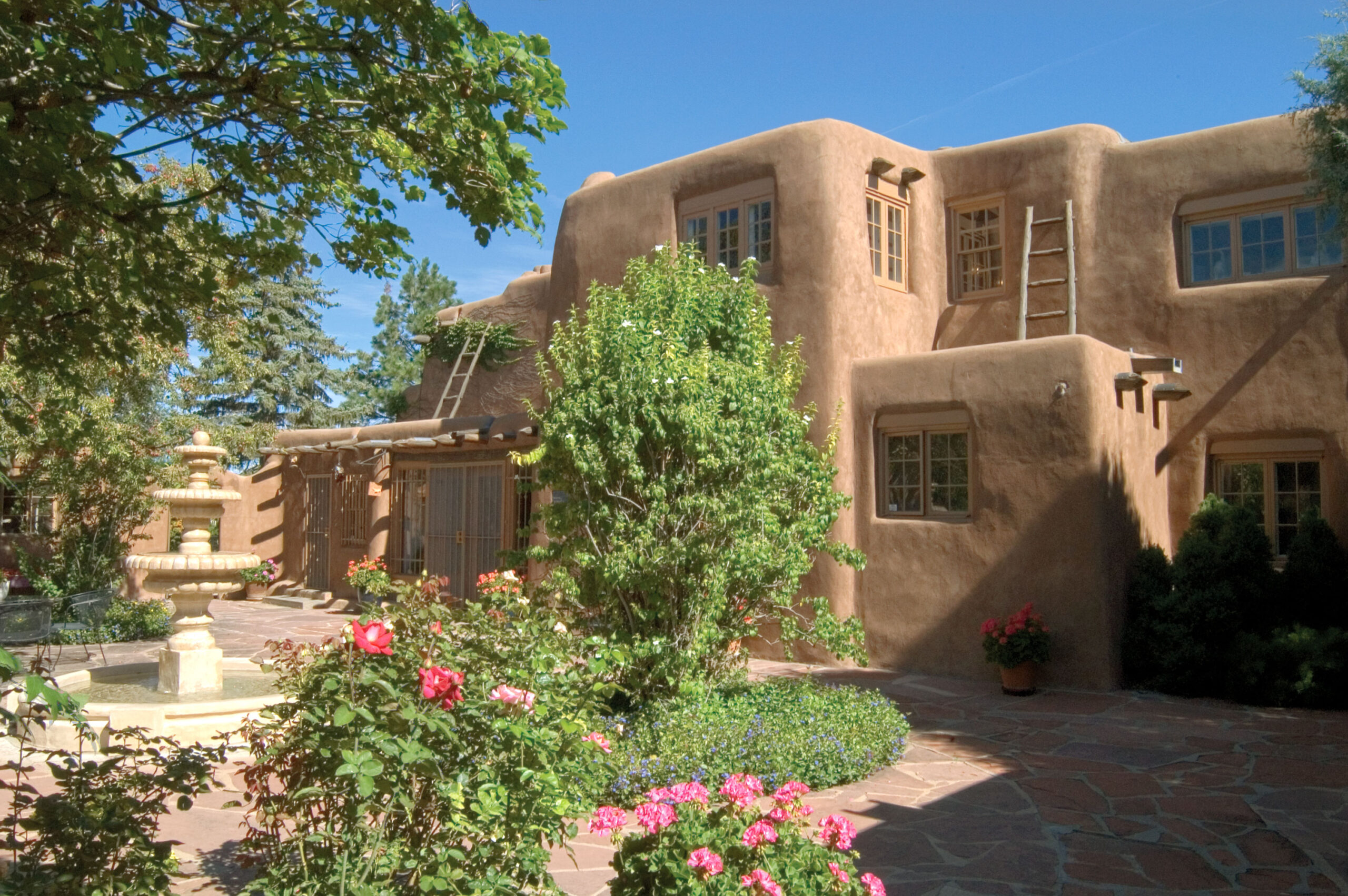
Drive west on Canyon Road at sunset and you’ll see three different houses on the same block. One has thick walls, rounded corners, and a flat roof with a parapet that slopes gently up and down. The next has crisp white trim around tall windows and a tidy brick line across the top of an otherwise similar adobe shape. The third — usually a little newer, often a little higher up the foothills — has a steeply pitched metal roof that catches the last light of the day.
They look like cousins, not strangers. But they’re three distinct architectural styles, and on a listing sheet they’ll be described very differently. Understanding the difference matters when you’re spending seven figures in this market — it shapes your insurance, how the house handles a February snowstorm, what you can and can’t change about the exterior, and how the property reads when you go to resell.
PueblO: the one most people picture
When someone says “Santa Fe style,” they usually mean Pueblo architecture. It’s the look the city has actively protected since the 1920s, and as such Pueblo Revival became a new and synonymous nomenclature. It’s the one that gets photographed: earth-tone stucco, walls that flare slightly outward at the base (called battered walls), rounded corners and rounded parapets, exposed wooden roof beams (vigas) poking through the exterior, and water spouts called canales that shoot rain off the flat roof.
The style was popularized by John Gaw Meem, who arrived in Santa Fe in 1920 to recover from tuberculosis and became the most influential architect in the city’s history. Meem didn’t try to copy old Pueblo buildings literally — in a 1966 essay he wrote that he used the symbolic forms to “evoke a mood without attempting to produce an archaeological imitation.” That distinction matters, because most Pueblo Revival houses you’ll see for sale today are doing exactly that: borrowing the shapes and materials of centuries-old buildings, but with modern framing, insulation, and HVAC underneath.
Telltale Pueblo Revival details on a listing photo:
- Flat (or nearly flat) roof, no overhang
- Earth-colored stucco — beige, tan, brown, or pinkish — usually with a slightly rough finish
- Stepped or rounded parapets along the roofline
- Vigas projecting through the exterior, usually six to ten inches in diameter
- Small, recessed window openings
- Walled courtyards and zaguán entries
Territorial: the cleaner cousin
Territorial style is what happened when Anglo-American building details — milled lumber, fired brick, larger windows — started arriving in New Mexico in the mid-1800s, after the Santa Fe Trail opened the territory to East Coast goods. Builders kept the adobe walls and the flat roof, but they laid a row of brick along the top of the parapet to keep water from eroding the mud underneath, and they framed taller, double-hung windows with painted wood trim. The result is recognizably the same family as Pueblo Revival, but more linear, more formal, and a little less earthy.
The fastest way to tell Territorial from Pueblo Revival: look at the top of the wall and the windows. If you see a clean horizontal line of brick along the parapet and a pedimented (triangular) lintel above the windows, often painted white or a faded blue, you’re looking at Territorial. The stucco is usually smoother as well, and many Territorial homes have a brightly painted front door — the traditional blue-green door is so common in Santa Fe that out-of-state buyers sometimes assume it’s an HOA rule rather than a regional habit.
Territorial homes tend to read as slightly more “East Coast” — more right angles, more visible woodwork, more formal symmetry. Buyers coming from older Northeastern or Mid-Atlantic cities often gravitate toward Territorial because it feels familiar; buyers coming from Phoenix or Tucson often prefer the rounded forms of Pueblo Revival.
Northern New Mexico: the snow-shedding adaptation
The third style you’ll encounter, especially north of town and at higher elevation, is Northern New Mexico style — also called Northern New Mexico vernacular. It’s essentially what happened when traditional adobe buildings met the realities of northern New Mexico winters. Once the railroads brought tin and corrugated metal roofing into the region in the late 1800s, rural builders started capping their flat-roofed adobes with steeply pitched metal roofs that could shed snow before it had a chance to seep into the parapets.
You’ll see this style in the villages north and east of Santa Fe — Tesuque, Chimayó, Truchas, parts of Pojoaque — and on contemporary homes that quote it in higher-snow neighborhoods like Las Campanas, Hyde Park, and the foothills above Tano Road. The defining feature is the pitched standing-seam metal roof, usually in a dark color (forest green, dark red, gray, or rust), often visible from a long way off because the metal catches light. The walls underneath are typically still stucco, and the floor plan and proportions still draw from Pueblo and Territorial vocabulary, but the roof solves a real climate problem that flat roofs don’t.
If snow load and roof maintenance are a real concern for you — and at Santa Fe’s 7,200 feet of elevation, they should be — a Northern New Mexico-style pitched roof is worth taking seriously over a flat parapet roof, which can be high-maintenance and expensive to repair when it leaks.
Why this matters legally: the 1957 Historic Zoning Ordinance
Santa Fe didn’t preserve its look by accident. In 1957, a committee led by John Gaw Meem drafted a Historic Zoning Ordinance that effectively prohibited the construction of new buildings in any style other than Spanish-Pueblo or Territorial Revival within the city’s Historic District. That district covers roughly twenty percent of Santa Fe — mostly the downtown core and the Historic East Side — and it’s still in force today.
What this means as a buyer: if you purchase a home inside the Historic District, your ability to alter the exterior is constrained. You can’t add a second story with a pitched roof, you can’t replace the stucco with siding, you can’t enlarge windows in a way that changes the building’s mass and proportion, and exterior changes typically require Historic Districts Review Board approval. The constraint is the reason the city looks the way it does, and most owners of Eastside and downtown properties consider it a feature rather than a bug. But it’s a real factor in renovation planning, and worth knowing before you fall in love with a fixer-upper inside the boundary.
Outside the Historic District — which is most of Santa Fe, including Eldorado, Las Campanas, Casa Solana, much of the Westside, and the foothills neighborhoods — you’ll find a much wider range of styles, including contemporary homes that may borrow from the regional vocabulary without being bound by it.
What does this mean for me as a buyer?
A few practical takeaways:
- Roof type drives long-term cost. Flat parapet roofs (Pueblo Revival, Territorial) need periodic re-coating and are vulnerable to canale failure and parapet erosion. Pitched metal roofs (Northern New Mexico) are usually cheaper to maintain in the long run, especially at higher elevation.
- True adobe vs. stuccoed frame matters. A house that looks Pueblo Revival on the outside may be 18-inch true adobe (excellent thermal mass, expensive to insure, slow to heat in winter) or 2×6 frame with stucco (cheaper insurance, faster heating, no thermal mass benefit). Always ask the listing agent which it is, and confirm with the inspector.
- Historic District location changes renovation math. Inside the boundary, expect a longer permitting timeline and limits on what you can do to the exterior. Outside it, you have significantly more flexibility.
- Resale follows style. A well-executed Pueblo Revival or Territorial home tends to hold value strongly in Santa Fe because buyers actively seek those styles. A poorly executed pastiche — overdone faux-adobe with no real proportion or detail — does not.
If you’re new to Santa Fe and looking at properties for the first time, spend a weekend just walking — the Historic East Side around Canyon Road, the Plaza, and a drive through Tesuque and Eldorado will teach you more about the three styles than any photo gallery. Once your eye gets calibrated, listing photos start telling a much more useful story.
Webster Estates covers the Santa Fe real estate market from the perspective of buyers and sellers making real decisions in a market that doesn’t always behave like anywhere else. If you’re starting your search from out of state, our buyers guide walks through the practical questions that come up after the architecture starts making sense — financing, inspections, water rights, and what to ask when you’re ready to make an offer.
Buying Land in Santa Fe County: A Practical Guide to Lots, Water, Septic, and Building