
If you’re moving to Santa Fe from California, Texas, Colorado, or New York, the first thing worth knowing about New Mexico property taxes is that they are almost certainly lower than what you’re used to — often by a wide margin. The median effective rate in the city of Santa Fe is roughly 0.50% to 0.54% of market value, well below the national median of about 1.02%. On a $1 million home, that translates to an annual property tax bill in the neighborhood of $5,000 to $5,500, depending on the exact district and any bond measures attached to your parcel.
But the rate alone tells only part of the story. New Mexico has an unusual assessment system, a strong cap on year-over-year increases for owner-occupied homes, and several exemptions that quietly reduce the bill further. Here’s how the pieces fit together for a Santa Fe buyer.
How New Mexico calculates a property tax bill
The math has three steps:
- Market value. The Santa Fe County Assessor sets a market value for the property, generally tied to recent sales of comparable homes.
- Taxable value = 1/3 of market value. New Mexico statute fixes the assessment ratio at exactly one-third. A home with a market value of $900,000 has a taxable value of $300,000 before any exemptions.
- Apply the mill rate. The taxable value, minus exemptions, is multiplied by the local mill rate (a per-thousand tax rate that combines county, municipal, school district, and any bond levies). Rates differ depending on whether you’re inside city limits or in the unincorporated county, and which school district you’re in.
The result is that two homes with the same market value can have noticeably different bills based on district lines. It’s worth pulling the actual mill rate for a specific parcel before you assume the median figure applies to you. The County Assessor publishes annual mill rates by district, and most listing agents can produce the current bill from the county’s online records.
The 3% cap — and why it resets when you buy
This is the single most important rule for new buyers to understand. Under New Mexico Statute 7-36-21.2, the taxable value of an owner-occupied primary residence cannot increase by more than 3% per year, regardless of how much the market value rises. It’s a meaningful protection — comparable in spirit to California’s Proposition 13, though less aggressive.
The catch for buyers: the cap resets at sale. The new owner’s taxable value is recalculated based on the current market value at the time of purchase. This means that the seller’s last tax bill is not a reliable preview of what you’ll pay. A home that’s been in the same family for fifteen years, with a market value that’s tripled over that span, may carry a tax bill far below what the next owner will inherit.
Before making an offer, ask the listing agent — or pull from the county’s records — both the current annual tax bill and an estimate of what the bill will look like after the cap resets to your purchase price. The Santa Fe County Assessor offers a property tax estimation tool that produces a reasonable projection.
The cap also does not apply to non-owner-occupied properties. If you’re buying a second home that won’t be your primary residence, or a rental, the assessed value can be adjusted to market each year. Investors and second-home buyers should plan for higher effective rates over time than full-time residents.
Exemptions worth applying for
New Mexico offers several exemptions that come off the taxable value before the mill rate is applied. None of them are automatic — you have to file with the County Assessor, usually within thirty days of receiving your Notice of Value in April.
- Head of Family exemption. A $2,000 reduction in taxable value for owner-occupied single-family dwellings. For the 2026 tax year, the combined modified gross income of the applicant and household members must be below $44,200. Modest in dollar terms — at Santa Fe’s median rate, the savings are roughly $10 a year — but it costs nothing to file if you qualify.
- Veteran exemption. An honorably discharged resident veteran is eligible for a $4,000 reduction in taxable value on their primary residence.
- Disabled veteran exemption. Following the November 2024 voter approval of Constitutional Amendment 1, New Mexico now provides a proportional exemption for veterans with any service-connected disability rating from 10% to 100%, effective the 2026 tax year. Veterans with a 100% rating continue to receive a full exemption from property taxes on their primary residence. The application goes through the New Mexico Department of Veterans Services, which then issues a certificate to take to the county assessor.
What does property tax actually cost on a $1 million Santa Fe home?
Working through the math on a $1,000,000 owner-occupied primary residence inside the city of Santa Fe, with no exemptions other than the standard rules:
- Market value: $1,000,000
- Taxable value (1/3): $333,333
- Applied mill rate (representative figure for in-city residential, roughly 16 mills): about $5,300 annually
The same home in the unincorporated county can run a bit lower, depending on the school district and any bond levies. A $1.5 million home in Las Campanas, where county rates apply, typically lands between $7,000 and $9,000 a year. A $600,000 home on the Westside might come in under $3,500. These are illustrative ranges — pull the actual mill rate for the specific district before relying on any single number.
When bills arrive and when they’re due
Santa Fe County sends two bills a year, paid in two installments:
- First-half bill: mailed by November 1, due November 10, delinquent after December 10.
- Second-half bill: due April 10, delinquent after May 10.
- Notice of Value: mailed in April. You have thirty days from the mailing date to file a protest if you believe the assessor’s market value is too high.
Most lenders escrow property taxes alongside the monthly mortgage payment, so out-of-state buyers financing a purchase will rarely write a separate check to the county. If you’re paying cash, payments can be made online through the Santa Fe County Treasurer, by mail, or in person at 100 Catron Street.
Is it worth protesting your assessment?
Sometimes. The most common grounds are a market value that’s clearly out of step with recent comparable sales, or a classification error (residential vs. non-residential, owner-occupied vs. not). The thirty-day clock is strict — miss it and you wait a year. If the assessor’s value seems off, pull two or three recent sales of genuinely comparable homes (same neighborhood, similar size, similar architectural style, similar lot) and bring them to a meeting with the assessor’s office before filing a formal protest. Most cases are resolved informally.
For buyers who just closed: the year you purchase, the assessor will reset the market value to your purchase price. There’s usually no point in protesting that — your offer is the strongest possible evidence of market value. The protest opportunity becomes more relevant in years two, three, and beyond.
What to take away
For most out-of-state buyers, New Mexico’s property tax bill is a pleasant surprise: lower effective rates than coastal markets, a real cap on year-over-year increases once you own the home, and a handful of exemptions worth filing for. The friction points are the reset at sale (don’t trust the seller’s bill as your future bill) and the discipline of paying attention to your April Notice of Value if you ever want to protest.
Webster Estates publishes guides for buyers navigating the Santa Fe market from out of state. Our buyers guide walks through the financing, inspection, and closing process specific to New Mexico — including the property tax details that catch first-time Santa Fe buyers off guard.

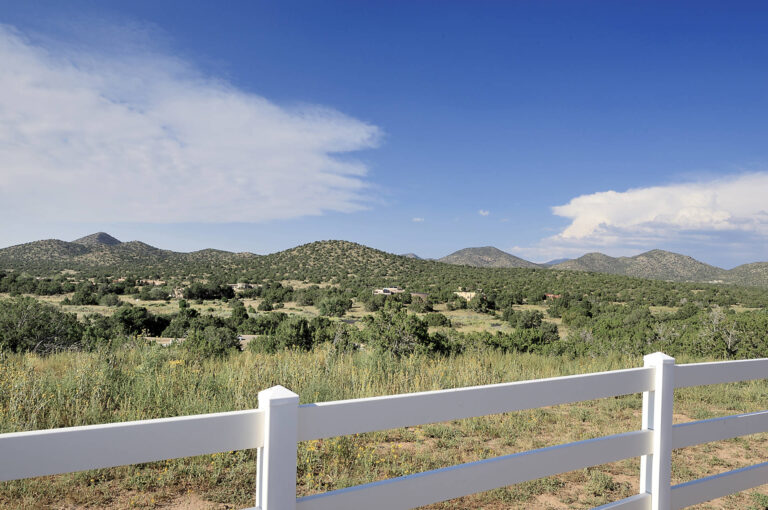

Las Campanas Santa Fe: A Buyer’s Guide to the West Side’s PRIVATE Gated Golf Community