Canyon Road is a half-mile of historic adobe, more than a hundred galleries, several restaurants, and a small number of private residences and compound estates, all packed into a working street that has been continuously occupied for over four centuries. It is one of the most concentrated commercial art districts in the country, and it is also a real residential neighborhood, with all the trade-offs that combination implies.
A brief history
Canyon Road began as Camino del Cañon, a Spanish colonial route running east from the Plaza along the Santa Fe River and into the canyon country toward the Pecos Wilderness. For most of its history it was residential and agricultural, a thread of adobe homes, small farms, orchards, and the occasional rancho, and it remained so well into the twentieth century. The first artists’ studios opened on the road in the 1910s and 1920s, and the modern gallery district took shape gradually through the mid-twentieth century. The full transformation into Santa Fe’s premier gallery street happened in the 1970s and 1980s, when zoning and the broader art-market boom pulled more galleries into the historic compound homes.
Several of the street’s significant residences trace their construction history to the 17th and 18th centuries. The Borrego House, the Casón del Triunfo, and the Gerald Cassidy Estate are well-known examples, each with documented histories that include multiple generations of expansion, division, and renovation. Most properties on or directly adjacent to Canyon Road carry historic-preservation protections.
Architecture: layered adobe
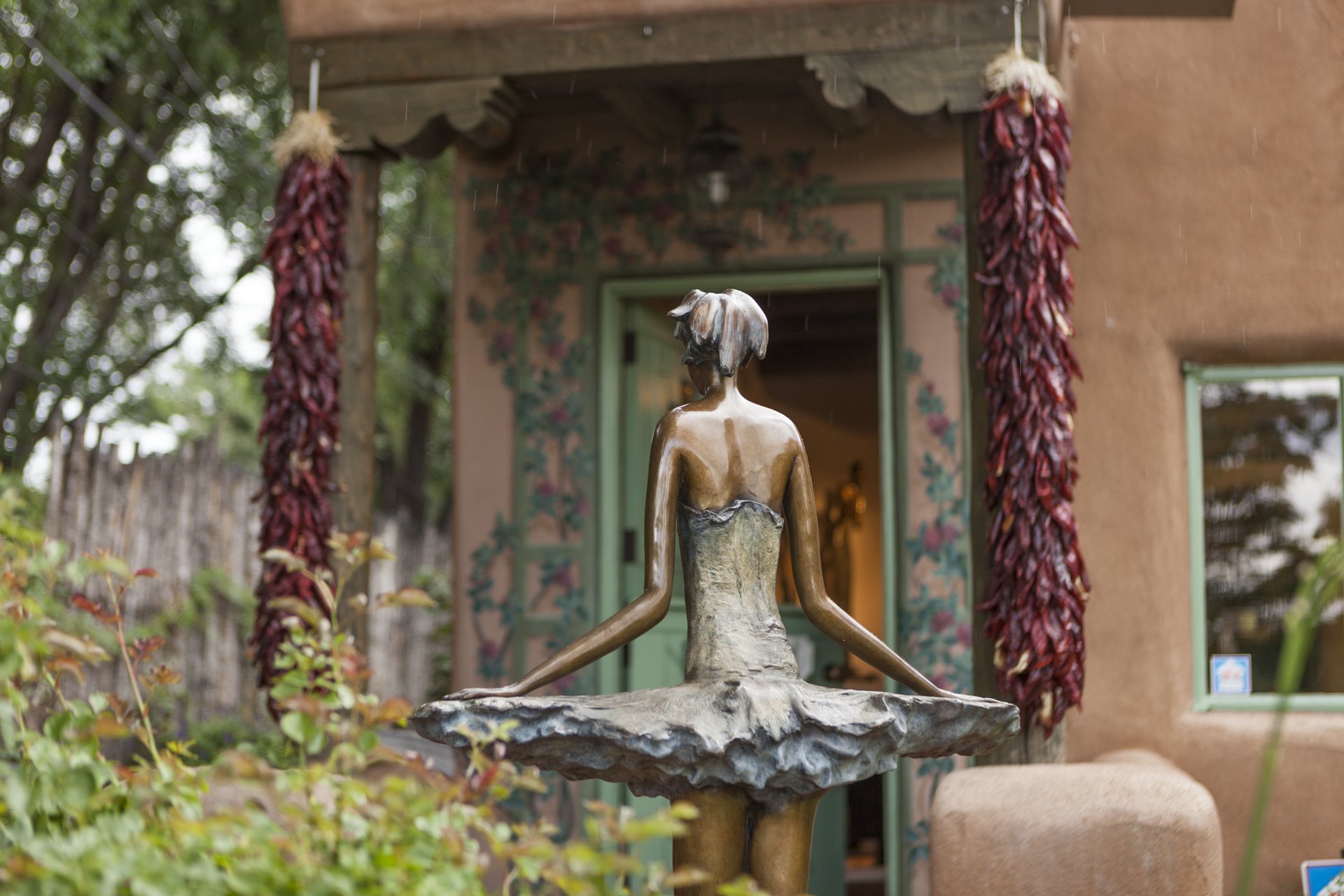
The defining architectural character of Canyon Road is historic adobe. Hand-formed, layered over centuries, often modified to serve multiple uses (residence, gallery, studio, sometimes all three in the same building). The earliest construction is Spanish colonial. Later layers include nineteenth-century Territorial work and twentieth-century Pueblo Revival renovations. A property on Canyon Road typically presents as a coherent whole but reads, on closer inspection, as a composite of building campaigns across two or three centuries.
Compound configurations are common. A main residence with one or more outbuildings (originally guest quarters, servant housing, or workshop space; today often guest casitas, gallery space, or studio). Many properties retain their original placita courtyards. Wall thickness, ceiling height, and floor materials vary substantially between rooms in older homes. A buyer evaluating a Canyon Road property is often evaluating multiple structures and multiple eras of construction in one transaction.
Daily life on a working art street
Living on Canyon Road is unusual. The street has a daily and seasonal rhythm shaped by the galleries. Weekday mornings are quiet, with most galleries opening between 10 and 11. Late mornings and afternoons bring steady foot traffic, particularly during summer and fall. Friday gallery openings can fill the street with crowds. The August Indian Market spillover and the Christmas Eve farolito walk are the year’s two biggest single events.
Walking access to the Plaza is the central practical benefit: fifteen to twenty minutes from the eastern end of the street, less from the lower end. Cathedral Park, the museums, and the Lensic are similarly walkable. The Compound sits at the heart of the street, Geronimo is across from it, and The Teahouse anchors the eastern (upper) end. Coverage is denser than in any other Santa Fe neighborhood, but turnover among galleries and restaurants means the street’s specific texture shifts year to year.
The privacy question
Canyon Road is a public street with high foot traffic. Most residences on the road sit behind tall adobe walls or set back behind gallery spaces (the courtyard tradition does a lot of work here), but the level of privacy that other Santa Fe neighborhoods take for granted is not the norm on Canyon Road. Buyers who value visual seclusion typically look at properties set back from the road, on side streets like Camino del Monte Sol, or on the upper (eastern) end where the street narrows and foot traffic thins.
Who buys on Canyon Road
Three buyer profiles recur. Art collectors and gallery owners, sometimes the same people, who want a residence and a gallery or studio under one roof. Lifestyle buyers, often relocating from coastal cities, who specifically want to live inside an active cultural district rather than near one. And owners who use the property as a second or third home with high seasonal use, opening for Indian Market and the holidays and closing for the slower months.
Buyers primarily focused on quiet residential character usually find the broader Historic East Side a better fit. The same architectural quality and walking access to the Plaza, with substantially less foot traffic, sits just a few blocks away.
Market dynamics
Canyon Road inventory is among the thinnest in Santa Fe. A typical year sees only a handful of public listings, and significant transactions often happen quietly. Pricing reflects both the historic provenance of the property and the lot quality: frontage on the road, depth of the compound, separate guest quarters, gallery-zoned ground floor. Most Canyon Road sales open well into the seven figures, and a meaningful share reach the eight figures for major estates with documented histories.
Webster Estates and Canyon Road
Webster Estates has been involved in Canyon Road transactions for decades, including the Casón del Triunfo, the Historic Borrego House, the Gerald Cassidy Estate, and several compound properties on the upper and lower ends of the road. The full list of available and recently sold Canyon Road properties is on the Canyon Road market archive. Webster Santa Fe’s Canyon Road guide walks through the street’s gallery culture and history in more depth.