


The Compound
In 1966 Alexander Girard was designing an airline. Braniff had handed him the entire look of it, aircraft to ticket counters, and while that was going on the Hooton family asked him to turn the main house of their Canyon Road compound into a restaurant. He used what was left over. The acoustic tiles on the ceiling of The Compound are wrapped in Mexican cotton from the Braniff job and in remnants of Navajo weaving, and they are still up there. Santa Fe keeps things in use rather than under glass, and this is one of the plainest instances of it available.
What Girard Left
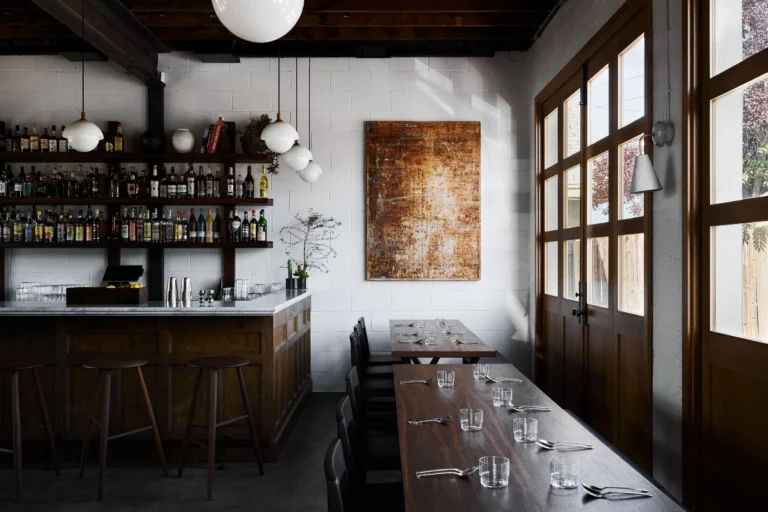
He worked in sanded white plaster, and against it he put color where it would be noticed and nowhere else. A sunken bar, built low so that a conversation would stay inside itself. A heart at the entrance that says love in fourteen languages. A Navajo-woven American flag from 1966. The tiles overhead. The point of the design was never decoration but temperature: a Girard interior is warm the way a well kept house is warm, and it is why people who have eaten here once describe the space before they describe the food.
Girard had been in Santa Fe since 1953 and was collecting the folk art that would become the founding collection of the Museum of International Folk Art on Museum Hill. The interior here is not a visiting designer’s job. It is the same eye that filled a museum four miles away, working at the scale of one house, and it is generally described as the last of his restaurant interiors still in use.
Three Owners in Sixty Years
Will and Barbara Hooton opened it in 1966 with fine dining as the premise, which was new in this city. Victor Sagheer, who had been the first general manager, bought it in the mid-1970s and ran it in the French manner, with a dress code, white gloves, and tuxedos. Mark Kiffin bought it from Sagheer and reopened on May 30, 2000. Kiffin had spent eight years with Mark Miller at Coyote Cafe, the kitchen credited with modern Southwestern cooking, and in 2005 the James Beard Foundation named him Best Chef: Southwest. No Santa Fe chef took a regional Best Chef award again until Sazón‘s Fernando Olea in 2022.
The Ground It Sits On
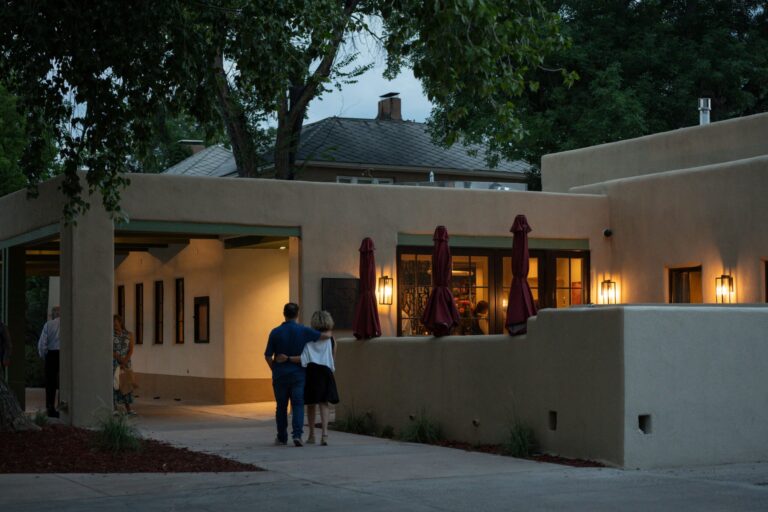
The address is 653 Canyon Road, and the name is literal: this was the main house of a family compound. The house gives its own ground as farmland first and then a sheep ranch on the ditch, and the acequia still runs behind the building. Two stories of adobe is uncommon on this street. The patio under the trees is what most people remember afterward.
Before it was anything public, the compound was a retreat, and the house’s own account of the guest list runs to Georgia O’Keeffe, John Wayne, and Errol Flynn. Whatever the truth of any single name, the shape of the story is right: this was a private place that people came a long way to be private in.
Geronimo is a few doors up the road, in a house older than this one, and between them they are what fine dining on Canyon Road means. They are not the same proposition. Geronimo is an eighteenth century house kept as a house, and The Compound is an old adobe with a modernist interior installed inside it. Whether you want the house or the design is the real question. The Santa Fe Year says when the patio is worth planning around.
Common Questions
Is Alexander Girard’s 1966 interior still in place?
Much of it. The sunken bar, the heart that says love in fourteen languages, the Navajo-woven flag, and the ceiling tiles wrapped in Braniff and Navajo textiles are original to the 1966 conversion.
Does The Compound hold a James Beard award?
The award belongs to a person. Mark Kiffin, the owner since 2000, won Best Chef: Southwest from the James Beard Foundation in 2005. A Best Chef award is given to a chef, not to a restaurant.
Discover More


Get in Touch
Let's connect and discuss how we can help you enrich your Santa Fe experience.
