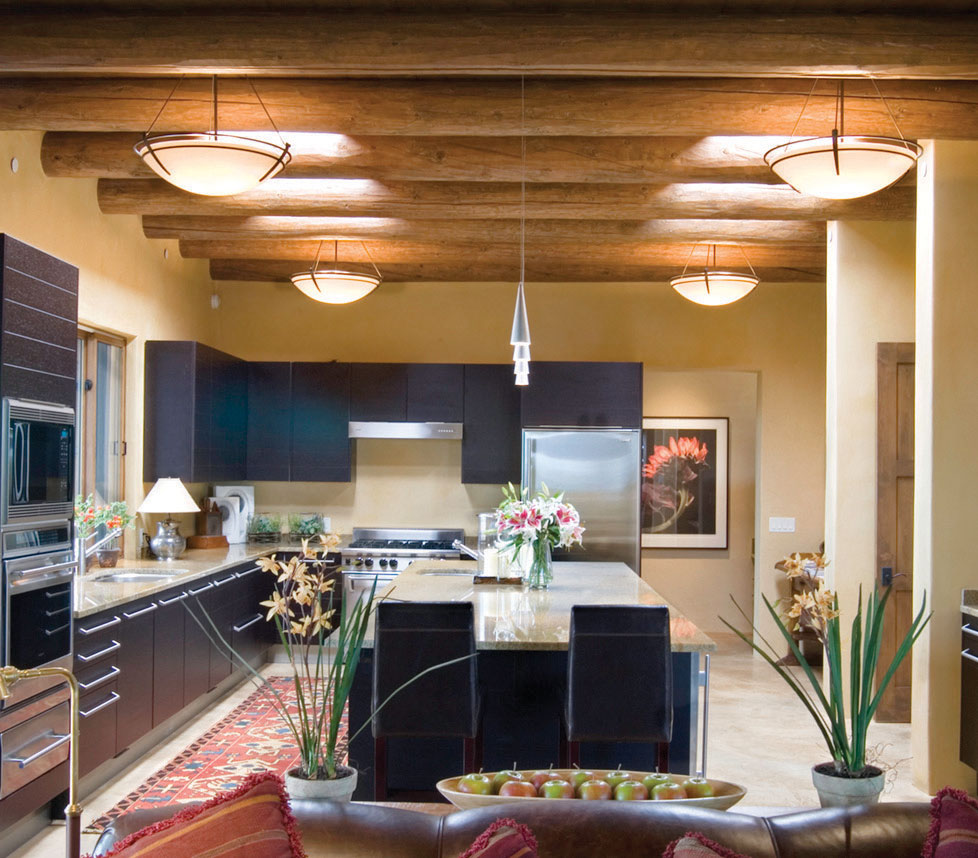
Contemporary Adobe is the twenty-first-century iteration of Santa Fe’s adobe tradition — modern interior planning wrapped in the traditional vocabulary of thick stuccoed walls, exposed vigas, deeply set windows, and earth-toned exteriors. It is the most common new-construction style in the upper end of the Santa Fe market and represents a genuinely contemporary contribution to the city’s architectural lineage, not a copy of the older revival styles.
What is Contemporary Adobe?
Contemporary Adobe homes adopt the visual language of the older Northern New Mexico tradition — adobe-style massing, flat roofs with parapets, viga ceilings, deeply set windows, earth-toned stucco exteriors, integrated outdoor living — but apply it to interior plans that reflect modern residential expectations: open kitchen-and-living combinations, larger glass openings designed around views, primary suites with dedicated outdoor access, contemporary mechanical systems integrated invisibly into the construction.
The style emerged in earnest in the 1990s and has been the dominant idiom for new high-end Santa Fe construction since roughly 2000. Architects working in this space include both Santa Fe firms with multi-decade local practices and out-of-town designers who have learned the local vocabulary well enough to produce work that reads as authentic to the place. The quality varies widely; the best examples are subtle, well-proportioned, and feel inevitable on their sites, while weaker examples can feel like Pueblo Revival pastiche with bigger windows.
How does Contemporary Adobe differ from Pueblo Revival or Spanish Pueblo Revival?
The exterior vocabulary is similar — earth-toned stucco, vigas, flat roofs, deeply set windows. The differences emerge in the interior planning and in the proportions of the openings.
Pueblo Revival and Spanish Pueblo Revival homes — built primarily between the 1910s and 1950s — have compartmentalized floor plans with smaller rooms, lower ceilings, and small deeply set windows that reflect the structural limits of hand-formed adobe construction. Contemporary Adobe uses modern construction methods (often stucco-over-frame with deep wall sections that approximate adobe mass, or actual stabilized adobe block) to allow much larger spans, taller ceilings, and substantially larger glass openings — particularly on the south and west elevations where contemporary buyers want view connection and outdoor living.
The other major difference is in the placita courtyard tradition. Traditional Pueblo Revival often organizes around enclosed central courtyards; Contemporary Adobe often replaces the placita with a continuous indoor-outdoor flow toward a view, with covered portales and outdoor living spaces that read more as patio than as compound interior.
Where Contemporary Adobe concentrates
Several Santa Fe-area neighborhoods are dominated by Contemporary Adobe construction.
Las Campanas is the single largest concentration. The community’s design guidelines steer almost all new construction into a Northern New Mexico vernacular interpretation, and the bulk of homes built since the late 1980s have been Contemporary Adobe in the broad sense. Quality across the community varies — the best lots and the most accomplished architects have produced some excellent examples, while production-builder work in the smaller subdivisions can feel formulaic.
The Upper Eastside has substantial Contemporary Adobe inventory, often on hillside view lots where the style’s larger glass openings and outdoor living connections show particularly well. The Northside includes a mix of older custom contemporary work from the 1980s through the 2010s — much of it Contemporary Adobe in style — on the larger acreage that the corridor accommodates.
Tesuque’s ridge subdivisions — Tesuque Ridge, Tesuque Ridge Ranch — are similarly populated with Contemporary Adobe homes, often on premier view lots that take advantage of the elevation and the long views back toward the Jemez and Sangre de Cristos.
What buyers should evaluate
The two questions that matter most with Contemporary Adobe are quality of execution and quality of siting. The style is forgiving of mediocre execution in a way the historic revival styles are not — most Contemporary Adobe homes look acceptable from the curb whether the underlying architecture is strong or not. The differences emerge in the proportions of the windows, the relationship of indoor and outdoor space, the texture of the stucco, the quality of the woodwork, and the way the home sits on its lot. A well-designed Contemporary Adobe is one of the most livable home types in Santa Fe; a poorly designed one can feel inert.
The siting question is particular to this style. Because Contemporary Adobe homes are typically built around larger glass openings to take advantage of views, the orientation of the lot and the framing of those views significantly affects long-term enjoyment of the property. Buyers benefit from visiting prospective Contemporary Adobe properties at multiple times of day — morning, mid-afternoon, sunset — to read how the home’s relationship to the sun and the surrounding landscape actually plays out.
Webster Estates and Contemporary Adobe
Webster Estates handles a steady flow of Contemporary Adobe transactions across Las Campanas, the Upper Eastside, Tesuque, and the Northside. Distinguishing between strong and weak examples — and identifying the design moves that age well versus the ones that don’t — is part of how Webster Estates evaluates new-construction properties. Available and recently sold examples appear across the Las Campanas, Upper Eastside, Tesuque, and Northside market archives.