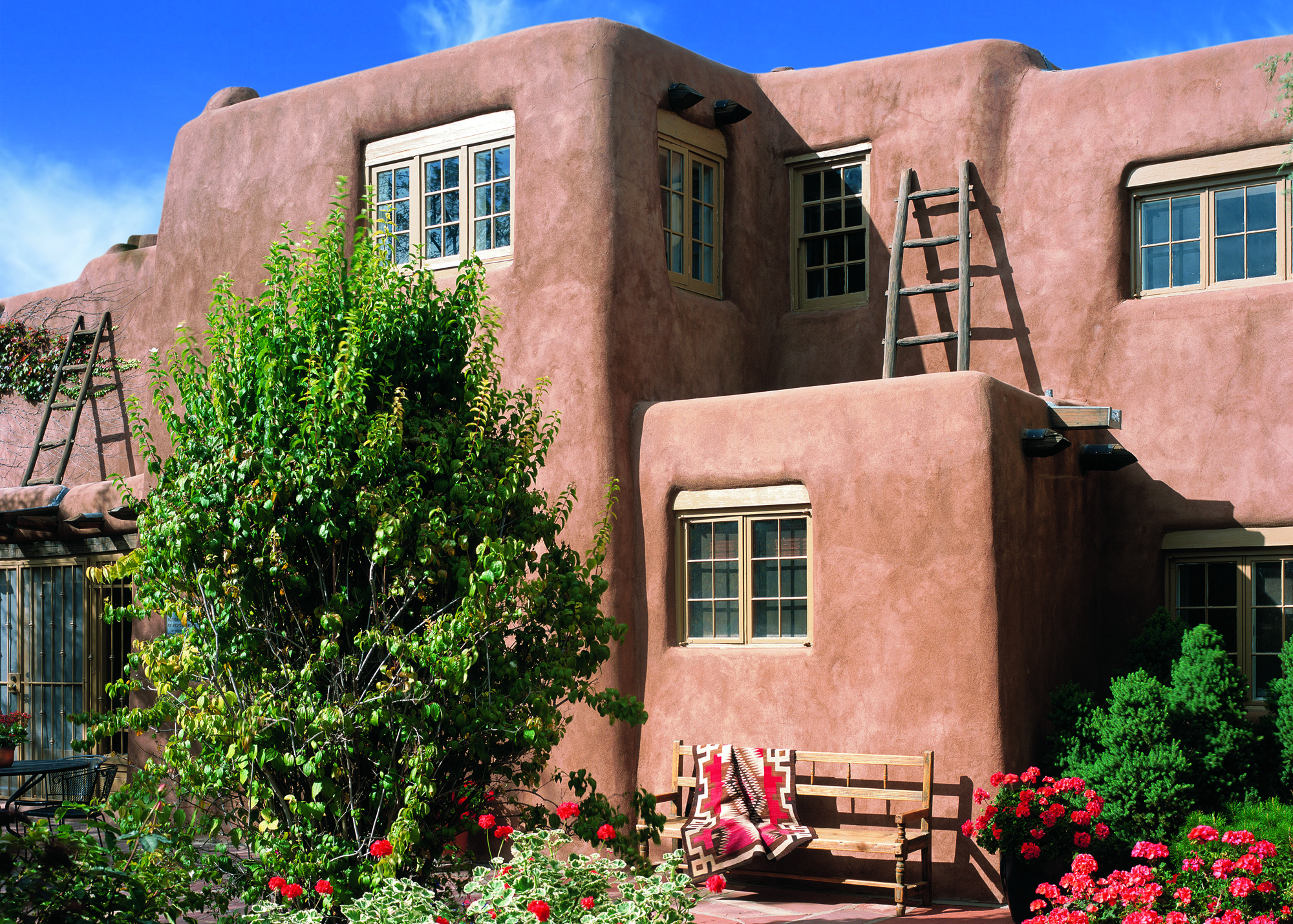
Spanish Pueblo Revival is the most refined expression of what most people call “Santa Fe Style.” It is the synthesis of Pueblo Revival’s adobe forms with selective Spanish Colonial details (carved corbels, decorative wood, occasional sloped roof sections), and it is the style most closely associated with the residential work of John Gaw Meem. This guide covers what distinguishes Spanish Pueblo Revival from related styles and where the strongest examples appear in the Santa Fe market.
What is Spanish Pueblo Revival?
Spanish Pueblo Revival emerged in the 1910s and 1920s in Santa Fe as a deliberate synthesis. Architects and patrons of the period, most notably John Gaw Meem working in Santa Fe from 1924 onward, were drawn to the indigenous Pueblo architectural tradition but also recognized the centuries-deep Spanish Colonial layer that had shaped New Mexico vernacular for three hundred years before the Revival movement. The resulting style blends both: the massing and material palette of Pueblo Revival with the carved wood, ornamental ironwork, and occasional sloped-roof elements of Spanish Colonial design.
The two terms, Pueblo Revival and Spanish Pueblo Revival, are used somewhat interchangeably in Santa Fe real estate listings. In stricter use, Pueblo Revival refers to the more austere, indigenous-derived expression (Carlos Vierra’s house is a canonical example), while Spanish Pueblo Revival refers to the synthesis with Spanish Colonial vocabulary (John Gaw Meem’s mature residential work is the canonical expression).
Identifying features
A property reads as Spanish Pueblo Revival rather than pure Pueblo Revival when you see:
- Carved wood corbels supporting vigas and lintels, often with subtle Spanish ornamental detailing
- Spanish-style carved doors with hand-forged iron hinges and hardware
- Occasional sloped roof sections in addition to the dominant flat roofs, often over a placita-facing wing or a chapel-like element
- Placita courtyards as central organizing spaces, more formally composed than in pure Pueblo Revival
- Refined interior details (carved doors, integrated nichos, traditional fireplace forms, built-in benches) that reflect the Spanish Colonial design tradition
- More symmetrical massing than the irregular stepped forms of pure Pueblo Revival, particularly in formal-entry compositions
Many homes blend both styles, with Pueblo Revival sections and Spanish Pueblo Revival sections within the same residence. Provenance and dating matter. The earliest expressions of the style (1920s through 1940s) are the canonical work; later contemporary interpretations vary widely in quality and authenticity.
The John Gaw Meem connection
Spanish Pueblo Revival is, more than any other Santa Fe architectural style, associated with one architect. John Gaw Meem worked in Santa Fe from 1924 until his retirement, and his residential work, alongside major institutional commissions like Cristo Rey Church and the additions to La Fonda, defined what the style looked like at its highest level. A documented Meem residence almost always reads as Spanish Pueblo Revival; the style is more or less his architectural vocabulary applied at residential scale.
The relationship runs both ways. Buyers shopping for Spanish Pueblo Revival homes are often also shopping for Meem provenance, and the two searches overlap substantially. Confirming a Meem attribution is part of how the upper end of the Spanish Pueblo Revival market is evaluated; the John Gaw Meem guide covers the verification process in more detail.
Where Spanish Pueblo Revival shows up in the market
The strongest concentrations are in three neighborhoods.
Old Pecos Trail has the highest density of documented Spanish Pueblo Revival residences in Santa Fe, including several confirmed Meem homes. The corridor’s build-out happened largely during the style’s peak period (1920s through 1950s), and the relatively large lots accommodated the more elaborate compositions that Spanish Pueblo Revival often called for.
The Historic East Side includes substantial Spanish Pueblo Revival work, often in the form of additions and renovations to older adobe properties rather than ground-up new construction. Camino del Monte Sol, the address of choice for the early-twentieth-century Santa Fe artist colony, contains some of the most carefully maintained Spanish Pueblo Revival examples in the city.
Las Campanas includes a large number of contemporary Spanish Pueblo Revival interpretations: homes built since the late 1980s following the community’s design guidelines, which orient most construction toward a Northern New Mexico vernacular informed by the Meem tradition.
What buyers should evaluate
The single most consequential question with a Spanish Pueblo Revival home is provenance: when was it built, by whom, and how much of the original work survives. A 1930s Meem residence with intact original details and clean preservation history is a substantially different property than a 1990s contemporary built in the same idiom, even if the surface impressions are similar.
Original interior details (carved corbels, hand-forged hardware, integrated nichos, traditional fireplace forms) are a meaningful component of the property’s value. Renovations that have replaced or removed these elements typically reduce value relative to comparable properties that have preserved them. The same applies to adobe maintenance: authentic adobe construction requires its own discipline, and properties that have been maintained appropriately for decades read very differently from properties that have not.
Webster Estates and Spanish Pueblo Revival
Webster Estates has handled significant Spanish Pueblo Revival transactions over the years, including documented Meem residences on Old Pecos Trail and architecturally significant Historic East Side compounds. Identifying a true Spanish Pueblo Revival home (versus a Pueblo Revival home, a contemporary in the same idiom, or a later renovation of an older property) is part of how the team evaluates properties from this period. Available and recently sold examples appear across the Old Pecos Trail, Historic East Side, and Canyon Road market archives.