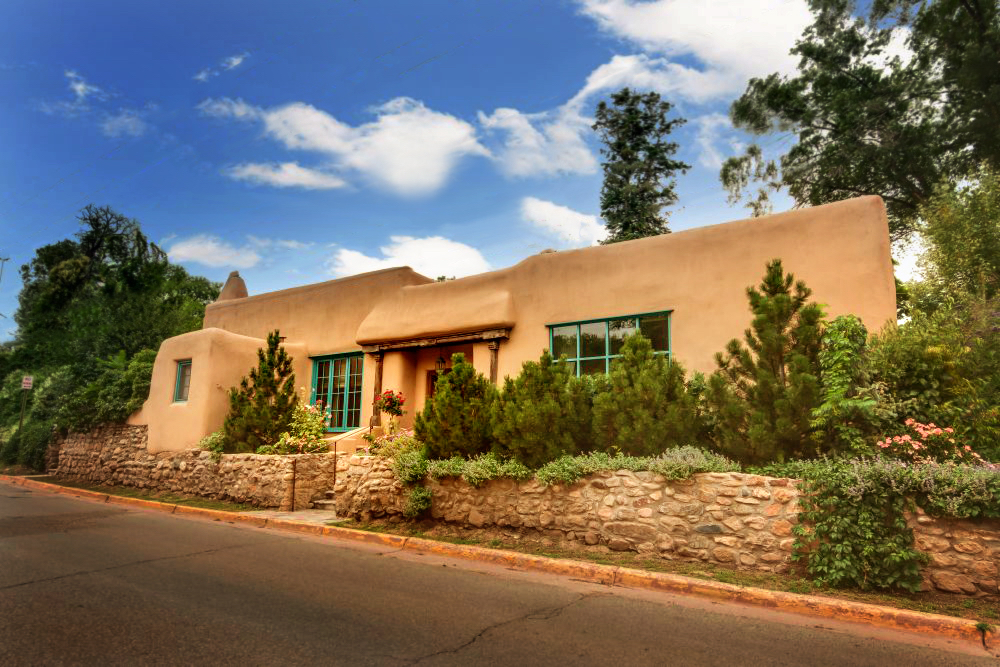
Pueblo Revival is the architectural style most closely associated with Santa Fe — and it is the style that buyers searching for “a Santa Fe home” most often have in mind. It is also the most commonly misidentified style in the city. This guide walks through what Pueblo Revival actually is, how it differs from related Santa Fe styles, and where the strongest examples turn up in the local market.
What is Pueblo Revival architecture?
Pueblo Revival is a 20th-century style that draws its forms from the multi-story Pueblo communities of New Mexico and Arizona — particularly Taos Pueblo and the ancient sites at Bandelier, Chaco, and Mesa Verde. The style was developed and codified in Santa Fe between roughly 1908 and 1940 by a small group of architects and patrons who wanted the city to look more like the landscape and culture it sat in, and less like the Anglo-American small town it had become in the late 19th century.
The defining features are consistent across well-built examples: thick walls (originally adobe, often stuccoed-over frame in revival construction); flat or stepped rooflines with parapets; rounded corners and softly battered walls; exposed wooden vigas projecting through the parapet; smaller, deeply set windows; and natural earth-toned stucco that ranges from sand to warm brown. Interior details typically include latilla ceilings (the small wooden poles laid between vigas), thick window seats carved into the walls, beehive corner fireplaces (kivas), and brick or saltillo tile floors.
How is Pueblo Revival different from Spanish Pueblo Revival, Territorial, and Northern New Mexico Vernacular?
The four terms overlap and locals use them inconsistently, but the distinctions matter when you are evaluating a property.
- Pueblo Revival draws specifically from Pueblo-period architecture — stepped massing, flat roofs, vigas, no decorative trim. Carlos Vierra’s own house on Old Pecos Trail (built 1918) is one of the earliest and most influential examples.
- Spanish Pueblo Revival is sometimes used interchangeably with Pueblo Revival but in stricter use refers to the synthesis John Gaw Meem developed in the 1920s–30s: Pueblo forms with selective Spanish Colonial details (carved corbels, decorative wood, occasional sloped roof sections).
- Territorial style is a different style entirely — flat-roofed adobe with white-painted brick coping at the parapet, white-trimmed windows, and a more Anglo, post-1846 sensibility. Common throughout the Historic East Side.
- Northern New Mexico Vernacular is the broadest term, encompassing the older pre-1900 adobe homes built by ranching families across the region — humbler, more functional, and often modified over generations.
Where Pueblo Revival shows up in the Santa Fe market
The strongest Pueblo Revival examples in Santa Fe cluster in a few specific neighborhoods, almost all developed in the 1910s–1950s when the style was still being defined.
Old Pecos Trail and the corridor south of the Plaza
The Old Pecos Trail neighborhood contains the most documented concentration of Pueblo Revival and Spanish Pueblo Revival homes in the city. The Carlos Vierra House — an artist-built hand-formed adobe, designated historic — is here, as are several confirmed John Gaw Meem residences. Lots are generally larger and the streetscape has retained its 1920s–1940s character better than most parts of the city.
The Historic East Side and Canyon Road
The Historic East Side mixes older true-adobe homes with Pueblo Revival additions and renovations. Many properties started as 19th-century farmhouses and were re-stuccoed and re-detailed in the Pueblo Revival idiom during the 1920s–1940s revival period. Canyon Road itself includes both authentic pre-revival adobes (the Gerald Cassidy Estate, the Borrego House) and twentieth-century Pueblo Revival compounds. The lines blur — and provenance research is often part of evaluating a Canyon Road property accurately.
The Upper Eastside and contemporary Pueblo Revival
The Upper Eastside hosts more contemporary interpretations of the style — homes built in the 1980s–2010s that adopt Pueblo Revival forms (flat roofs, vigas, thick stucco walls) but at larger scales and with more glass than the early-twentieth-century originals. Same for parts of Las Campanas, where the community’s design guidelines steer most new construction toward a Northern New Mexico vernacular that draws on Pueblo Revival.
What buyers should know before evaluating a Pueblo Revival home
Real Pueblo Revival construction — particularly hand-formed adobe — comes with maintenance considerations that the style’s contemporary imitators do not. Adobe walls move with moisture, require periodic re-stuccoing (every 5–15 years depending on exposure), and need attention to drainage. Vigas weather over time and occasionally need replacement, which is a careful craft because they are often structural rather than decorative. Original interior details (latillas, carved corbels, brick floors) are part of the property’s value and should be preserved through renovation, not removed.
The other practical question is age. A 1920s Pueblo Revival home has had a century of remodeling decisions, additions, and infrastructure upgrades layered onto it. The best examples retain the original character; many have been compromised by later additions in incompatible styles. A buyer evaluating a Pueblo Revival home benefits from someone who can quickly distinguish original from added, and authentic from imitative.
Webster Estates and Pueblo Revival properties
Webster Estates has handled significant Pueblo Revival and Spanish Pueblo Revival transactions over the years, including the Carlos Vierra House, the Gerald Cassidy Estate on Canyon Road, the Historic Borrego House, and several documented John Gaw Meem residences on Old Pecos Trail. Available and recently sold examples appear in the Old Pecos Trail, Historic East Side, and Canyon Road market archives.
If you are evaluating a specific Pueblo Revival property — or trying to identify whether a home you are considering is actually Pueblo Revival or a related style — Webster Estates is happy to walk through the building, the documentation, and the neighborhood context with you.