
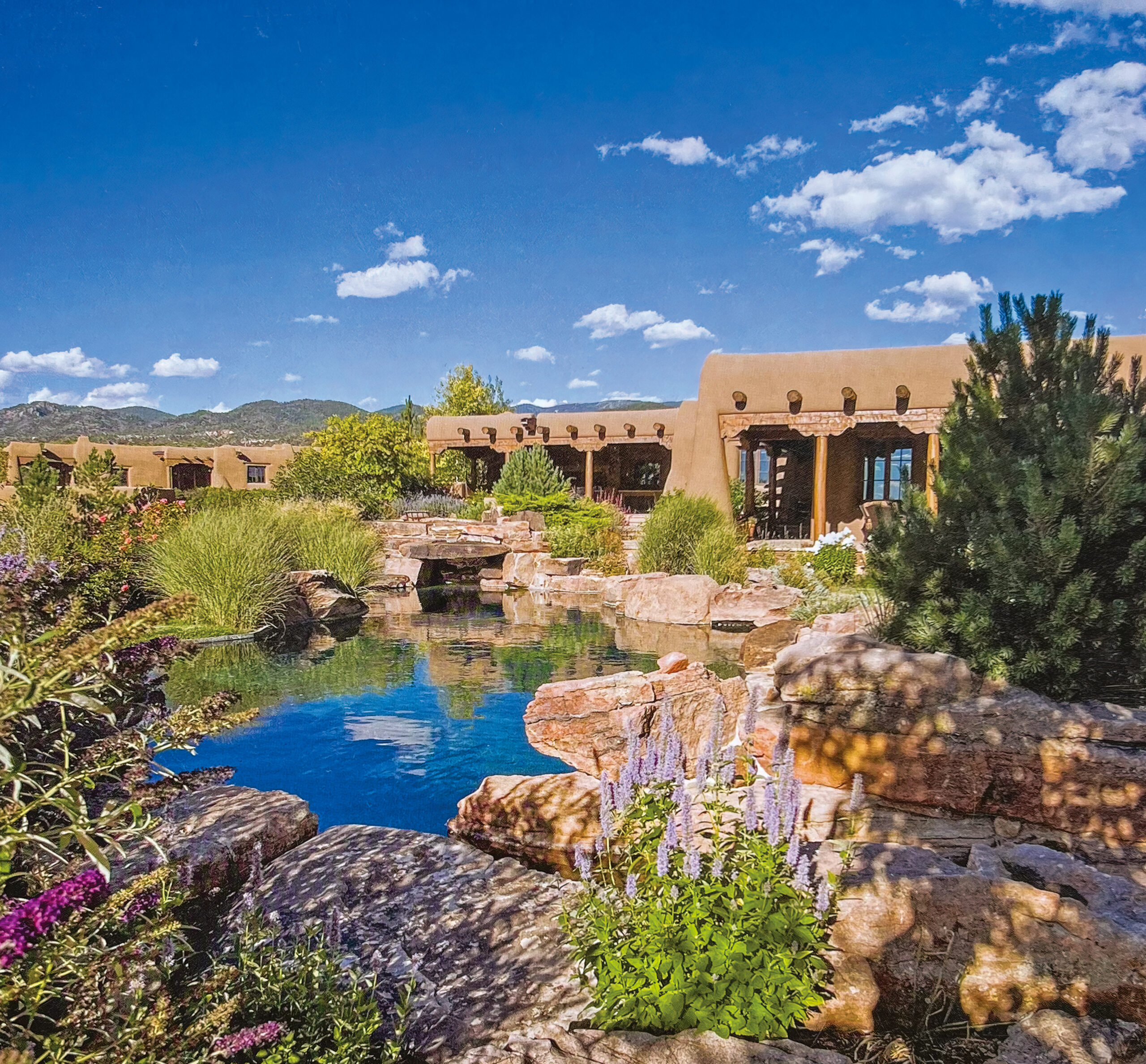
The first time a Santa Fe property under contract surprises an out-of-state buyer, it is almost never the architecture or the property taxes. It is the water. A house that looks identical to one in Austin or Denver may run on a private well, sit downstream of a community ditch dating to the 1700s, or come with water rights that were quietly conveyed away from the land decades ago. None of that is a problem — but none of it is obvious from the listing, either.
This guide is the orientation we wish every buyer had before their first showing in Santa Fe County. It covers the four water situations you will actually encounter — city service, private wells, shared wells, and acequia-adjacent properties — plus how water rights work as a separate legal interest, and what to verify during due diligence.
City of Santa Fe water service: where it ends
Inside the city limits, almost every property is on the City of Santa Fe water utility. The system draws from the Santa Fe River reservoirs (McClure and Nichols, treated at the Canyon Road plant), seven active municipal wells along the river, and the Buckman Direct Diversion — a 15-million-gallon-per-day intake that pulls San Juan–Chama and Rio Grande water and supplies roughly half of the city’s needs.
Bills are modest by national standards. A typical household uses about 4,200 gallons a month and pays in the neighborhood of $48–$50, depending on where the meter falls in the city’s three-tier rate structure (breakpoints at 4,000, 7,000, and 9,000 gallons, adopted January 2025). Rates rose roughly $2 per month at the start of 2026 and are scheduled to rise modestly each year through 2029 to fund infrastructure.
One quirk worth knowing: even inside the city, a new home can sometimes be served by a private domestic well rather than the city utility — but only if the city water main is more than 300 feet away or connection cost exceeds the cost of drilling. If you are looking at a property that already has a well inside the city limits, ask whether it is grandfathered, and confirm the use rights with the seller’s title work.
Private wells in Santa Fe County
Step outside the city service area — Eldorado, Tesuque, La Cienega, La Tierra, Las Campanas’s outer parcels, much of the southern county — and you are likely on a private domestic well. In New Mexico, those wells are permitted under the Office of the State Engineer’s domestic-use rule (19.27.5 NMAC), which allows a standard diversion of up to 3.0 acre-feet per year per household. That works out to nearly one million gallons, which is far more than a typical household uses (the statewide average is closer to 0.29 acre-feet, or about 7,900 gallons a month).
Some pockets of the county sit inside a designated Domestic Well Management Area, where the limit drops sharply to 0.25 acre-feet per year (about 81,500 gallons). That is enough for indoor household use but tight for any meaningful outdoor irrigation. If a property is in a DWMA, the listing rarely says so — your agent and a title officer should be able to confirm before contingencies expire.
What does it cost to drill a new well in Santa Fe County?
Northern New Mexico’s geology is hard, with depths frequently exceeding 500 feet in the foothills and mesa country. Industry estimates put a complete private well system — drilling, casing, pump, pressure tank, electrical — at $15,000 to $50,000 for routine cases, and $30,000 to $70,000 for deeper or more difficult sites. National per-foot pricing of $25–$65 is a useful baseline; expect the upper end here.
For an existing well, the items to verify during inspection are concrete:
- Sustained yield in gallons per minute. Five GPM is the accepted minimum for a single-family home. Anything below that should prompt a conversation about storage tanks.
- Pump age and condition. Submersible pumps typically last 8–15 years. A pump near end-of-life is a near-term capital expense, not a deal killer — but it should affect your offer.
- Recent water quality testing. The New Mexico Department of Health hosts free Water Test Fairs that screen for arsenic, fluoride, nitrate, sulfate, iron, conductivity, and pH. Arsenic in particular is common in parts of northern New Mexico.
- Well log on file with the OSE. Every legitimate well has one. If the seller cannot produce it, the title company can usually pull a copy.
Shared wells: more common than you’d think
Plenty of rural Santa Fe County properties are served by a shared well — typically two to four homes drawing from a single wellhead under a recorded shared-well agreement. The arrangement is normal, not a red flag, but the agreement itself is what matters.
Read it carefully before closing. It should spell out cost-sharing for routine maintenance and capital repairs (a new pump, a casing repair), define how decisions are made, address what happens if one household’s usage spikes, and lay out a mechanism for resolving disputes. Maintenance contributions are usually modest — $15–$20 per household per month is a common figure — but the big-ticket replacements are where unclear agreements cause friction. If the seller cannot produce a recorded agreement, that is a flag worth raising with your closing attorney.
Acequias and the properties they touch
Many parcels in and around Santa Fe — particularly in the historic neighborhoods, the valleys north and south of the city, and the rural villages — are crossed by or adjacent to an acequia, a community-managed irrigation ditch. Some acequias predate New Mexican statehood by two centuries. They are not decorative. They are a working legal and cultural institution, governed by a mayordomo (the elected ditch boss who allocates water and calls cleaning days) and the parciantes who hold rights to draw from it.
If a property includes acequia water rights, the obligations come with them. State statute (NMSA 73-2-21 and 73-2-39) requires parciantes to supply labor or a substitute for the annual ditch cleaning, or pay a penalty in lieu of labor. You can fulfill the obligation; you cannot ignore it. The New Mexico Acequia Association and the Interstate Stream Commission both made expanded infrastructure funding a 2025 legislative priority, which is a good signal of how seriously the institution is taken statewide.
If you do not want the obligations, that is fine — but you need to understand what you are buying. Sometimes a property is adjacent to an acequia but holds no rights in it; sometimes it does. The deed and water-rights file will tell you.
Water rights as a separate property interest
This is the piece that surprises out-of-state buyers most. In New Mexico, water rights can be severed from the land they once irrigated. A property with historical agricultural use may look like it has water rights — there may even be a visible ditch crossing the parcel — and yet hold none, because a previous owner transferred them. The New Mexico Supreme Court confirmed this in Turner v. Bassett: once the Office of the State Engineer issues a change-of-place-of-use permit, the rights are presumed severed even if the deed never said so explicitly.
Two practical consequences:
- Title insurance will not cover water rights. “Water rights, claims or title to water” is a standard exception on every New Mexico title commitment, and it cannot be deleted. Read the commitment carefully — the exception is real.
- Order a separate water-rights search. A title company or a water-rights attorney can pull the OSE file for the parcel. This is the only way to confirm what water rights, if any, actually convey with the property.
Is Santa Fe running out of water?
It is a fair question, and the honest answer is: not in the way buyers usually fear. Santa Fe County is currently in moderate drought, and the city imposes outdoor watering restrictions from May 1 through November 1 (no irrigation between 10 a.m. and 6 p.m.). The city has not imposed building moratoriums tied to water. Instead, since 2010 the Water Bank ordinance has required developers to offset new demand with retired water rights — a quieter policy lever that has kept supply and demand roughly in balance. The Buckman Direct Diversion brought significant new capacity online in 2011, and the city’s published planning currently shows no need for a new supply source until after 2030.
None of that means you should ignore water in your purchase decision. It means the responsible framing is not “is there water” but “what kind of water situation is this property in, and what does it commit me to.”
A short due-diligence checklist
Before contingencies expire on any Santa Fe County property:
- Confirm the water source in writing — city utility, private well, shared well, or community system. Get the well log if applicable.
- Test the well’s production rate and water quality. Note pump age.
- Read the shared-well agreement, if any. Verify it is recorded.
- Order a separate water-rights search from a title company or water attorney. Title insurance alone will not protect you here.
- If the property is on or adjacent to an acequia, identify the ditch by name and ask whether parciante obligations come with the deed.
- If the property is inside a Domestic Well Management Area, factor the 0.25 acre-foot annual limit into your landscaping plans.
Water in Santa Fe is more layered than it looks from a listing photo — but the layers are knowable, the questions are answerable, and most of them have clear paper trails. The buyers who run into trouble are almost always the ones who treated water as a closing-week afterthought rather than a part of the property worth understanding. At Webster Estates, we walk every out-of-state buyer through this checklist before they are under contract, because once the inspection clock is running, there is rarely time to untangle a water-rights question that should have been asked weeks earlier.



Buying Land in Santa Fe County: A Practical Guide to Lots, Water, Septic, and Building