Walk three blocks east of the Plaza, cross Paseo de Peralta, and the city changes. Sidewalks narrow, then disappear. Adobe walls press up against the lane. A cottonwood-shaded irrigation ditch — the Acequia Madre, dug shortly after Santa Fe was founded in 1610 — runs along one of the side streets. This is the Historic East Side, and for buyers willing to navigate its rules and price tags, it remains the most architecturally distinctive piece of real estate in northern New Mexico.
Where the Historic East Side actually is
The neighborhood occupies the wedge between the Plaza and the foothills of the Sangre de Cristo Mountains, roughly bordered by Paseo de Peralta on the west, the foothills on the east, and the Santa Fe River corridor on the south. It includes Canyon Road and the streets that branch off it — Acequia Madre, Camino del Monte Sol, Camino San Acacio, García Street, Delgado, and several quieter lanes that don’t appear on most tourist maps.
Most of the neighborhood sits inside the city’s Downtown & Eastside Historic District, the most strictly regulated of Santa Fe’s five historic districts. That regulation is the central fact of buying here. It protects what makes the neighborhood feel like the neighborhood — and it also constrains what you can do with the property after closing.
What homes cost on the East Side
The East Side typically commands the highest price-per-square-foot of any neighborhood in Santa Fe. A few reference points for buyers running the math:
- Entry-level (~$1M–$1.6M): small casitas, condo conversions, or older homes that need work. Often under 1,500 square feet. A property at this end of the market is usually a project, not a turnkey purchase.
- Mid-range ($1.6M–$3M): renovated three-bedroom adobes, well-kept courtyard homes, walkable properties off Canyon Road or García Street. Most buyers in this band are buying a primary or second home that’s ready to live in.
- Compound and estate range ($3M–$10M+): walled compounds with guest houses, restored 19th-century adobes, properties with multiple structures and significant land for an in-town neighborhood. Provenance matters at this level — buyers are paying for documented history as much as square footage.
Price-per-square-foot frequently lands between $600 and $900, and goes higher for restored historic homes with full provenance. Land alone — a buildable lot on a desirable Canyon-Road-adjacent street — can run well into seven figures before a single wall goes up.
The architecture you’re actually buying
The Historic Districts Ordinance, first drafted in 1957 with John Gaw Meem among its authors, restricts new construction and exterior renovation in the Downtown & Eastside District to two recognized styles: Old Santa Fe Style (Spanish-Pueblo Revival or Territorial) and New Santa Fe Style (compatible contemporary work that matches the older neighborhood in materials, color, proportion, and detail).
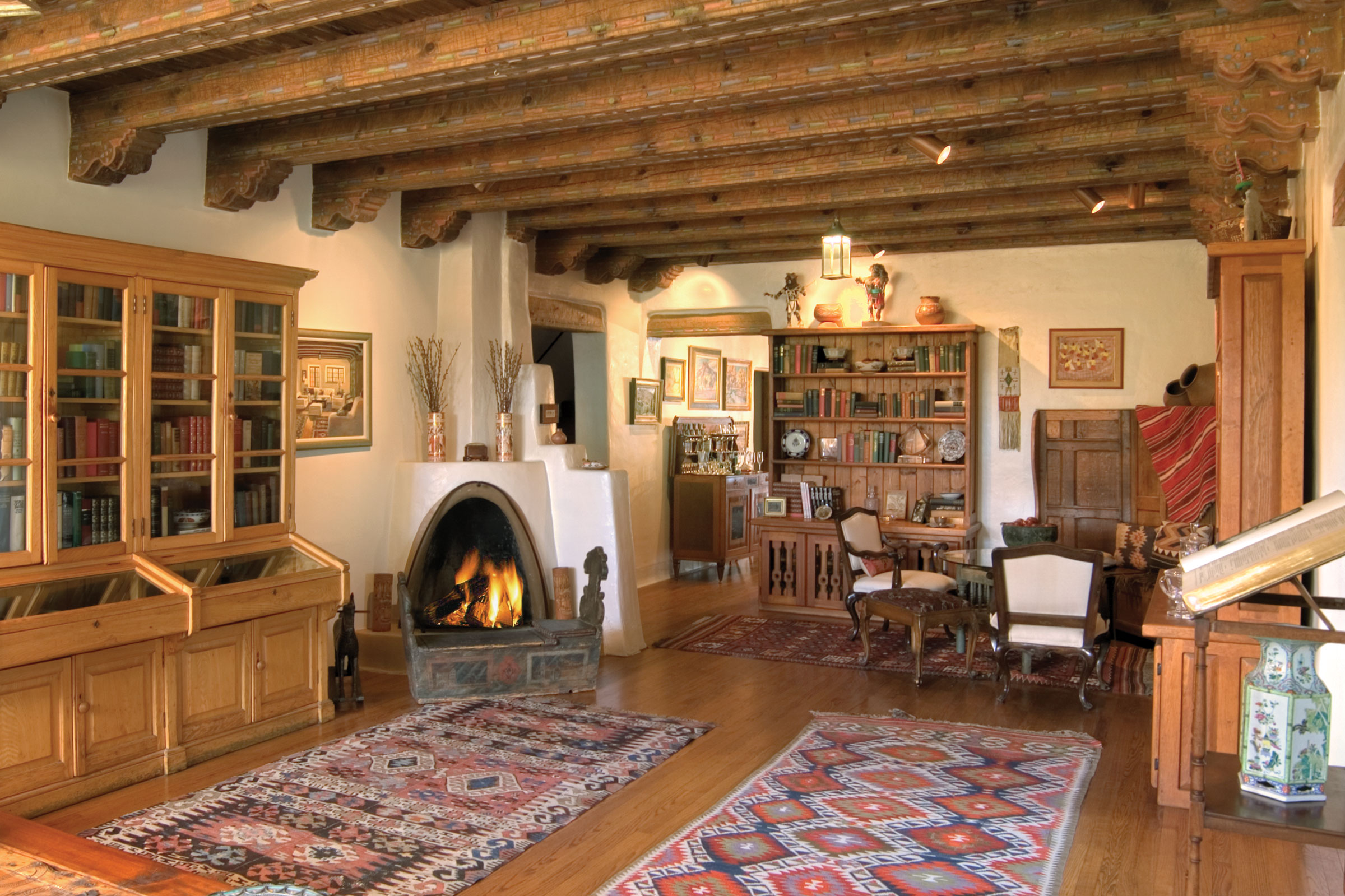
In practice, that means most of what you’ll tour shares a vocabulary: thick adobe or adobe-style walls, flat or low-pitched roofs hidden behind parapets, hand-troweled stucco in earth tones, deep-set windows, kiva fireplaces, and ceilings finished with vigas (round beams) and latillas (smaller branches laid between them). Many homes incorporate genuine 19th-century adobe walls inside later additions. A good inspector who understands historic adobe is worth more here than almost anywhere else in the city.
What the Historic Districts Review Board controls
Almost any change visible from a public street requires review by the Historic Districts Review Board (HDRB). That includes, at minimum:
- Window replacement, including matching glass and frame style
- Stucco color, when re-coating an exterior
- Roof replacement, height changes, or parapet alterations
- Gates, garden walls, and street-facing fencing
- Additions, dormers, portales, and any change to the building footprint
- Solar panels and mechanical equipment in any visible location
The HDRB meets the second and fourth Tuesday of each month except holiday weeks. Straightforward applications are sometimes handled administratively without a hearing; anything contested or non-standard goes to the full board. Plan for a four-to-eight-week review timeline at minimum, longer for complex projects. The takeaway for buyers: factor approval lead times into any renovation budget, and never assume “we’ll just replace the windows” will be a weekend project.
Canyon Road and the rhythm of the neighborhood
Canyon Road runs through the heart of the East Side and has been a designated residential arts-and-crafts zone since 1962. The half-mile stretch holds over 100 galleries, plus restaurants and a few small shops. The galleries draw daytime visitors year-round, with the Friday-evening art walks during summer being the busiest hours. If you buy on Canyon Road itself or on one of the immediately adjoining streets, you accept a low but steady level of pedestrian traffic outside your gate. Two blocks deeper into the neighborhood and it goes very quiet.
Acequia Madre Street, one block south of Canyon Road, is the other defining lane. The ditch it’s named for still carries water seasonally and is managed by a local mayordomo under traditional acequia law. Properties along it sometimes have water rights tied to that system — a detail worth asking about during due diligence, since acequia rights come with both seasonal water and seasonal maintenance obligations.
What about lot sizes and outdoor space?
Lots are small by suburban standards. Many East Side properties sit on a quarter acre or less. What buyers often don’t realize until they tour is how effectively the courtyard layouts use that space: a walled compound on a tenth of an acre can feel completely private, with a garden, portal, and outdoor fireplace that all exist behind the street wall. Don’t filter listings by lot size alone — the configuration matters more than the acreage.
Is the Historic East Side a good investment?
Returns here behave differently than they do in most American neighborhoods. Supply is fixed — the historic district’s boundaries don’t expand, and tear-down redevelopment is effectively prohibited. The buyer pool is largely from out of state and skews older and wealthier, which makes pricing less sensitive to local-economy swings than other Santa Fe neighborhoods. The flip side: the carrying costs are real (property taxes, adobe maintenance, the time and money any renovation absorbs), and resale timelines for higher-priced compounds can be measured in months rather than weeks. It’s a hold-it-and-enjoy-it neighborhood more than a flip-it neighborhood.
Practical things to know before you make an offer
- Get the right inspector. Adobe behaves differently than frame construction. Cracks, moisture, and roof drainage all need someone who has done historic Santa Fe homes before.
- Verify what’s permitted. Older renovations were sometimes done without HDRB approval. Unpermitted work can become your problem at resale or insurance renewal.
- Ask about acequia rights and ditch obligations. If a ditch runs along or through the property, find out the membership status and the annual workday requirement.
- Read the title carefully. Some older East Side parcels have unusual easements — pedestrian rights-of-way, historic burro paths, party walls shared with neighbors.
- Budget realistically for maintenance. Adobe walls need re-stuccoing on a long cycle, but it’s expensive when the cycle comes due. Vigas and canales also have predictable lifespans.
Who the East Side is right for
This is not the neighborhood for a buyer who wants a new build, a large lot, or freedom to renovate on their own schedule. It is the neighborhood for buyers who want walking distance to the Plaza and Canyon Road, who actively want the character of older adobe homes, and who are willing to operate inside a regulatory framework that protects the streetscape they’re buying into. For the right buyer, no other Santa Fe neighborhood substitutes for it — and that’s reflected in the prices.
Webster Estates covers the Santa Fe market with neighborhood-by-neighborhood detail, including pricing, architecture, and the practical questions out-of-state buyers ask most. Browse current listings and neighborhood notes on the Santa Fe real estate hub.