Territorial Style is the other half of Santa Fe’s historic architectural vocabulary: the Anglo-influenced cousin of Pueblo Revival, distinct in origin and detail and often overlooked by buyers who arrive expecting only the rounded, viga-studded forms of the Pueblo tradition. This guide walks through what Territorial Style is, how it differs from Pueblo Revival and the rest of Santa Fe’s architectural lineup, and where in the market you’ll find the strongest examples.
What is Territorial Style architecture?
Territorial Style is the New Mexican adaptation of Greek Revival sensibility. It emerged in the years following the 1846 American annexation, when the arrival of milled lumber, fired brick, and Anglo-American carpenters changed what was possible to build in adobe country. The Spanish-Pueblo tradition of hand-formed mud walls and viga roofs got married to imported Anglo details (sawn moldings, painted trim, larger window openings), and the result was a hybrid that defined high-end Santa Fe residential construction from roughly 1846 through 1912.
The Territorial Revival movement of the 1930s and 1940s, coincident with John Gaw Meem’s Pueblo Revival work, recodified the style for a new generation. Today, “Territorial” and “Territorial Revival” are used somewhat interchangeably in the Santa Fe market, with most homes labeled Territorial actually being twentieth-century revival construction rather than nineteenth-century originals.
What does a Territorial Style home look like?
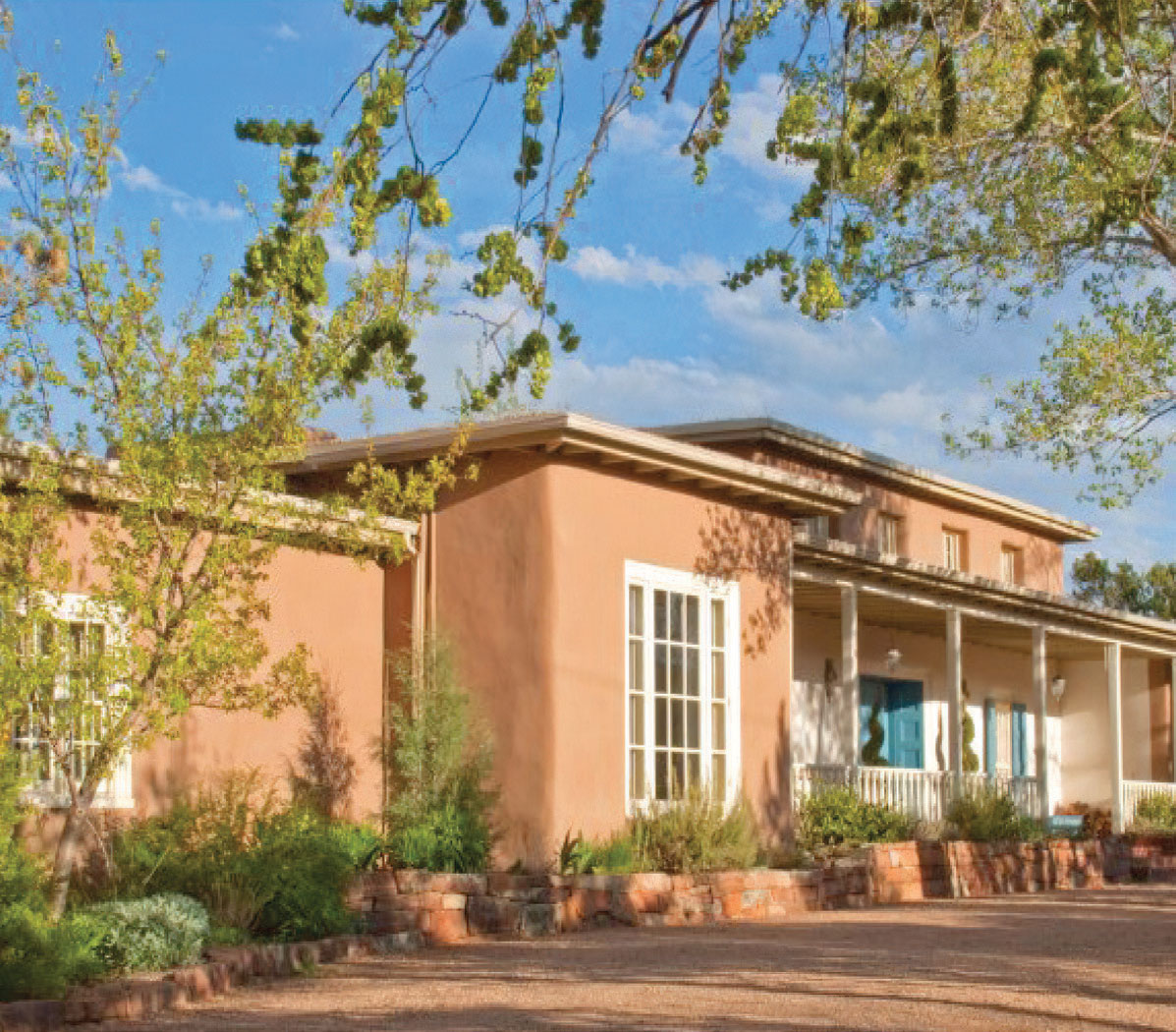
The most distinctive identifier is the brick coping on the parapet: a single course or two of fired brick laid across the top edge of the flat roof, often painted white. From the street, this brick coping is what tells you a home is Territorial rather than Pueblo Revival. Other identifying features:
- White-painted wood trim around windows and doors, in a milled rectangular profile with pediment or simple cornice details
- Larger, more rectangular windows than the small, deeply set openings of Pueblo Revival, often with double-hung sashes
- Symmetrical, rectangular plans rather than the irregular stepped massing of Pueblo Revival
- Flat roofs with parapets (same as Pueblo Revival) but topped with the signature brick coping
- Greek Revival flourishes at entrances: pediments, milled door surrounds, occasional pilasters
- Portales (covered porches) with milled wooden posts and squared rather than rounded edges
Some Territorial Revival homes from the 1930s onward incorporate sloped roofs in addition to flat sections, particularly over later additions. The pure flat-roof-with-brick-coping form remains the canonical identifier.
How is Territorial different from Pueblo Revival?
The simplest way to read the two styles is by what they refuse. Pueblo Revival refuses milled lumber, decorative trim, and rectilinear precision; it celebrates hand-formed mud, exposed wood, and rounded edges. Territorial Style embraces the milled and the painted: brick coping, white trim, squared corners, larger windows. They share a flat-roof, adobe-walled foundation but diverge in every applied detail.
In practice, many Santa Fe homes, particularly in the Historic East Side, blend both styles, sometimes in the same compound. A Pueblo Revival main house with a Territorial guesthouse, or vice versa, is common. The two styles were never strictly segregated; they were available to the same architects and builders, applied to suit different programs.
Where Territorial Style shows up in the Santa Fe market
Territorial Style is most concentrated in the older parts of the city built during or shortly after the 1846–1912 territorial period.
The Historic East Side
The Historic East Side contains the largest concentration of Territorial Style homes in Santa Fe. East Palace Avenue, East Alameda, and the side streets running north toward Cerro Gordo include numerous examples, many of them grand brick-coped homes built between the 1860s and the 1910s, with later renovations and additions in both Territorial Revival and Pueblo Revival idioms.
South Capitol and Old Pecos Trail
South Capitol, the residential neighborhood south of the Capitol building, between Old Santa Fe Trail and Don Gaspar, has a strong concentration of Territorial Revival homes from the 1920s through 1950s. Old Pecos Trail also includes Territorial Revival examples, often interspersed with Pueblo Revival and Spanish Pueblo Revival residences on the same blocks.
Canyon Road compounds
Several historic Canyon Road compounds include Territorial features, particularly on later additions and outbuildings. Brick coping and milled trim signal where a nineteenth- or early twentieth-century owner expanded an older adobe in the prevailing high-end style of the era.
What buyers should know before evaluating a Territorial Style home
Authentic Territorial-era adobe, from before 1912, comes with the same maintenance considerations as any historic adobe property: periodic re-stuccoing, drainage attention, foundation evaluation. The brick coping itself requires inspection; the coursing can shift over time as the parapet beneath it settles.
The interior details are often where Territorial properties show their age and pedigree. Original milled woodwork, plaster moldings, and double-hung windows are part of a home’s value and should survive renovation rather than be replaced with modern stand-ins. Many Territorial homes have been remodeled multiple times across their lifespan; careful evaluation of original versus added work matters for both pricing and long-term character.
Webster Estates and Territorial Style properties
Webster Estates has handled a number of significant Territorial and Territorial Revival transactions, particularly on East Palace Avenue, East Alameda, and Camino del Monte Sol. Available and recently sold Territorial homes appear in the Historic East Side, Old Pecos Trail, and Canyon Road market archives. If you are evaluating a specific property and trying to identify the style, or trying to understand what makes a particular home Territorial rather than Pueblo Revival, the team is happy to walk through the building, the documentation, and the surrounding context.