The Upper Eastside is Santa Fe’s hillside residential corridor, the streets that climb east-southeast from St. John’s College up Camino de Cruz Blanca and its tributary roads, rising several hundred feet above the basin where the Plaza and the Historic East Side sit. It is distinct from the Historic East Side proper, both geographically and architecturally, and it serves a different kind of buyer.
Where the Upper Eastside is
The neighborhood’s geographic anchor is St. John’s College, the small liberal arts college tucked against the foothills east of the city. The Upper Eastside begins where the streets behind St. John’s start to climb. Camino de Cruz Blanca is the spine: it runs east and southeast from the college up into the hills, and its side streets (Camino San Acacio, Camino del Norte, Camino Pinones, and others) branch off to form the bulk of the residential corridor. The neighborhood extends roughly to where the developed roads end at the boundary of the Santa Fe National Forest and the Atalaya Mountain trailhead network.
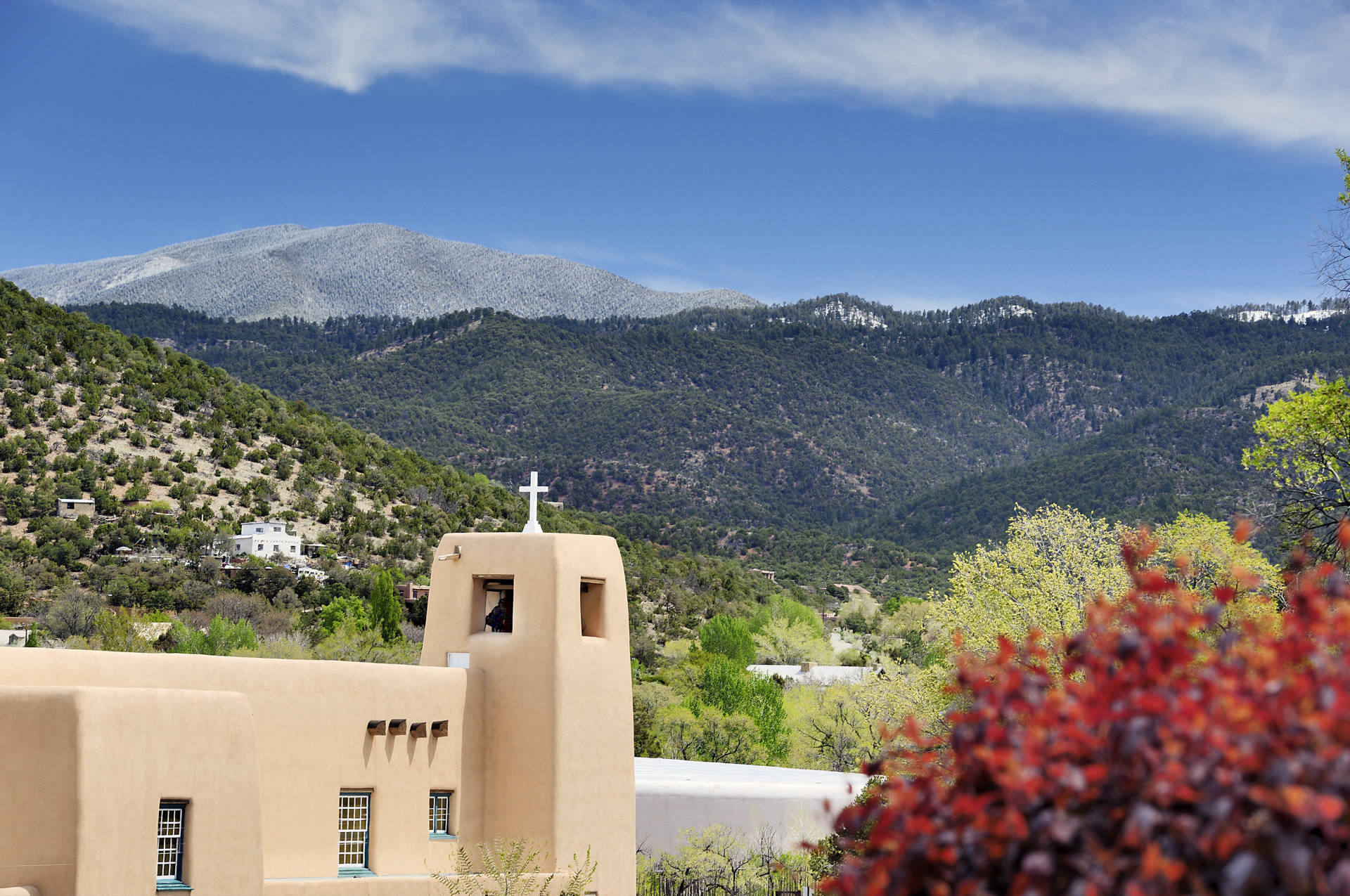
The elevation gain matters. Many Upper Eastside homes sit several hundred feet above the basin floor, with views back over downtown Santa Fe toward the Jemez Mountains in the west. The hillside terrain shapes everything about the neighborhood’s character.
A brief history
For most of Santa Fe’s history, the country east of St. John’s was undeveloped foothill terrain, too steep for agriculture and too remote for early residential development. St. John’s College itself opened on its current campus in 1964, after relocating from Annapolis to a sister campus in Santa Fe, and the surrounding residential development followed in stages from the 1960s onward. The first wave of hillside estate construction came in the 1970s and 1980s, accelerating as view-quality lots became more sought-after through the 1990s and 2000s.
The neighborhood does not have the centuries of layered occupation that characterize the Historic East Side. What you find instead is residential architecture from the past sixty years, substantially newer than central Santa Fe, with a higher concentration of contemporary and contemporary-traditional designs.
Architecture: view-driven contemporary
The architectural character is shaped by the views and the hillside terrain. Most Upper Eastside homes are designed to capture and frame the long views west over the basin: large windows, glass-heavy living spaces, outdoor terraces that step down the slope. The style language is typically custom contemporary or contemporary-traditional, with adobe-influenced massing and earth-toned exteriors that read as Northern New Mexico but with distinctly modern interior planning.
Older traditional adobe homes exist on the corridor (a handful predate the major build-out of the area), but the prevailing aesthetic is post-1970 design that treats the foothill setting as a primary feature. Hacienda del Cielo and the various Camino de Cruz Blanca compound properties are representative examples. Lot sizes vary with the topography: hillside lots tend to be larger to accommodate driveway access and septic systems, with two to five acres common on the more rural portions of the corridor.
Daily life
The Upper Eastside’s practical orientation is east, toward the foothills, the trails, and the National Forest, rather than west toward downtown. The Atalaya Mountain trailhead network behind St. John’s is one of the city’s best-loved walking and trail-running networks, with trails accessible directly from many Upper Eastside addresses. Hyde Park Road and the high-country hiking opportunities are a short drive. For residents who use the trails frequently, the proximity is a meaningful part of why they chose the neighborhood.
The Plaza and the central Santa Fe institutions (the New Mexico Museum of Art, the Cathedral, the Lensic) are five to ten minutes by car. Walking to the Plaza from most Upper Eastside addresses is theoretically possible but practically unusual; the elevation gain on the return trip discourages it. For walkable downtown access, the Historic East Side remains the natural choice.
Who buys on the Upper Eastside
View buyers are the dominant segment. The Upper Eastside delivers a quality of view (long, layered, sunset-oriented) that almost nothing else in central Santa Fe can match. Estate buyers looking for newer construction on larger lots than the Historic East Side allows find the Upper Eastside a natural fit. Outdoor-oriented buyers (runners, hikers, mountain bikers) choose the neighborhood for the trail access. Some buyers come from the Historic East Side specifically, trading walkability for view quality and newer construction.
The neighborhood is less suited to buyers who specifically want walkable urban living or who prioritize historic-character architecture. Both of those use cases point back to the Historic East Side or Canyon Road.
Market dynamics
Upper Eastside inventory is thin in any given year. The neighborhood’s lot count is finite (the topography and the Forest boundary cap the total number of properties), and turnover is slow. Pricing reflects both the lot quality (size, view, slope) and the home itself. Entry-level Upper Eastside properties typically open above $2 million. The majority of recent transactions have been in the three-to-six-million range. Premier estate properties on the best view lots reach considerably higher.
Webster Estates and the Upper Eastside
Webster Estates has handled significant Upper Eastside transactions on Camino de Cruz Blanca and the surrounding streets. The full list of available and recently sold Upper Eastside properties is on the Upper Eastside market archive. For buyers comparing the Upper Eastside to the Historic East Side proper, Webster Santa Fe’s Historic East Side guide offers useful context on the lower-elevation portion of the city’s east side.