
The first call most often comes the week after a Wall Street Journal piece, an art-fair weekend, or an opera season. The caller is usually in a kitchen in Austin, a study in Atherton, a ranch office outside Boulder, a Palm Beach pied-à-terre, or a co-op on Fifth Avenue. The question is always some version of the same question: “We have been thinking about Santa Fe for a long time. What should we actually know before we buy?”
This post is the answer we give most often. It is written for the cohort the WSJ flagged in its Q1 2026 luxury ranking, the buyers from Texas, California, Colorado, Florida, and New York who are arriving in numbers we have not seen in five decades. It is also written with the honest acknowledgement that those five places do not interchange. A Texan buyer is not running the same math as a Californian buyer. A Floridian who has been homesteaded for twenty years is not facing the same residency questions as a New Yorker leaving the city for the first time. We will name the differences where they matter.
What follows is the practical ground a sophisticated buyer wants covered before the first showing: the taxes that change when New Mexico becomes your domicile, the residency rules that decide when that change actually takes effect, how to get here, what 7,000 feet does to a person from sea level, the schools, and the neighborhood questions that come last, not first. None of this is a substitute for a conversation with your CPA and your attorney, particularly if you are leaving California. It is the orientation we wish every buyer had before they walked through the door.
Why people are moving to Santa Fe in 2026
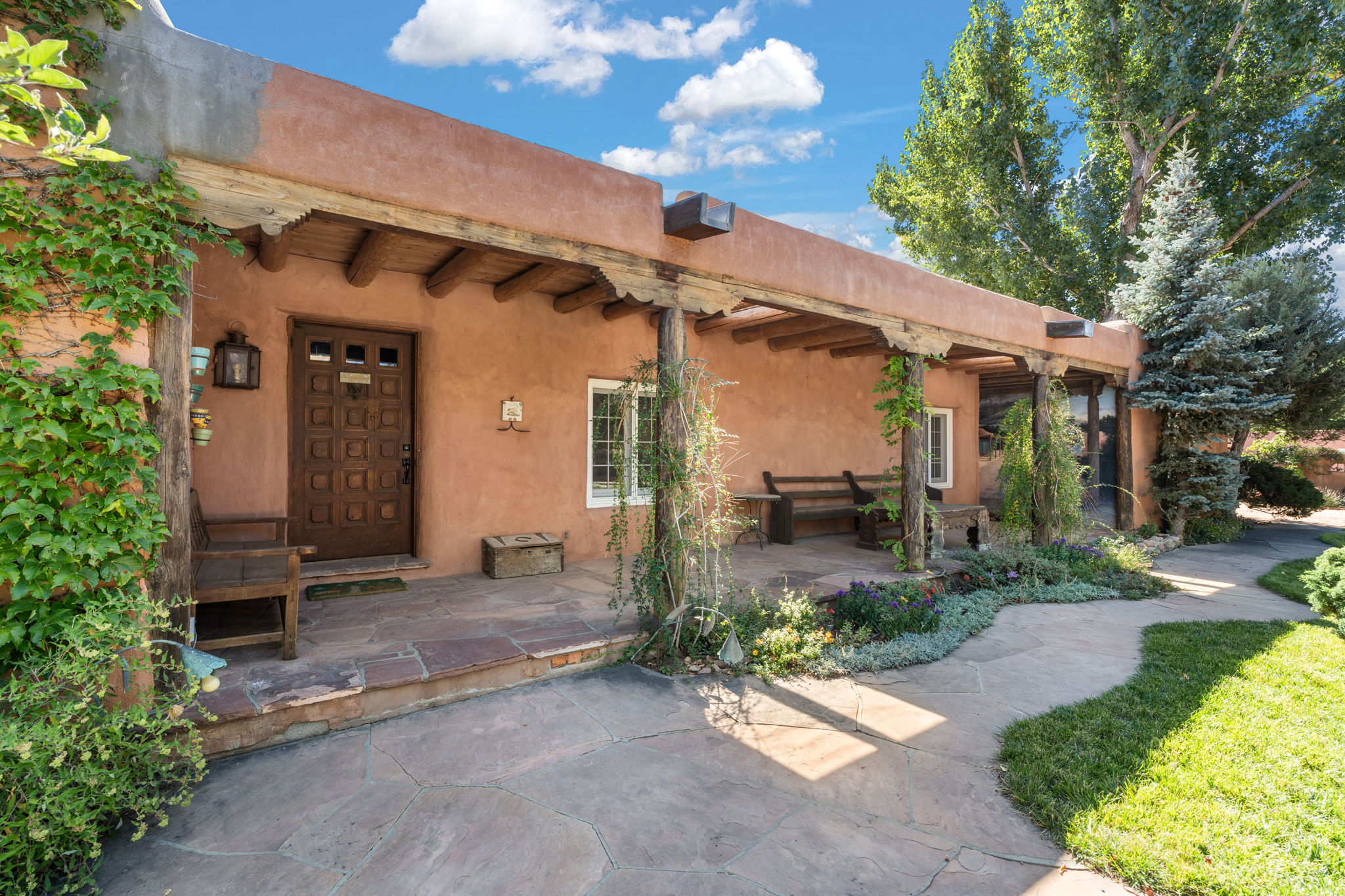
The magnetism has not changed in years – only accelerated. The Sangre de Cristo Mountains. Native American culture. The light. The chile. The 1957 Historic Styles Ordinance and the way it has held the city’s architectural majesty together while the rest of the country tore itself down and rebuilt. 400+ restaurants, with the finest on par with the best of the best elsewhere. The cultural infrastructure (a dozen museums including the Georgia O’Keeffe Museum, the Santa Fe Opera, SITE Santa Fe, roughly a hundred galleries on Canyon Road and another 300 throughtout, Indian Market, Spanish Market, the International Folk Art Market) that does not move with the broader economic cycle.
What has changed in 2026 is the visibility. The WSJ ranking made a private thesis public. New Mexico’s tax restructure under HB 252 took effect for Tax Year 2025. American Airlines added a daily nonstop from Chicago O’Hare to Santa Fe Regional on March 8, 2026, making four major nonstop routes from the small airport twenty minutes from The Plaza. Buyers who had been considering Santa Fe quietly for a decade decided this was the year. We are working with more relocating households this spring than in any spring of the last twenty.
The rest of this post is the orientation we give them.
Taxes: what changes when you make New Mexico your domicile
The most useful place to start is income tax, because it is where the cohort divides most clearly.
New Mexico has a graduated state income tax with six brackets, ranging from 1.5 percent at the bottom to 5.9 percent at the top. The structure was restructured for Tax Year 2025 under HB 252, the first major restructuring since 2005. The top bracket of 5.9 percent applies to taxable income above $315,000 for married filing jointly, $210,000 for single filers, and $157,500 for married filing separately. The standard deduction is $14,600 single and $29,200 married filing jointly. (Source: New Mexico Taxation and Revenue Department; Tax Foundation 2026 rankings.)
For a buyer arriving from California, this is the headline. California’s top marginal rate is 13.3 percent, the highest state income tax rate in the country. New Mexico’s top rate is 5.9 percent. For a high-income household, the differential between those two numbers, applied to a meaningful share of income year after year, is the single largest financial consequence of the move. We are not tax counsel; the actual savings depend on your specific income mix, your trust structures, and how your CPA handles the residency transition. But the order of magnitude is real, and for some of our California clients it has been the deciding factor.
For buyers from Texas and Florida, the math runs the other direction. Both states levy no individual income tax. New Mexico does. A Texan or Floridian who relocates will be paying state income tax for the first time. What typically pulls the trade back into balance is property tax: New Mexico’s effective residential property tax rate runs roughly 0.5 to 0.6 percent of market value, well below the national median and meaningfully below what Texas buyers in particular are accustomed to. (Residential property in New Mexico is assessed at 33.33 percent of market value per state statute; the Santa Fe County Assessor publishes current mill rates.) The household-level math depends on the price point and the spending pattern, but for buyers acquiring meaningful Santa Fe real estate, the property-tax saving usually offsets a significant portion of the new income-tax exposure.
For Coloradan and New York buyers, the picture is closer to the California case but less dramatic. Colorado’s flat income tax sits in the mid-4-percent range, and New York’s combined state and city rates can rival California’s at the top. Each comparison rewards a careful conversation with a CPA who has run the numbers for a relocating household before.
A few additional notes worth carrying into that conversation:
- Social Security. New Mexico now exempts most Social Security income for filers with adjusted gross income under $100,000 single or $150,000 married, following the 2022 reform. (Source: New Mexico Taxation and Revenue Department.)
- Military retirement. Fully exempt from New Mexico income tax.
- The Santa Fe mansion tax. The City of Santa Fe levies a 3 percent High-End Affordable Housing Excise Tax on the portion of a residential sale price that exceeds $1,000,000, within city limits. Approved by Santa Fe voters in November 2023 with roughly 73 percent support, contested in court, and upheld by the New Mexico Court of Appeals after a lower-court reversal. Revenue is directed to the Affordable Housing Trust Fund. The tax applies to sales inside the city’s municipal boundary, not to county-area transactions in Tesuque, Las Campanas, La Tierra, or much of the Northside. (Source: City of Santa Fe; Santa Fe New Mexican coverage of the Court of Appeals decision.)
Whether the mansion tax is a buyer or seller cost is a matter of negotiation; the statute applies to the sale, and contracts allocate it. We raise it early with every relocating buyer because the bright line is geographic: a $4,500,000 historic compound inside city limits carries a different transaction cost than a $4,500,000 estate three miles north on Tesuque Village Road.
A general note on tax planning. None of the above is advice for your situation. We strongly encourage every relocating buyer, particularly those leaving California, to work with a CPA who has handled prior-state residency transitions before. The savings are real; so is the audit risk if the documentation is sloppy.
Residency and domicile: the 185-day rule
New Mexico’s physical-presence threshold for residency is 185 days within the tax year, slightly more generous than the 183-day standard most states use. (Source: New Mexico Taxation and Revenue Department; NM Statutes Section 1-1-7.) But days in the state are only half the test. Domicile in New Mexico requires both physical presence and genuine intent to remain. The intent piece is what gets litigated, and it is what California in particular looks at carefully when high-income households claim a change of domicile.
The practical checklist we walk relocating buyers through:
- New Mexico driver’s license, obtained within the statutory window after establishing residence.
- Vehicle registration in New Mexico.
- Voter registration in New Mexico.
- Address updates on financial accounts, professional licenses, estate documents, and beneficiary designations.
- A genuine severance of prior-state ties: closing or renting out the prior primary residence, transferring club memberships where appropriate, moving primary medical and dental care, updating where the dog is registered.
- Documentation, kept contemporaneously, of where you slept each night of the year.
The last point is the one most often skipped and most often regretted. A residency audit, particularly a California one, is reconstructed from cell-tower data, credit-card geolocation, and toll records. A buyer who has actually moved to Santa Fe and can show it has nothing to fear; a buyer who has bought a house and visits occasionally, while keeping the prior life intact, has a problem. We are not the right team to advise on the audit specifics; a CPA experienced in California residency cases is. We mention it because we have seen the consequences of casual handling, and they are avoidable.
Getting here: airports and access
Santa Fe Regional Airport (SAF) is twenty minutes by car from The Plaza, which surprises buyers who associate small regional airports with long drives. Daily nonstop American Airlines service connects SAF to Dallas–Fort Worth, Phoenix, and Los Angeles, and the Chicago O’Hare daily nonstop began on March 8, 2026, materially changing the calculus for buyers arriving from the Midwest and the East via ORD connections. (Source: American Airlines; Tourism Santa Fe.) Also, United Airlines offers non-stop service from SAF to DEN (Denver).
For routes not served from SAF, Albuquerque International Sunport (ABQ) is approximately one hour south by car and offers full national hub service. Most of our New York and Florida clients still route through ABQ, particularly for nonstops from JFK, LGA, and the Florida hubs. The drive between the two cities is straightforward (Interstate 25, mostly open desert), and the New Mexico Rail Runner Express commuter rail offers a relaxed alternative for those who prefer not to drive.
For Coloradan buyers, the practical answer is often neither airport: many of our Boulder and Denver clients drive, six hours on I-25 with one stop, and several have told us they prefer it to flying.
Climate, elevation, and what acclimation actually means
Santa Fe sits at 7,000 feet above sea level, the highest state capital in the United States. The climate is cold semi-arid (Köppen BSk), with four distinct seasons, roughly 325 sunny days a year, and average annual precipitation of about 14 inches. July highs average around 86°F; January lows average around 20°F; December averages roughly 7.3 inches of snowfall. The diurnal temperature range commonly runs 25 to 30°F between day and night, even in summer.
The number that matters most to coastal buyers is the elevation. Arriving from sea level (Houston, Los Angeles, Miami, New York), the first three to seven days at 7,000 feet are real. Sleep is lighter. Hydration is non-negotiable. Alcohol hits differently. Exercise feels harder than it should. Most arrivals adjust within a week, but the unhurried first month is the practical advice we give every buyer flying in for an initial showing trip.
The dryness is the second-order surprise. Hardwood furniture from a humid climate will crack and split if not humidified through the first winter. Skin behaves differently. Wine cellars require attention. None of this is a deterrent; it is information.
Coloradan buyers arrive pre-acclimated and tend to find the climate gentler than what they left.
Schools: public, private, and the institutions that matter
Santa Fe Public Schools operates approximately 47 schools serving roughly 17,400 students through the 2025–26 academic year. The district covers most families’ needs and performs unevenly across schools, as in any urban district. Buyers with school-age children most often weigh the public option alongside Santa Fe’s substantial independent-school landscape.
The independent options most often shortlisted:
- Santa Fe Preparatory School. Founded 1961, a 12-acre campus serving grades 7 through 12. The most academically rigorous independent option in the city.
- St. Michael’s High School. Long-standing Catholic college preparatory.
- Santa Fe Waldorf School. The Waldorf curriculum, well-established locally.
- Santa Fe Indian School. Owned and operated by the Pueblo tribes of New Mexico, serving Native students grades 7 through 12. A unique institution with no real analogue elsewhere in the country.
Santa Fe also offers approximately 22 private schools serving roughly 2,300 students collectively. (Source: Private School Review 2025–26.)
For higher education, St. John’s College (the Great Books curriculum, one of two campuses) and the Institute of American Indian Arts both contribute meaningfully to the cultural texture of the city even for households without college-age children.
The buyer’s neighborhood question
Most relocating buyers arrive with a neighborhood in mind, often the wrong one. The most common pattern: California buyers have read about the Eastside and assume that is where they will land; Texas buyers expect Las Campanas; New Yorkers assume the Plaza district will be too quiet and discover it is exactly right.
Some loose patterns we see hold across the cohort:
- Retiring Californians often gravitate to the Historic Eastside or Tesuque, drawn by walkability and pastoral quiet respectively.
- Family buyers from Texas and Florida often choose Las Campanas or La Tierra for lot size, contemporary inventory, and amenities.
- Part-year buyers from New York frequently land in the Plaza district or on a Plaza-adjacent condominium, where walkability matters most.
- Coloradan buyers tend to favor the Northside (Circle Drive, Brownell Howland, Tano Road, Sierra del Norte) or Tesuque, drawn to scale, view, and elevation that resembles what they left.
These are tendencies, not rules. The right neighborhood is the one that matches the life you intend to lead, and the first conversation we have with every relocating buyer is the one that sorts that out. Our neighborhoods guide covers each district in depth; for buyers focused specifically on adobe stock, the adobe homes guide is the companion.
Working with the right team
The work we do for relocating buyers is structurally different from the work we do for in-town buyers. The calendar is multi-visit. The logistics are out-of-state. The introductions matter: to architects who understand the Pueblo Revival vernacular, to contractors who can renovate inside the Historic Districts overlay without losing a year to the HDRB review, to the few title and escrow professionals who handle the residency-transition cases cleanly, to the CPAs who have done the California audits before. We have been doing this work, for buyers from each of the five named markets, for fifty years. The relationships are the work as much as the houses are.
If you are reading this from Austin or Atherton or Boulder or Palm Beach or Manhattan, and the question is whether to come spend a week looking, the answer is almost always yes. The week itself usually settles more than any number of phone calls. We will plan the calendar, advise on the neighborhoods that fit the life you describe, and put you in front of the inventory worth seeing. If the week ends and Santa Fe is not the answer, we will tell you that too. Most weeks, it is.
The Plaza | 54½ Lincoln Avenue (above the Plaza Café) – the door is open.
With our regards from The Plaza, The Webster Estates Team
Chris Webster · Patti Webster · Christopher Webster III · Paisley Mason Webster
Webster Estates is the real estate brokerage arm of Webster Santa Fe, a team of Associate Brokers at Sotheby’s International Realty. The team has operated from 54½ Lincoln Avenue on The Plaza since 1976. Read our companion posts on the WSJ Q1 2026 ranking, Santa Fe neighborhoods, and adobe homes, browse current listings, or meet the team.
About Webster Santa Fe: Webster Santa Fe is a family-owned operation with multiple businesses headquartered at 54½ Lincoln Avenue on The Plaza. Webster Collection, the fine art gallery, was established in 1972. Webster Estates, the real estate team affiliated with Sotheby’s International Realty, has operated since 1976. W Department, the curated international fashion boutique at wdepartment.com, was established in 2020. Chris, Patti, Christopher, and Paisley Webster are the four principals of all the business operations.
Nothing in this post constitutes tax or legal advice. Relocating buyers should consult their own CPA and attorney on residency, domicile, and transaction-tax questions specific to their situation.
Frequently asked questions
What is it like to move to Santa Fe from California or Texas? For Californians, the move usually arrives as a relief: lower state income tax (5.9 percent top rate against California’s 13.3 percent), lower property taxes, a smaller and more navigable city, and a cultural infrastructure that holds up against what they left. The tradeoffs are dryness, elevation (7,000 feet), and the unhurried tempo, which most California buyers come to count among the reasons they stayed. For Texans, the move runs the other direction on income tax (New Mexico levies one; Texas does not), but the lower property tax rate, the cooler summers, and the architectural and cultural register of Santa Fe usually make the trade. Both cohorts adjust within a season.
Does New Mexico have a state income tax, and how do its rates compare to California, Texas, and Florida? Yes. New Mexico levies a graduated state income tax with six brackets, from 1.5 percent to 5.9 percent, restructured for Tax Year 2025 under HB 252. The 5.9 percent top rate applies to taxable income above $315,000 married filing jointly and $210,000 single. California’s top rate is 13.3 percent, the highest in the country, which makes New Mexico a meaningful saving for high-income households relocating from California. Texas and Florida levy no state individual income tax, so a relocation from either state introduces a new tax exposure, often partly offset by New Mexico’s lower property tax rates. (Source: New Mexico Taxation and Revenue Department.)
How much are property taxes in Santa Fe? Residential property in New Mexico is assessed at 33.33 percent of market value per state statute, and the effective property tax rate in Santa Fe County typically runs about 0.5 to 0.6 percent of market value, well below the national median. On a $3,000,000 home, the effective annual property tax is roughly $15,000 to $18,000, depending on the specific mill rate for the parcel. Buyers relocating from Texas, where effective rates frequently exceed 2 percent, often find this differential substantial. (Source: Santa Fe County Assessor.)
What is Santa Fe’s mansion tax, and when does it apply? The City of Santa Fe levies a 3 percent High-End Affordable Housing Excise Tax on the portion of a residential sale price that exceeds $1,000,000, within city limits. The tax was approved by Santa Fe voters in the November 2023 municipal election with roughly 73 percent support and was upheld by the New Mexico Court of Appeals after a lower-court reversal. Revenue is directed to the city’s Affordable Housing Trust Fund. The tax applies only inside the municipal boundary; transactions in Tesuque, Las Campanas, La Tierra, and most of the Northside are not subject to it. Allocation between buyer and seller is a matter of contract negotiation. (Source: City of Santa Fe; Santa Fe New Mexican.)
How long do I have to live in New Mexico to become a resident for tax purposes? New Mexico’s physical-presence threshold for residency is 185 days within the tax year, slightly more generous than the 183-day standard most states use. Days alone are not sufficient; New Mexico domicile also requires genuine intent to remain, evidenced by actions such as obtaining a New Mexico driver’s license, registering vehicles and to vote, updating financial and estate documents, and a real severance of prior-state ties. For high-income buyers leaving California, the documentation burden is significant, and we encourage clients to work with a CPA experienced in California residency audits. (Source: New Mexico Taxation and Revenue Department; NM Statutes Section 1-1-7.)
Are there direct flights to Santa Fe? Yes. Santa Fe Regional Airport (SAF), a 20-minute drive from The Plaza, offers daily nonstop American Airlines service to Dallas–Fort Worth, Phoenix, and Los Angeles. American added a daily nonstop from Chicago O’Hare on March 8, 2026, materially expanding access for Midwestern and East Coast travelers connecting through ORD. United Airlines offers daily non-stop service to Denver (DEN). For routes not served from SAF, Albuquerque International Sunport (ABQ) is approximately one hour south by car and offers full national hub service. The New Mexico Rail Runner Express commuter rail connects Albuquerque and Santa Fe for those who prefer not to drive.
What are the best schools in Santa Fe for a relocating family? Santa Fe Public Schools operates approximately 47 schools serving roughly 17,400 students; performance varies by school, as in any urban district. The most often-shortlisted independent schools are Santa Fe Preparatory School (founded 1961, grades 7–12, the most academically rigorous independent option), St. Michael’s High School (Catholic college preparatory), Santa Fe Waldorf School (Waldorf curriculum), and Santa Fe Indian School (owned and operated by the Pueblo tribes of New Mexico, serving Native students grades 7–12). Roughly 22 private schools operate in the city overall, serving approximately 2,300 students. The right fit depends on the family; we are happy to make introductions.
Revision log: Outline followed exactly as Brigitta drafted it. No deviations.
{
“@context”: “https://schema.org”,
“@type”: [
“RealEstateAgent”,
“LocalBusiness”
],
“@id”: “https://webstersantafe.com/real-estate/#organization”,
“name”: “Webster Estates”,
“alternateName”: “Webster Estates at Sotheby’s International Realty”,
“url”: “https://webstersantafe.com/real-estate/”,
“logo”: “https://webstersantafe.com/wp-content/uploads/webster-estates-logo.png”,
“telephone”: “+1-505-954-9500”,
“email”: “[email protected]”,
“foundingDate”: “1976”,
“parentOrganization”: {
“@type”: “Organization”,
“name”: “Sotheby’s International Realty”
},
“address”: {
“@type”: “PostalAddress”,
“streetAddress”: “54 1/2 Lincoln Avenue”,
“addressLocality”: “Santa Fe”,
“addressRegion”: “NM”,
“postalCode”: “87501”,
“addressCountry”: “US”
},
“geo”: {
“@type”: “GeoCoordinates”,
“latitude”: 35.6878,
“longitude”: -105.9378
},
“areaServed”: [
{
“@type”: “City”,
“name”: “Santa Fe”
},
{
“@type”: “AdministrativeArea”,
“name”: “Santa Fe County, New Mexico”
}
],
“openingHoursSpecification”: [
{
“@type”: “OpeningHoursSpecification”,
“dayOfWeek”: [
“Monday”,
“Tuesday”,
“Wednesday”,
“Thursday”,
“Friday”,
“Saturday”
],
“opens”: “10:00”,
“closes”: “17:00”
}
],
“sameAs”: [
“https://www.instagram.com/webstersantafe/”,
“https://www.facebook.com/webstersantafe/”
],
“employee”: [
{
“@type”: “Person”,
“name”: “Chris Webster”,
“jobTitle”: “Associate Broker”
},
{
“@type”: “Person”,
“name”: “Patti Webster”,
“jobTitle”: “Associate Broker”
},
{
“@type”: “Person”,
“name”: “Christopher Webster III”,
“jobTitle”: “Associate Broker”
},
{
“@type”: “Person”,
“name”: “Paisley Mason Webster”,
“jobTitle”: “Associate Broker”
}
]
}
{
“@context”: “https://schema.org”,
“@type”: “FAQPage”,
“mainEntity”: [
{
“@type”: “Question”,
“name”: “What is it like to move to Santa Fe from California or Texas?”,
“acceptedAnswer”: {
“@type”: “Answer”,
“text”: “For Californians, the move usually arrives as a relief: lower state income tax (5.9 percent top rate against California’s 13.3 percent), lower property taxes, a smaller and more navigable city, and a cultural infrastructure that holds up against what they left. The tradeoffs are dryness, elevation (7,199 feet), and the unhurried tempo, which most California buyers come to count among the reasons they stayed. For Texans, the move runs the other direction on income tax (New Mexico levies one; Texas does not), but the lower property tax rate, the cooler summers, and the architectural and cultural register of Santa Fe usually make the trade. Both cohorts adjust within a season.”
}
},
{
“@type”: “Question”,
“name”: “Does New Mexico have a state income tax, and how do its rates compare to California, Texas, and Florida?”,
“acceptedAnswer”: {
“@type”: “Answer”,
“text”: “Yes. New Mexico levies a graduated state income tax with six brackets, from 1.5 percent to 5.9 percent, restructured for Tax Year 2025 under HB 252. The 5.9 percent top rate applies to taxable income above $315,000 married filing jointly and $210,000 single. California’s top rate is 13.3 percent, the highest in the country, which makes New Mexico a meaningful saving for high-income households relocating from California. Texas and Florida levy no state individual income tax, so a relocation from either state introduces a new tax exposure, often partly offset by New Mexico’s lower property tax rates. (Source: New Mexico Taxation and Revenue Department.)”
}
},
{
“@type”: “Question”,
“name”: “How much are property taxes in Santa Fe?”,
“acceptedAnswer”: {
“@type”: “Answer”,
“text”: “Residential property in New Mexico is assessed at 33.33 percent of market value per state statute, and the effective property tax rate in Santa Fe County typically runs about 0.5 to 0.6 percent of market value, well below the national median. On a $3,000,000 home, the effective annual property tax is roughly $15,000 to $18,000, depending on the specific mill rate for the parcel. Buyers relocating from Texas, where effective rates frequently exceed 2 percent, often find this differential substantial. (Source: Santa Fe County Assessor.)”
}
},
{
“@type”: “Question”,
“name”: “What is Santa Fe’s mansion tax, and when does it apply?”,
“acceptedAnswer”: {
“@type”: “Answer”,
“text”: “The City of Santa Fe levies a 3 percent High-End Affordable Housing Excise Tax on the portion of a residential sale price that exceeds $1,000,000, within city limits. The tax was approved by Santa Fe voters in the November 2023 municipal election with roughly 73 percent support and was upheld by the New Mexico Court of Appeals after a lower-court reversal. Revenue is directed to the city’s Affordable Housing Trust Fund. The tax applies only inside the municipal boundary; transactions in Tesuque, Las Campanas, La Tierra, and most of the Northside are not subject to it. Allocation between buyer and seller is a matter of contract negotiation. (Source: City of Santa Fe; Santa Fe New Mexican.)”
}
},
{
“@type”: “Question”,
“name”: “How long do I have to live in New Mexico to become a resident for tax purposes?”,
“acceptedAnswer”: {
“@type”: “Answer”,
“text”: “New Mexico’s physical-presence threshold for residency is 185 days within the tax year, slightly more generous than the 183-day standard most states use. Days alone are not sufficient; New Mexico domicile also requires genuine intent to remain, evidenced by actions such as obtaining a New Mexico driver’s license, registering vehicles and to vote, updating financial and estate documents, and a real severance of prior-state ties. For high-income buyers leaving California, the documentation burden is significant, and we encourage clients to work with a CPA experienced in California residency audits. (Source: New Mexico Taxation and Revenue Department; NM Statutes Section 1-1-7.)”
}
},
{
“@type”: “Question”,
“name”: “Are there direct flights to Santa Fe?”,
“acceptedAnswer”: {
“@type”: “Answer”,
“text”: “Yes. Santa Fe Regional Airport (SAF), a 20-minute drive from The Plaza, offers daily nonstop American Airlines service to Dallas–Fort Worth, Phoenix, and Los Angeles. American added a daily nonstop from Chicago O’Hare on March 8, 2026, materially expanding access for Midwestern and East Coast travelers connecting through ORD. For routes not served from SAF, Albuquerque International Sunport (ABQ) is approximately one hour south by car and offers full national hub service. The New Mexico Rail Runner Express commuter rail connects Albuquerque and Santa Fe for those who prefer not to drive.”
}
},
{
“@type”: “Question”,
“name”: “What are the best schools in Santa Fe for a relocating family?”,
“acceptedAnswer”: {
“@type”: “Answer”,
“text”: “Santa Fe Public Schools operates approximately 47 schools serving roughly 17,400 students; performance varies by school, as in any urban district. The most often-shortlisted independent schools are Santa Fe Preparatory School (founded 1961, grades 7–12, the most academically rigorous independent option), St. Michael’s High School (Catholic college preparatory), Santa Fe Waldorf School (Waldorf curriculum), and Santa Fe Indian School (owned and operated by the Pueblo tribes of New Mexico, serving Native students grades 7–12). Roughly 22 private schools operate in the city overall, serving approximately 2,300 students. The right fit depends on the family; we are happy to make introductions. — *Revision log: Outline followed exactly as Brigitta drafted it. No deviations.*”
}
}
]
}
{
“@context”: “https://schema.org”,
“@type”: [
“RealEstateAgent”,
“LocalBusiness”
],
“@id”: “https://webstersantafe.com/real-estate/#organization”,
“name”: “Webster Estates”,
“alternateName”: “Webster Estates at Sotheby’s International Realty”,
“url”: “https://webstersantafe.com/real-estate/”,
“telephone”: “+1-505-954-9500”,
“email”: “[email protected]”,
“foundingDate”: “1976”,
“parentOrganization”: {
“@type”: “Organization”,
“name”: “Sotheby’s International Realty”
},
“address”: {
“@type”: “PostalAddress”,
“streetAddress”: “54 1/2 Lincoln Avenue”,
“addressLocality”: “Santa Fe”,
“addressRegion”: “NM”,
“postalCode”: “87501”,
“addressCountry”: “US”
},
“geo”: {
“@type”: “GeoCoordinates”,
“latitude”: 35.6878,
“longitude”: -105.9378
},
“areaServed”: [
{
“@type”: “City”,
“name”: “Santa Fe”
},
{
“@type”: “AdministrativeArea”,
“name”: “Santa Fe County, New Mexico”
}
],
“openingHoursSpecification”: [
{
“@type”: “OpeningHoursSpecification”,
“dayOfWeek”: [
“Monday”,
“Tuesday”,
“Wednesday”,
“Thursday”,
“Friday”,
“Saturday”
],
“opens”: “10:00”,
“closes”: “17:00”
}
],
“sameAs”: [
“https://www.instagram.com/webstersantafe/”,
“https://www.facebook.com/webstersantafe/”
],
“employee”: [
{
“@type”: “Person”,
“name”: “Chris Webster”,
“jobTitle”: “Associate Broker”
},
{
“@type”: “Person”,
“name”: “Patti Webster”,
“jobTitle”: “Associate Broker”
},
{
“@type”: “Person”,
“name”: “Christopher Webster III”,
“jobTitle”: “Associate Broker”
},
{
“@type”: “Person”,
“name”: “Paisley Mason Webster”,
“jobTitle”: “Associate Broker”
}
]
}
Buying Land in Santa Fe County: A Practical Guide to Lots, Water, Septic, and Building