
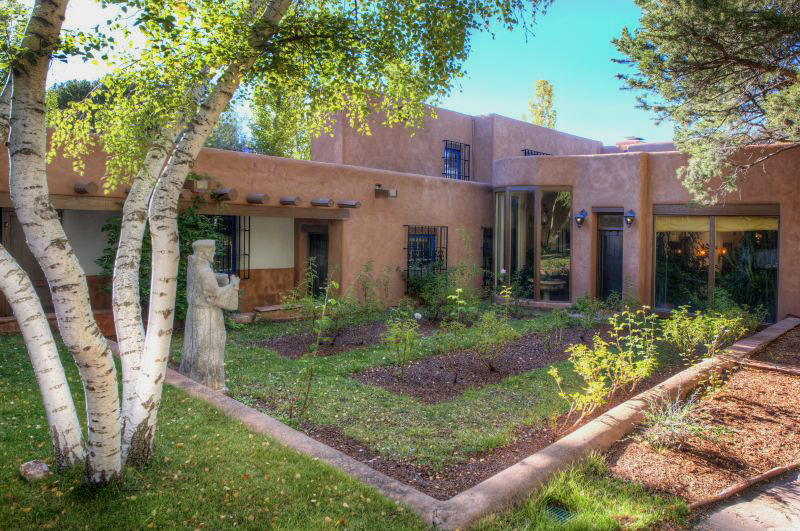
A standard home inspection report is built for a wood-frame house in a humid climate. In Santa Fe, that checklist misses about half of what actually matters. An adobe wall does not behave like a 2×4 wall. A flat parapet roof does not fail the way an asphalt-shingle gable fails. A house at 7,000 feet, with 300 days of intense sun and freeze-thaw cycles from October through April, ages on a different timeline than a house in Phoenix or Denver. If you are buying here, the inspection is where you find out what you are actually getting into — and the questions you should be asking are specific to this place.
Below is a practical walk-through of what to look at, what to ask, and where standard inspection language quietly glosses over local realities.
Start at the roof, because almost everything starts at the roof
Most Santa Fe homes have flat or low-slope roofs with parapet walls and canales — the metal or wooden scuppers that drain water off the roof and away from the building. After summer monsoons, pooled water and clogged canales are the single most common source of expensive damage. Ask your inspector to walk the roof (not just look from a ladder) and check three things: the condition and slope of the roof membrane, the flashing at every parapet wall and roof penetration, and whether the canales actually direct water clear of the stucco below. Long vertical stains on an exterior wall under a canale outlet are a clue that water has been hitting the wall rather than launching past it.
Parapets themselves are a Santa Fe-specific maintenance item. Because they sit horizontally on top of the wall and take weather from every direction, parapet stucco cracks more often than wall stucco — and when it cracks, the building paper underneath is exposed. Ask whether the parapets have been re-stuccoed or capped in the last five to ten years.
Find out what the walls are actually made of
This is the single most useful question a buyer can ask before going under contract, and a surprising number of listings are vague about it. A house in Santa Fe styled in the Pueblo Revival tradition can be one of three very different things:
- Single or double adobe — actual mud bricks, often 10 to 24 inches thick, sometimes a hundred years old or more. Heavy thermal mass, slow to heat and slow to cool, requires adobe-literate maintenance.
- Frame with stucco — standard wood framing with stucco on the outside, designed to look like adobe. Lighter, faster to build, behaves like a conventional house under inspection.
- Hybrid — original adobe portion with frame additions, very common in older homes that have been added onto over decades.
A seller or listing agent who hedges on this answer is a signal to dig deeper. The difference matters for insurance, for maintenance budget, and for the kind of inspector you should hire. If part of the house is true adobe, the inspector needs to understand earthen-wall behavior — moisture, settling, lintel condition, and the way adobe walls move with the seasons.
Stucco cracks: which ones matter, which ones do not
Every adobe-style home in Santa Fe has stucco cracks. Hairline cracks running along the surface are normal — the building expands and contracts with the seasons, and the cracks are how the material breathes. They are almost always cosmetic and not a sign of failure.
The cracks that matter are different:
- Diagonal cracks at the corners of windows and doors. These can indicate foundation movement or settling beyond what is normal.
- Horizontal cracks along the bottom two feet of an exterior wall. Often a sign of moisture wicking up from the ground.
- Bulging, hollow-sounding stucco, or visible efflorescence — the white powdery residue that means water has been moving through the wall.
- Cracks on parapets and horizontal surfaces. Stucco does not perform well on horizontal planes, and parapet cracks often expose the waterproofing layer underneath.
One more nuance worth raising: Portland cement stucco applied directly over true adobe traps moisture in the wall, because cement is less permeable than the mud or lime plasters adobe was designed to breathe through. If the home is genuine adobe with modern cement stucco, ask when it was applied and whether there has been any record of moisture problems since.
Look up: vigas, latillas, and lintels
Vigas are the heavy ponderosa-pine beams that span the ceiling in traditional Santa Fe homes; latillas are the smaller poles, often peeled aspen or cedar, laid across them. Both are real structural elements in many older houses, not decoration. Where viga ends project through the exterior wall, they are exposed to sun, rain, and snow on three sides — which makes them a known weak point for rot and insect damage.
Ask the inspector to check viga ends both from the outside (looking for cracking, softness, fungal staining, or evidence of past patching) and from the inside (looking at the ceiling around viga penetrations for water stains). Lintels — the wood headers above doors and windows — should be evaluated the same way. In a house where the vigas are decorative half-rounds rather than structural beams, this matters less, but you want to know which kind you have.
The wall base, the ground line, and drainage
For an adobe house, the bottom two feet of an exterior wall is where most failure begins. Ground moisture wicks up. Sprinkler systems pointed at the wall cause more damage than weather does. A planter built directly against an adobe wall is, over years, an excavation project waiting to happen.
Walk the perimeter with the inspector. Look for grade that slopes away from the foundation, for irrigation heads aimed at the wall, for plaster discoloration or erosion right at the base. On older homes, ask whether the wall has a moisture barrier or a stem-wall foundation under it — many of the oldest adobe homes in town do not, and that is a maintenance reality, not necessarily a deal-breaker, as long as you know.
Radon, well water, and septic — the things outside the standard report
Santa Fe County sits in EPA Radon Zone 1, the highest risk category, which means average indoor radon readings here are predicted above the 4 pCi/L action level. A short-term radon test is inexpensive and worth including as a line item on every inspection, whether you are buying in the historic core or out in Eldorado.
If the property is on a well, add a water-quality test for bacteria, nitrates, and heavy metals — wells outside the city service area can have any of those depending on the surrounding land use. If it is on septic, get a separate septic inspection that includes a tank pump-out and a leach-field evaluation. These are not optional for a property that depends on them, and a standard home inspector usually will not perform either one — they will recommend specialists.
Portals, coyote fences, and the things that look great but rot
Two visual signatures of Santa Fe homes — covered portals (front and rear porches built into the structure) and coyote fences (vertical latilla privacy fences) — are also two of the highest-maintenance exterior features. Sun degrades softwood fast at this elevation. Portal posts and beams should be checked at the base, where they meet flagstone or concrete, for soft wood and insect damage. Coyote fences with proper preservative and pressure-treated wood can last 15 to 20 years; untreated ones often need post replacement within five to ten.
Should you hire a regular home inspector or an adobe specialist?
For a frame-with-stucco home built in the last 30 to 40 years, a competent general home inspector who works in Santa Fe regularly is usually enough — most local inspectors have seen plenty of pueblo-style construction. For a true adobe home, particularly one that is 50+ years old or has historic provenance, hire an inspector with explicit adobe experience, and budget for a second opinion from a structural engineer if anything in the walls, foundation, or roof system raises a question. Adobe-savvy inspectors charge more and take longer. On a multi-hundred-thousand-dollar purchase, that is the right place to spend the money.
One practical step: ask the inspector how many adobe homes they have inspected in the last year. A vague answer is itself an answer.
A short pre-inspection checklist for buyers
- Confirm the wall construction type before the inspection is scheduled.
- Ask for a roof walk, not just a ladder look.
- Add radon testing as a line item.
- If on well or septic, schedule those as separate inspections.
- Walk the perimeter looking at grade, canales, and the wall base.
- For homes older than 50 years or true adobe, hire an adobe-experienced inspector.
- Get any concerns documented in writing before the inspection-objection deadline in the purchase contract.
A home inspection in Santa Fe is not a formality. It is the moment when the romance of an adobe house meets the reality of what an adobe house costs to keep standing. Done well, it gives you a clear picture and a maintenance roadmap. Done poorly — or done by someone treating the house like a tract home — it gives you a clean report on a building that has been quietly failing for years.
Webster Estates publishes practical, locally specific guidance for buyers and sellers navigating the Santa Fe market. If you are working through an inspection report and want a second opinion on what to push on, the contractors and inspectors collected in our Santa Fe real estate resources are a good place to start — every one is someone we trust to give a straight answer about a Santa Fe property, adobe or otherwise.

Buying Land in Santa Fe County: A Practical Guide to Lots, Water, Septic, and Building