


Cafe Pasqual’s
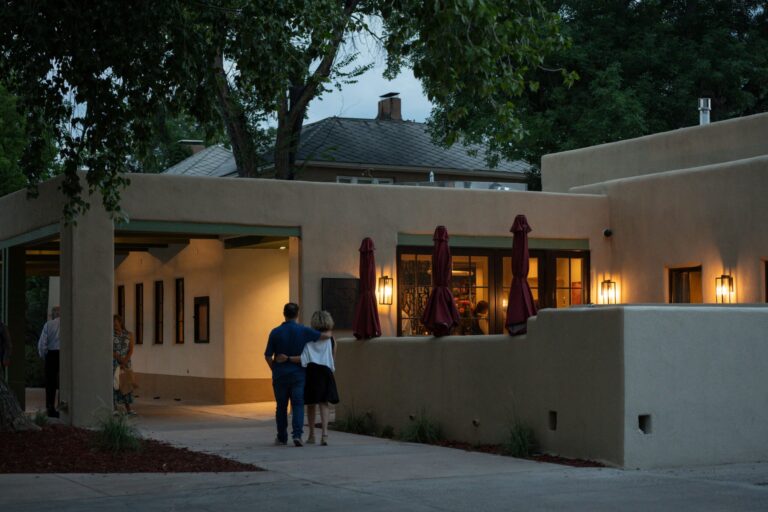
The corner of Don Gaspar and Water Street had a long habit of losing restaurants. The Liberty Cafe took it in 1923. After that the K.C. Waffle House, the Mayflower Cafe until 1970, the Golden Temple of Conscious Cookery, and a sandwich shop called Pogo’s that lasted a matter of months in 1978. Katharine Kagel signed the lease the following year and named her cafe for San Pasqual, the folk saint who looks after kitchens and cooks, and who was so lost in prayer, in the story New Mexico tells about him, that angels had to stir his pots to keep them from burning. The cafe has been there ever since. Santa Fe has always kept its santos close to the work they are meant to protect.
What Pasqual’s Actually Cooks
Breakfast, before anything else, and the dish is huevos motuleños: eggs over corn tortillas with black beans, red and green chile, a tomato and jalapeño salsa, feta, and sautéed banana. The banana is the tell. The dish is Yucatecan, it has never pretended to be New Mexican, and this kitchen has never treated the distance between the two as a problem to be solved. The menu runs on from there through Mexico, New Mexico, and Asia without apology, which was an eccentric position in 1979 and is now most of what people mean when a kitchen is said to have a point of view.
Kagel opened on March 31, 1979, and it is the only restaurant she has ever worked in. She was buying from local growers, pastured meat, and sustainably caught fish long before any of that had a name attached to it. The James Beard Foundation enrolled Cafe Pasqual’s among America’s Classics in 1999, the first of four New Mexico restaurants to hold that citation, and nominated Kagel for Best Chef: Southwest in the same year.
The Communal Table and the Walls
The table in the middle seats twelve and came out of Kagel’s own house in the 1970s. The cafe seats forty-eight in all, which means it gives a quarter of its capacity to a table nobody can book as a party. That is a real decision with a real cost. You sit down next to whoever is already there.
The walls carry the other half of the argument. Leovigildo Martínez, from the city of Oaxaca, painted the five-panel mural on the east wall, La Luna Se Fue a Una Fiesta, in which the moon attends a daytime party thrown in her honor. A second mural, Música, runs along the north wall. He drew the menu cover as well. Papel picado hangs overhead. The gallery upstairs shows his paintings and lithographs alongside micaceous pottery.
Where It Sits, and Why That Matters
One block south of the Plaza, and on a corner rather than on the square itself: close enough that every visitor walks past, far enough that the cafe never had to turn into a souvenir.
What Pasqual’s does that the older New Mexican kitchens do not is treat Santa Fe as a place on a road rather than a place at the end of one. This has been the north end of a route from Mexico City for four hundred years. A cafe that puts a Yucatecan breakfast on the same page as red chile is describing that accurately.
Two kitchens in this region hold the same Beard citation: The Shed, half a block off the Plaza on East Palace, and Rancho de Chimayó, thirty miles north up the High Road. Tia Sophia’s, two blocks west on San Francisco Street, is the other downtown counter where the city eats breakfast. La Choza and Leo’s are what you find walking south and west out of downtown, which is where most of the interesting cooking in this city has gone, while Sazón has been cooking mole off the same street since 2015. Red chile is a seasonal argument as much as a regional one; The Santa Fe Year explains what happens in September.
Common Questions
Who is San Pasqual?
San Pasqual Bailón is the folk saint of kitchens and cooks, and his carved image hangs in kitchens across northern New Mexico. In the story he was so absorbed in prayer that angels stirred his pots for him. Katharine Kagel named the cafe for him in 1979.
What are huevos motuleños?
A Yucatecan breakfast: eggs on corn tortillas with black beans, red and green chile, a tomato and jalapeño salsa, feta, and sautéed banana. It is the dish Cafe Pasqual’s is best known for.
Discover More


Get in Touch
Let's connect and discuss how we can help you enrich your Santa Fe experience.
