


Rancho de Chimayó
In the 1800s two brothers, Hermenegildo and Epifanio Jaramillo, built each other’s houses in the Chimayó valley, across the road from one another. Both are still standing and both still take strangers in. Hermenegildo’s grandson Arturo and his wife Florence opened a restaurant in his in October 1965, after two years spent putting in electricity, plumbing, and heat. The family turned Epifanio’s into an inn in 1984. Most of what is written about northern New Mexico as a continuous place is written by people passing through. This is what continuity actually looks like: two houses, one road, two brothers who helped each other build, and their descendants still feeding people in both.
It Is a Drive, and That Is the Point
Chimayó is not in Santa Fe. It is about thirty miles north, out past Pojoaque and then east into the foothills where the valley opens, at the southern end of the High Road to Taos. The valley grows its own cultivar of red chile, kept in seed here for generations, with small pods and a dark, smoky character that comes from drying and roasting. El Santuario de Chimayó, a National Historic Landmark and one of the most heavily visited pilgrimage sites in the country, is a few minutes away, and thousands walk to it on Good Friday. The village has been weaving for as long as it has been farming. Treating the restaurant as a Santa Fe restaurant that happens to be far away gets it backwards. It is a Chimayó restaurant, and you go to Chimayó.
What Rancho de Chimayó Actually Cooks
Northern New Mexican food out of family recipes, which is a claim every restaurant in the region makes and this one can document. Carne adovada. Tamales rolled by hand. Posole, pinto beans, blue corn enchiladas, chile rellenos. Sopaipillas with honey, flan, natillas. The James Beard Foundation’s own citation lists most of that, which is unusual; the foundation tends to write about atmosphere.
The other thing invented here is a drink. The Chimayó cocktail, tequila and apple cider, was put together in the restaurant’s first years for the practical reason that the valley had more apples than it could sell. It has outlived the surplus.
The House, and the Fire
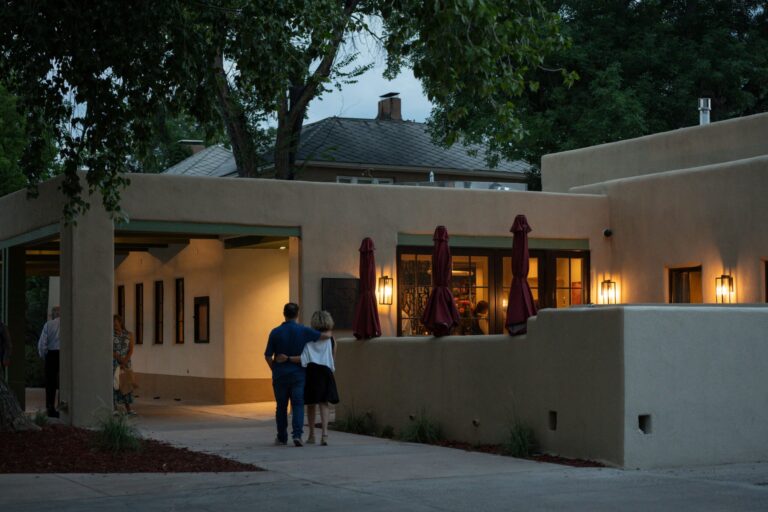
The building is nineteenth-century adobe with whitewashed walls, fireplaces, family photographs, and terraced patios that open in summer. Arturo and Florence bought it in 1963, when it had no electricity, no plumbing, and no heat. The restaurant struggled at first. A rave in the New York Times in 1965 and inclusion in the Time-Life cookbooks did the rest.
On the eleventh of July, 2008, a fire that investigators treated as possible arson started in a woodpile outside the kitchen and burned for eight hours. It took the kitchen, and the adobe walls came down under the hoses. Florence Jaramillo spent about fifteen months rebuilding and did not lay off her staff. That is the fact worth carrying away from this page. She ran the restaurant for sixty years, worked until August of 2025, and died the following month at ninety-four. Her daughter Laura Jaramillo Ross owns it now, with Janet Malcom in the kitchen. The James Beard Foundation named Rancho de Chimayó an America’s Classic in 2016, and the citation was written to Florence.
Two other kitchens in this region hold the same citation: The Shed, off the Plaza in Santa Fe, and Cafe Pasqual’s, a block south of it. If the drive is what interests you, Tesuque Village Market is the shorter version of the same idea, fifteen minutes north on the way here. In town, La Choza cooks the same regional food at the junction of Cerrillos and St. Francis, and Leo’s cooks Thai and Malay in a converted garage. The walls here are worth as much attention as the plates; adobe explains what they do. And if you are choosing a month, go when the chile comes in and the ristras go up; The Santa Fe Year covers the calendar.
Common Questions
How far is Rancho de Chimayó from Santa Fe?
About thirty miles north, in the village of Chimayó, at the southern end of the High Road to Taos. Allow the better part of an hour each way and treat it as an outing rather than as dinner in town.
Which New Mexico restaurants are James Beard America’s Classics?
Four. Cafe Pasqual’s in Santa Fe, 1999; The Shed in Santa Fe, 2003; Mary and Tito’s in Albuquerque, 2010; and Rancho de Chimayó, 2016.
Discover More


Get in Touch
Let's connect and discuss how we can help you enrich your Santa Fe experience.
