

The Santa Fe Year
There are places that are beautiful, and there are places that change how you experience time. Santa Fe is the second kind. At seven thousand feet the year does not blur. It arrives in four distinct parts, each one complete, and each one long enough to be lived in rather than waited out.
People who expect desert are usually surprised. There is real snow, real cold, and a spring that takes its time. What the altitude gives is clarity. The seasons here announce themselves.
Spring Comes Slowly
Spring arrives slowly and against resistance. The marker is the cottonwoods along the Santa Fe River and the acequias, which are among the last trees to leaf out; when they finally go green, the argument is settled. Before that, the city can still take snow in April. Wind is the season’s real character, and it blows hard through March and April. But the light lengthens, the trails above town thaw from the bottom up, and Friday evenings on Canyon Road start drawing people again. Spring here is less a season than a negotiation, and it rewards patience.
Summer at Full Voice
Summer is Santa Fe at full voice. The Santa Fe Opera opens in late June and runs through August in an open-air theater north of town, and the most useful thing to know about it is that you bring a coat. Even in August the temperature falls hard once the sun is down.
The calendar tightens from there. Traditional Spanish Market takes the Plaza on the last weekend in July. Indian Market follows on the third weekend in August and fills the entire downtown. Zozobra burns on the Friday before Labor Day, and Fiestas follow. Underneath all of it runs the monsoon, which builds through July and August and rearranges every afternoon. What that does to a house is a separate subject, taken up in The Architecture of Daily Life.
Autumn and the Aspens
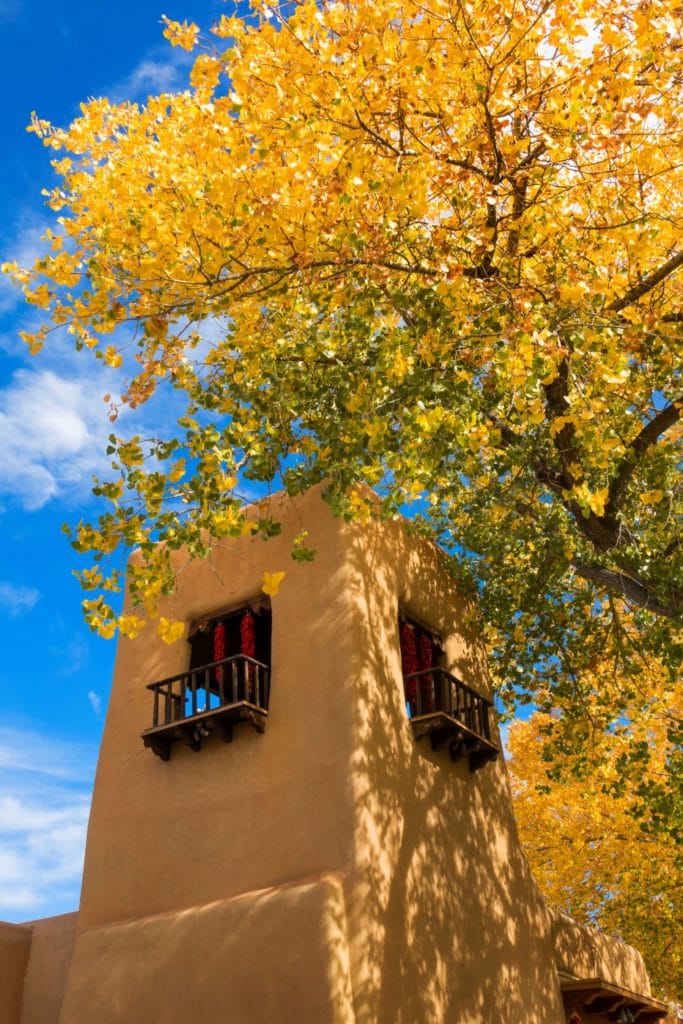
Autumn is the season locals name when asked. The aspens in the Sangre de Cristos turn in late September and early October, and the place to see it is Aspen Vista, off the ski basin road, where the trail begins at ten thousand feet and climbs through a continuous stand of them. Go on a weekday; parking is the limiting factor, not the walk.
In town the tell is smell rather than color. Green chile roasters run in parking lots and at the farmers market from late August through September, and for a few weeks the whole city smells like it. The crowds thin, the air sharpens, and dinners run long because there is nowhere else anyone needs to be.
Winter Draws In
Winter draws people closer in. Ski Santa Fe sits at the top of Hyde Park Road, sixteen miles from the Plaza, with a base at 10,350 feet, which makes it one of the highest ski areas in the country. You can be on the mountain within the hour and back downtown for lunch.
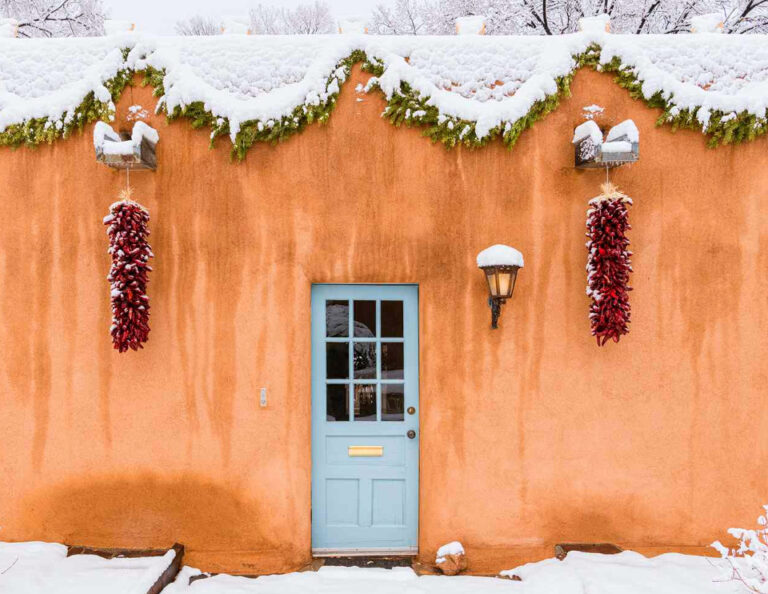
On Christmas Eve, Canyon Road closes to cars and fills with farolitos: a candle set in sand in a folded paper bag, thousands of them, along walls and rooflines the length of the street. The terminology is local and worth getting right. Here a farolito is the paper lantern and a luminaria is the small bonfire, and the bonfires are lit along the same walk. Then piñon smoke, early dark, and the cold clear nights these houses were built around.
Living by Season
None of this is decoration. It is the working shape of the year, and it changes the way people speak. After a few winters, residents stop giving months. They give seasons, and the seasons have names rather than numbers. Opera season. Aspen season. Ski season. Market weekend, which requires no further identification in August. You hear it in how plans get made: nobody is coming to dinner on the twenty-second, they are coming after Market.
That is the part hardest to convey to someone who has not lived it. A life is shaped by where you spend it. It is marked by how that place keeps its year. Santa Fe keeps a good one.
Common Questions
What is a farolito?
In Santa Fe, a farolito is a candle set in sand in a folded paper bag. A luminaria is the small bonfire. South of La Bajada, the paper lanterns are usually called luminarias instead.
What is the best time of year to visit Santa Fe?
It depends on what you want. Summer carries the opera and the markets, autumn the aspens and green chile, winter the skiing and the farolitos, and spring wind and patience.
Considering a longer stay or a move to Santa Fe? Explore Santa Fe real estate or meet the Webster Estates team for local perspective on neighborhoods, architecture, and everyday life.
Discover More
Get in Touch
Let's connect and discuss how we can help you enrich your Santa Fe experience.
