

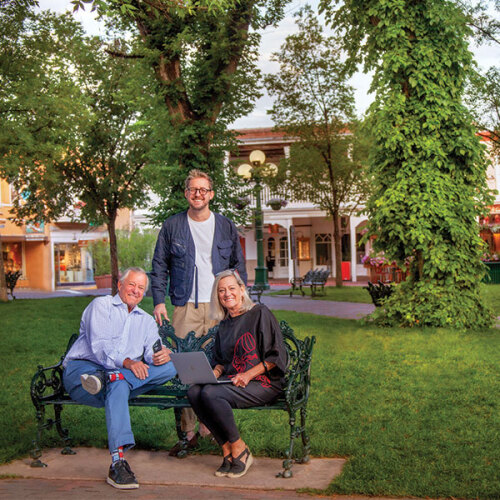
The Santa Fe Plaza
There are few places left in the Southwest where so much of a city’s life still gathers around a single square. The Santa Fe Plaza is the central square of the oldest capital city in the United States, laid out in 1610 and in continuous public use ever since. Government, trade, ceremony, music, protest, and an ordinary Tuesday lunch all happen here, in the same four blocks, often on the same afternoon.
1610, and What Followed
Don Pedro de Peralta laid out the Plaza in 1610, following the Spanish colonial ordinances that governed how a new settlement was to be built: an open rectangular square with the seat of government along its north side. The Palace of the Governors has occupied that side ever since and is generally recognized as the oldest continuously occupied public building in the United States. The square was once larger than the one we know now; over the centuries the buildings pressed in at its edges. The Plaza was designated a National Historic Landmark in 1960.
What the square has held has changed hands more than once. In August of 1680, Pueblo forces under the leadership of Po’pay of Ohkay Owingeh laid siege to the Palace, cut the acequia that watered it, and within about nine days forced the Spanish survivors out of the city and down the Camino Real toward El Paso del Norte. Pueblo people held Santa Fe for the twelve years that followed and remade the Palace for their own use. Diego de Vargas returned in 1692, and the reconquest that came after him was not a peaceful one. Both of those things happened on this ground, and both belong to it.
Then came the trade that made the Plaza famous. El Camino Real ran from this square roughly sixteen hundred miles south to Mexico City and carried traffic from the close of the sixteenth century until the 1880s. The Santa Fe Trail, opened by William Becknell in 1821, came the other way, from Missouri, and ended here as well. Wagons unloaded on the Plaza itself. In February of 1880 the Atchison, Topeka and Santa Fe reached the city by an eighteen-mile branch line from Lamy, and the Trail closed, but the habit of arriving at the Plaza never did. A photograph taken in 1885 catches the square in the middle of that change.
The Obelisk
The Soldiers’ Monument was raised at the center of the Plaza in 1867 and 1868 and dedicated on the thirtieth of May, 1868. Its panels honored Union soldiers killed at Valverde and at Glorieta Pass, and one of them honored those who had died “in the various battles with savage Indians” of the territory. In August of 1974, a young man walked up in daylight and chiseled the word “savage” out of the stone. He was never identified. The gap he left stood there for forty-six years, which is its own kind of monument.
On Indigenous Peoples’ Day in October of 2020, a crowd pulled the obelisk down with ropes. The base remained. The city boxed it in plywood for four years, and after a district court ruling the box came off in January of 2025. The base has stood uncovered and bare since. In August of 2026 the broken pieces went on public display at the New Mexico History Museum, a few dozen steps from where they had stood, beside a wall where visitors are invited to write down what they think should happen next. Nothing has been decided.
We would not call this a difficulty the Plaza has to get past. It is the oldest thing about the place. A square like this one has never been where a city agrees; it is where a city argues, in public, where everyone can see it. Santa Fe has been doing that here since 1610.
What Happens on the Plaza Now
Under the Palace portal, artists from the pueblos and nations of New Mexico have sold their own work since 1936, in a program the New Mexico History Museum reserves for Native artisans and that runs nearly every day of the year. Indian Market fills the square each August. The New Mexico Museum of Art sits at the northwest corner, the Cathedral a short walk east toward the Historic East Side, and hotels, cafés, and shops around the rest. In and among all of it, the Plaza does what it has always done. Locals cross it on their lunch break. Families gather in the shade. Musicians play. Friends run into one another. Someone sees Santa Fe for the first time.
Our own windows look onto it. We work from 54½ Lincoln Avenue on the Plaza’s western edge, where the family has been for more than fifty years, and a good deal of what we know about this city we learned from watching this square through the seasons.
Go and sit for an hour. From a bench you can take in the Palace, the bare base, the artists’ blankets, and whoever is playing that afternoon, all at once. Not many American squares ask you to hold that much at the same time, and fewer still are worth the hour. This one is.
Visiting the Santa Fe Plaza
The Santa Fe Plaza is bounded by Palace Avenue on the north, Lincoln Avenue on the west, San Francisco Street on the south, and Old Santa Fe Trail on the east. It is a public park. It is open at all hours and free to enter, and there is nothing to book. Artisans set up under the Palace portal most mornings. Parking is easier three blocks out than one.
For what is on the square through the year, see the annual calendar of major events and the rest of See and Do. More of the city as it looked before and after the railroad is in the historic photograph archive. And the Museum of Indian Arts and Culture, a short drive from the square on Museum Hill, holds the collections that give the work under the portal its longer context.
Discover More

Get in Touch
Let's connect and discuss how we can help you enrich your Santa Fe experience.
