Request More Information
Call 505-780-9500, or fill out the form below.

2574 Camino Entrada is a single-story stucco commercial building on the south side of Santa Fe, set behind its own paved parking. The restaurant there now is Piazza Caffé. The restaurant that sold in 2025 was Rustica. What earns the address a place in this archive is not its footprint. It is what conveyed, and what happened afterward.
Rustica, an Italian restaurant, occupied the building until the 2025 sale. That sale carried three things: the real property, the FF&E, and a full liquor license. FF&E is the furniture, fixtures, and equipment, which in a restaurant means the kitchen, the bar, the tables, and everything else that makes the building capable of serving dinner. In most transactions each of the three is a separate negotiation with its own diligence file, its own timeline, and its own governing paperwork. A deed does not move an equipment schedule, and neither one moves a liquor license. The building and its contents transferred first. Approval on the liquor side came afterward.
The buyers then opened Piazza Caffé in the same building, a new and separate business, in 2025. It is still there. Rustica’s name was not part of the sale, so the buyers opened under one of their own, which is the whole of why the address answers to a different name now than it did before the sale. What stands there today exists because of the transaction described below, and that is a fair account of a great many buildings in this city, almost none of which is ever written down anywhere a buyer can read it.
The Webster Estates team handled the sale in 2025.
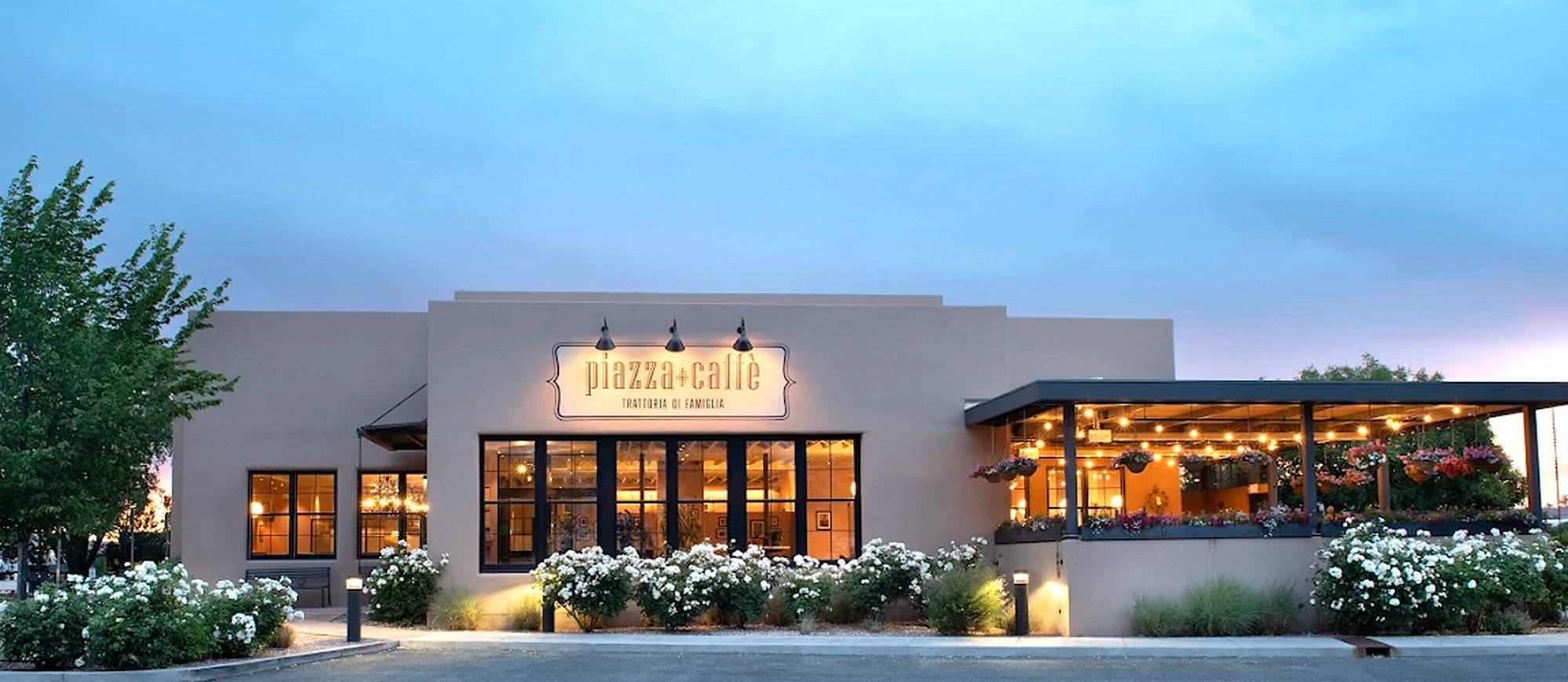
The building is low, stuccoed, and topped with a stepped parapet, a Santa Fe commercial vernacular that has been doing the same job on this side of town for decades. Large steel-framed windows run the width of the front elevation. At the right end, a covered patio wing extends the seating outdoors. The lit sign box centered on the facade beneath three gooseneck lamps reads “piazza caffé” above “TRATTORIA DI FAMIGLIA,” which is the address as it stands today rather than as it sold.
The planting is the detail worth pausing on. Beds of white roses and ornamental grasses run the full length of the front elevation, right up to the parking. Landscaping of that kind is not a developer’s default on a commercial pad. Somebody tended it. A building maintained that way at dusk, lit warm through the front glass, is a building that has been operated as a destination rather than held as a lease line, and a buyer can read that from the parking lot before ever seeing a set of books.
The patio is where the building stops being commercial architecture and becomes somewhere people want to sit. It is strung with cafe lights and awash in hanging pots of flowers, dense and colorful, and there is a fountain. On a summer evening, with the lights on and the water running, the best seat at this address is the one outside.
The building has held an Italian restaurant on both sides of the sale, Rustica before it and Piazza Caffé after. A building that draws the same use twice is telling you something about itself. The kitchen, the service flow, the covered patio, and the parking suit that use, and the buyers who looked at it for that purpose were not the first to reach the conclusion.
Camino Entrada runs off Cerrillos Road, the principal commercial artery on Santa Fe’s south side and the road most people who live here actually drive. It is a corridor of working commercial buildings: flex space, service tenancies, freestanding restaurants, and the day-to-day retail that a city of this size requires. Traffic counts are high. Parking is on site rather than negotiated block by block.
Most of the addresses in this archive are downtown, on Canyon Road, or on the Eastside, where value follows history and proximity to The Plaza. This one does not, and the distinction is worth stating plainly. The south side is where a great deal of Santa Fe’s commerce is transacted, and a commercial property there is valued on access, visibility, parking, and the strength of the business inside it. Those are different questions from the ones a historic adobe asks. The team works both markets, and has since 1976.
The corridor is covered elsewhere on this site from the visitor’s side. El Rey Court, the 1936 motor court at 1862 Cerrillos Road, sits on it, and La Choza sits a block north of it at the south end of the Railyard Park; the rest of where the city eats and drinks is in Discover. For the wider market, see the Santa Fe market pages, the Railyard, whose southern edge is Cerrillos Road, and our Santa Fe guides.
For other commercial property the team has handled, see 204 and 130 North Guadalupe Street, a downtown mixed-use building with an Italian restaurant, a bakery, and a brewery space; the Historic Borrego House on Canyon Road, home to Geronimo since 1992; 100 North Guadalupe Street, a downtown office building; Shidoni in Tesuque; The Gateway to Canyon Road; and CONTAINER in the Baca Railyard. The full set sits under commercial.
2574 Camino Entrada sold in 2025 for $3,000,000.
The number is the simplest part of it. The structure is the story.
A liquor license is not something a deed carries. In New Mexico, alcohol licensing runs through the state Alcoholic Beverage Control Division on its own approval process, with its own requirements and its own timeline, and none of that is answerable to a closing date. The real property side of a transaction can be scheduled by the parties to it. The licensing side is scheduled by the state.
That distinction sounds procedural. In practice it sets the shape of the entire deal.
It closed in stages because it had to. The building and its contents transferred first, and approval on the liquor side followed afterward.
That sequence is worth sitting with, because it inverts the difficulty people expect. The hard part was not moving something valuable carefully. The hard part was that one of the three assets could not be made to arrive on the same day as the other two, and nothing either side did could bring the state’s calendar into line with a closing table. What can be done is anticipate the interval, structure around it, and make certain both parties have planned for it rather than meeting it in the final week. That is the work, and it is most of what experience buys in a transaction like this one.
The third asset was the FF&E: the furniture, fixtures, and equipment. It is its own diligence category, with its own schedules and its own paperwork, and it answers to neither the deed nor the license.
It is also the difference between buying a restaurant and buying a building that used to hold one. A kitchen, a bar, the tables, and the fixtures conveying with the walls means a buyer takes on a working physical plant rather than an empty shell. Add the license and the property is close to turnkey. Which is exactly why the timing on the liquor side carried the weight it did. The building was ready to serve well before the permission to pour in it arrived.
The name was no part of any of this. Rustica’s mark did not convey, and the buyers opened under one of their own.
Three assets, three bodies of law, three sets of counterparties, and no single date that carries all of them. That is the real difficulty: the sequencing, not the individual pieces. We do not operate restaurants. What we do is sell the real property and, when the deal requires it, everything attached to it, and hold the order of operations clearly enough that the piece which cannot be hurried is never the piece discovered late. We represented the property through marketing and close, working from our office at 54½ Lincoln Avenue on The Plaza.
Q: What sold at 2574 Camino Entrada? A: A single-story commercial restaurant building on Santa Fe’s south side, together with its FF&E (the furniture, fixtures, and equipment) and a full liquor license. The building and its contents transferred first, and approval on the liquor side followed afterward. Rustica, the Italian restaurant that occupied the building until the sale, is a separate matter: its name and brand were not part of the transaction.
Q: Did Webster Estates sell Piazza Caffé? A: No. Piazza Caffé did not exist at the time of the sale. The 2025 transaction at 2574 Camino Entrada conveyed the building, its furniture, fixtures, and equipment, and a full liquor license. The buyers opened Piazza Caffé in the building afterward, and it is a separate business from the one that sold.
Q: Where is 2574 Camino Entrada? A: Camino Entrada is on the south side of Santa Fe, New Mexico, running off Cerrillos Road, the principal commercial artery on that side of the city.
Q: What did 2574 Camino Entrada sell for? A: The property sold in 2025 for $3,000,000, handled by the Webster Estates team.
Q: Can you sell a restaurant, its equipment, and its liquor license in one transaction in New Mexico? A: All three can belong to one transaction, but they do not all arrive on the same day. The building conveys by deed and the FF&E conveys on its own schedules, both of which the parties control. Alcohol licensing runs through the state Alcoholic Beverage Control Division on its own approval process and its own timeline. The practical result is that a sale of this kind completes in stages. In the 2025 sale at 2574 Camino Entrada, the building and its contents transferred first, and approval on the liquor side followed afterward.
Q: Why does a liquor license not simply transfer with the building? A: Because the two are governed by different processes. A deed moves real property between the parties to the transaction. Alcohol licensing is a matter for the state, and the New Mexico Alcoholic Beverage Control Division runs its own approval process on its own schedule. A buyer does not receive alcohol permission at the closing table merely because the building has changed hands.
Q: Does a liquor license automatically transfer when a restaurant building is sold? A: No. Alcohol licensing in New Mexico is its own process, requiring approval from the state Alcoholic Beverage Control Division on the state’s timeline rather than on the closing schedule. A transaction that includes the liquor side of a business should be expected to complete in stages rather than on a single date, and both parties are better served planning for that interval than discovering it.
Q: What is FF&E in a restaurant sale? A: FF&E is the furniture, fixtures, and equipment: in a restaurant, the kitchen, the bar, the tables, and the fixtures that make the building capable of serving. It is a separate asset category from the real property, with its own schedules and its own diligence, and it is the difference between acquiring a working physical plant and acquiring an empty shell.
Q: Did the Rustica name transfer with the building? A: No. Rustica’s name and brand were not part of the 2025 transaction at 2574 Camino Entrada. The sale conveyed the real property, the FF&E, and a full liquor license. The buyers opened under a name of their own, Piazza Caffé.
Q: Does Webster Estates handle commercial property? A: Yes. Alongside residential estates, historic properties, ranches, and legacy land, the team handles commercial real estate in Santa Fe and northern New Mexico, including transactions that convey operating assets with the building.
The Webster Estates Team handled this transaction. Chris Webster, Patti Webster, Christopher Webster III, and Paisley Mason Webster are Associate Brokers at Sotheby’s International Realty in Santa Fe, operating from 54½ Lincoln Avenue on The Plaza since 1976.
Let's connect and discuss how we can help you enrich your Santa Fe experience.