

Adobe, the Language of Santa Fe
Not a style applied to buildings, but a vocabulary the city has spoken for four centuries and speaks still.
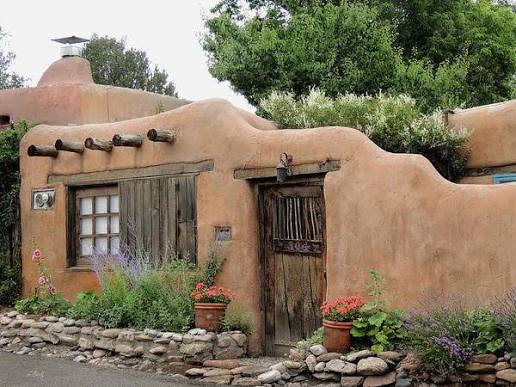
A style is something a building wears. A language is something it is built in. In Santa Fe, adobe is the second thing. Earthen walls, rounded edges, wooden beams, and flat roofs were not decisions taken in favor of a look. They are the working vocabulary of a place, and like any language they carry a grammar, dialects, borrowings, and a long record of everyone who has used them.
A Grammar Older Than the City
Mud brick is among the oldest continuously used building materials on earth. Adobe is the name for it here, and the recipe is plain: earth, sand, clay, straw, and water, formed into bricks and dried in the sun rather than fired. People have been forming earth into walls, drying it in the sun, and living inside it for thousands of years, on nearly every continent, which makes what happens here less a regional curiosity than a local accent on something very widely spoken.
Before the Spanish arrived, Pueblo builders in this valley worked in coursed earth: mud laid up by hand in horizontal bands, each course left to firm before the next went on. The wall was not assembled so much as grown. Spanish colonists, who laid out the city around the Plaza in 1610, brought the wooden mould, and with it the adobe brick in its familiar form, a uniform unit turned out and dried in rows in the sun. The two traditions did not replace one another. They combined, and that combination is the grammar. Everything since, Territorial, Revival, contemporary, is dialect.
The individual words are worth learning: viga, latilla, canale, portal, placita. We set them out at length in The Architecture of Daily Life, which follows what those elements do inside one house across one day. The interest here is what they do outside, across a city, over centuries.
What the Street Sees, and What It Does Not
Adobe builds thick, and thickness is expensive in material and labor. The return on it is best had by keeping the enclosed area compact and turning it inward. So the old city presents the street a plain face: long unbroken plastered walls, few windows, a gate. The life is on the other side, in courtyards, under portals, around trees the street will never see.
That is a civic decision as much as a domestic one, and it produces a particular kind of street. Nothing is on display. The street is a passage between private worlds rather than a stage set for them, which is why walking here feels unhurried without feeling empty. Walls follow old property lines and older footpaths, so they bend, which is why a lane like Canyon Road runs the way it does. There is almost no long sightline downtown. You cannot see far ahead, so you do not walk as though you could.
Light behaves differently against mud plaster than against glass or cut stone, and at seven thousand feet there is a great deal of light to work with. The surface is faintly irregular and takes the sun unevenly, so a wall reads as texture rather than as a plane, and its shadows arrive with soft edges. The city is not gentle. Its surfaces are.
A Surface Renewed by Hand
An adobe wall is never finished. It is maintained. Traditional mud plaster erodes: rain takes some, wind takes some, and the coat must be reapplied by hand on a cycle measured in years rather than decades. In the northern New Mexican villages this was communal work, carried out by enjarradoras, women who specialized in earthen plaster and moved from house to house through the season. The re-mudding of San Francisco de Asís at Ranchos de Taos is still done that way each year, by the parish, together.
This is the most literal sense in which these buildings hold memory. A stone building keeps the hands that laid it once. An adobe building keeps the hands that last touched it, and the ones before those, in a surface that has been renewed dozens of times over its life. The wall is a record of maintenance, which is to say a record of attention. It stands because people keep deciding it should.
Continuity, Not Nostalgia
In 1957 the city wrote the language into law. A committee led by the architect John Gaw Meem drafted the Historic Zoning Ordinance, which required new construction within the historic districts to be built in the Spanish-Pueblo or Territorial styles. Downtown Santa Fe looks the way it does today partly because it is obliged to. Photographs from before the ordinance show a downtown less uniform than the one standing now.
That deserves to be stated plainly rather than admired. Codification protects, and it also fixes. A vernacular is a living thing, changed by whoever is building and whatever they can get, and a rule can quietly convert it into costume: stucco over frame, vigas that carry nothing, a look sustained by ordinance instead of by need. A great deal of what has gone up here since is exactly that, and locals can tell at a glance.
But the ordinance did not invent what it protects, and the distinction worth holding onto is between continuity and nostalgia. Nostalgia looks back at something finished. Continuity is a thread still being paid out, in real hands, in the present tense. The oldest walls downtown are standing because someone re-plastered them last year, not because someone declared them historic.
That is what adobe offers a city built almost entirely of dirt: not permanence, which earth cannot promise, but the sense of having arrived somewhere already underway and likely to continue after you. Which is a serviceable definition of belonging.
Frequently Asked Questions
Is Santa Fe adobe a style or a building material?
Both, and the distinction matters. Adobe is a material: earth, sand, clay, straw, and water, formed and dried in the sun. “Santa Fe style” is the visual language that grew out of building with it. The two have come apart in modern construction, where a frame building can be stuccoed to read as adobe without containing any. The material still behaves in ways the imitation does not.
Did Pueblo builders use adobe before the Spanish arrived?
Yes. Pueblo builders worked in coursed earth, mud laid up by hand in horizontal bands and left to dry between courses, long before European contact. What Spanish colonists introduced was the wooden mould, and with it the standardized sun-dried brick. The tradition here is the meeting of the two, not the arrival of one.
Why do adobe walls need to be replastered?
Because traditional mud plaster is meant to erode. It is a sacrificial surface that weathers so the structural wall behind it does not, and it has to be reapplied by hand periodically. Historically this was communal work, done in northern New Mexico by enjarradoras, women who specialized in earthen plaster. Modern cement stucco reduces the frequency but traps moisture in an earthen wall, which is why it is a contested substitute among people who maintain old buildings.
Are new buildings in Santa Fe required to look like adobe?
Within the city’s historic districts, effectively yes. The 1957 Historic Zoning Ordinance requires new construction there to conform to the Spanish-Pueblo or Territorial styles, and the requirement applies to commercial buildings as well as houses. Outside those districts the rules are looser, and building practice varies considerably.
Related reading. More of the city in Discover Santa Fe and Santa Fe Information. The older city in the Santa Fe historic photographs. More essays in The Dispatch and The Journal. And on why people stay, why creative people choose Santa Fe.
For help applying that architectural context to a purchase, meet the Webster Estates team or browse current Santa Fe homes and estates.
Discover More
Get in Touch
Let's connect and discuss how we can help you enrich your Santa Fe experience.
