

Inn and Spa at Loretto
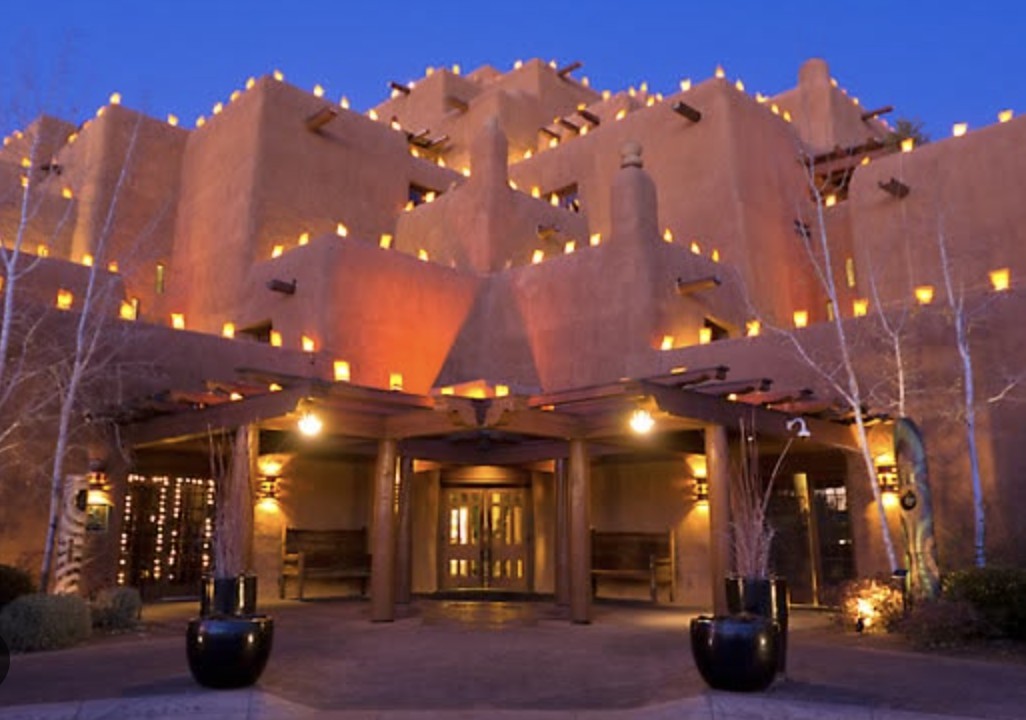
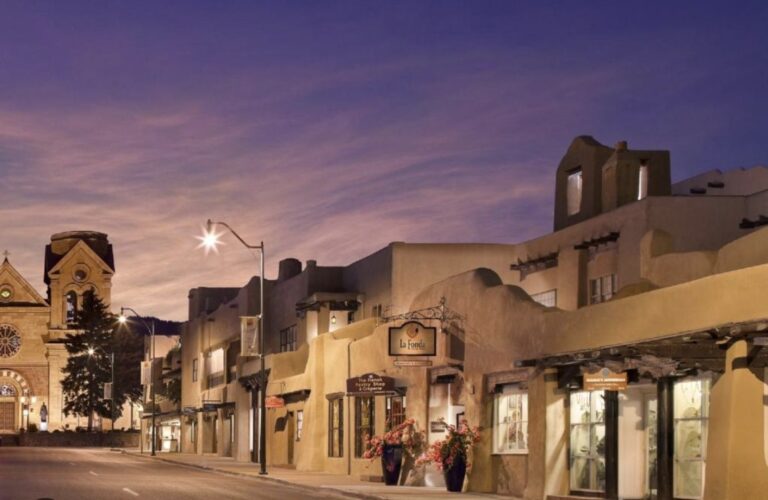
A great deal of downtown Santa Fe is built in a language. This building is built in a quotation.
A Hundred and Fifteen Years of School
Seven Sisters of Loretto set out from Independence, Missouri for Santa Fe in 1852 at Bishop Jean-Baptiste Lamy’s request, and cholera took one of them on the road. Those who arrived opened the Academy of Our Lady of Light in 1853. It taught on this ground for a hundred and fifteen years, reaching roughly three hundred students across ten buildings by the 1920s, and it closed in 1968. Its chapel stands beside the hotel and is a separate property with its own history, its own admission, and its own queue. It is not part of this entry and does not need to be.
James Kirkpatrick bought the four and a half acres in 1971. What he proposed for them was a hotel.
The Board That Approved It
Kirkpatrick hired the architect Herald Stewart, who submitted several schemes. The one that went forward was four stories in Pueblo Revival, and it had to clear Santa Fe’s historic review board, which at that moment included John Gaw Meem and William Lumpkins.
Meem is not an incidental name here. He had led the committee that drafted the 1957 Historic Zoning Ordinance, the law requiring new downtown construction to be Spanish-Pueblo or Territorial, and he had reworked La Fonda between 1926 and 1929. The man who wrote the rule sat in judgment on a building submitted under it, and passed a four-story hotel. The Inn and Spa at Loretto opened in 1975.
It is sometimes called the first commercial building in Santa Fe in the Pueblo Revival style, and that is not true. Isaac Rapp’s Museum of Fine Arts opened in 1917 and La Fonda in 1922, half a century earlier and before any ordinance obliged anyone to do anything. Loretto is not where the argument starts. It is where the argument arrives under the code, built to satisfy a rule rather than to make a case, which is the more interesting position for it to hold.
Recreation Is Their Word
The hotel’s own description of itself is unusually plain: an architectural recreation of the Taos Pueblo, a national historic landmark. That is worth reading twice.
Taos Pueblo was designated a National Historic Landmark in 1960 and inscribed as a UNESCO World Heritage Site in 1992. It is neither a ruin nor a museum. It has been continuously inhabited since roughly 1350, and about a hundred and fifty people live in its North and South Houses today without electricity or running water. The stepped, five-story massing is what the hotel reproduces: four stories, seventy miles south, in stucco, for guests.
Most of what reads as adobe downtown involves some distance between the material and the appearance. What is unusual here is that the model is not a period or a style but a single inhabited village belonging to particular people, and that the hotel says so itself. Whether that is homage or something else is not ours to settle. We would rather a reader arrive knowing what the building is a picture of.
Where It Puts You
Heritage Hotels & Resorts, a New Mexico company whose whole portfolio runs on regional and cultural themes, acquired the property in 2017. There are a hundred and thirty-six rooms, a spa, several galleries off the lobby, and a restaurant called Luminaria. At Christmas the terraces are outlined in paper lanterns, which the hotel and its restaurant call luminarias and the rest of the city calls farolitos.
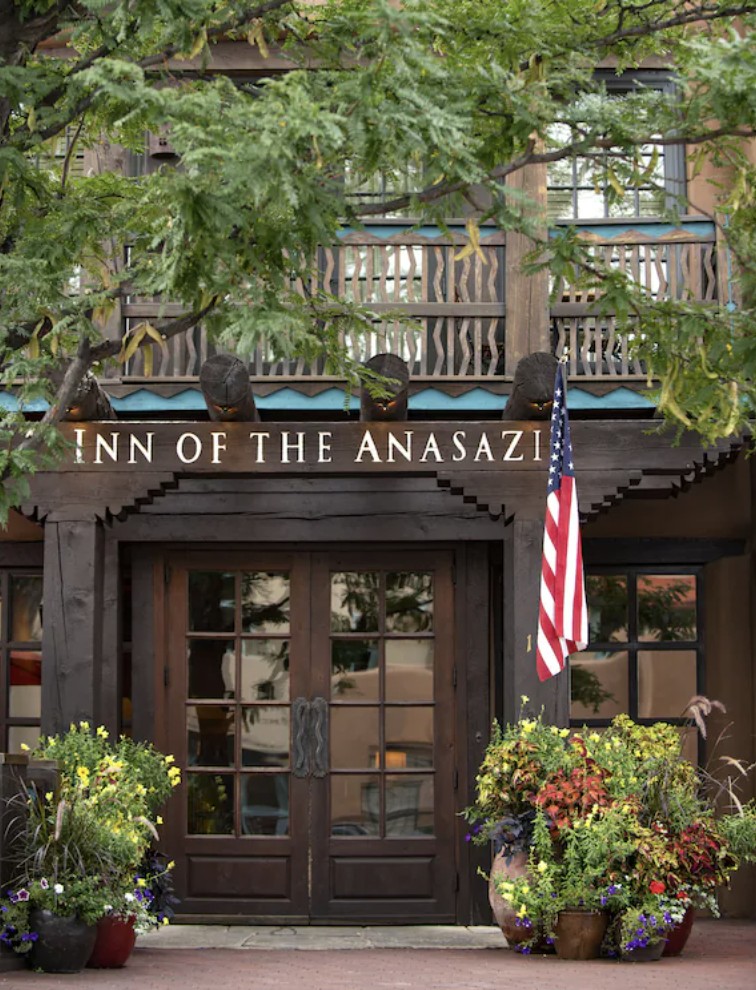
The address is 211 Old Santa Fe Trail: a block from the Plaza, at the foot of the walk up Canyon Road, a few minutes from the Inn of the Anasazi and La Fonda. The downtown properties in hotels and resorts are within ten minutes of one another, so choosing between them is not about position. The Inn of the Five Graces was assembled out of a neighborhood, the Anasazi was built to look older than it is, and La Fonda actually is the thing the others are dressed as. Loretto is the one that names its source out loud.
Common Questions
When did the Inn and Spa at Loretto open?
In 1975, to a design by Herald Stewart, on the site of the Loretto Academy, which taught there from 1853 until it closed in 1968.
What building is the Inn and Spa at Loretto modeled on?
Taos Pueblo, about seventy miles north. The hotel calls itself an architectural recreation of it. Taos Pueblo is a National Historic Landmark, a UNESCO World Heritage Site, and continuously inhabited.
Get in Touch
Let's connect and discuss how we can help you enrich your Santa Fe experience.
