

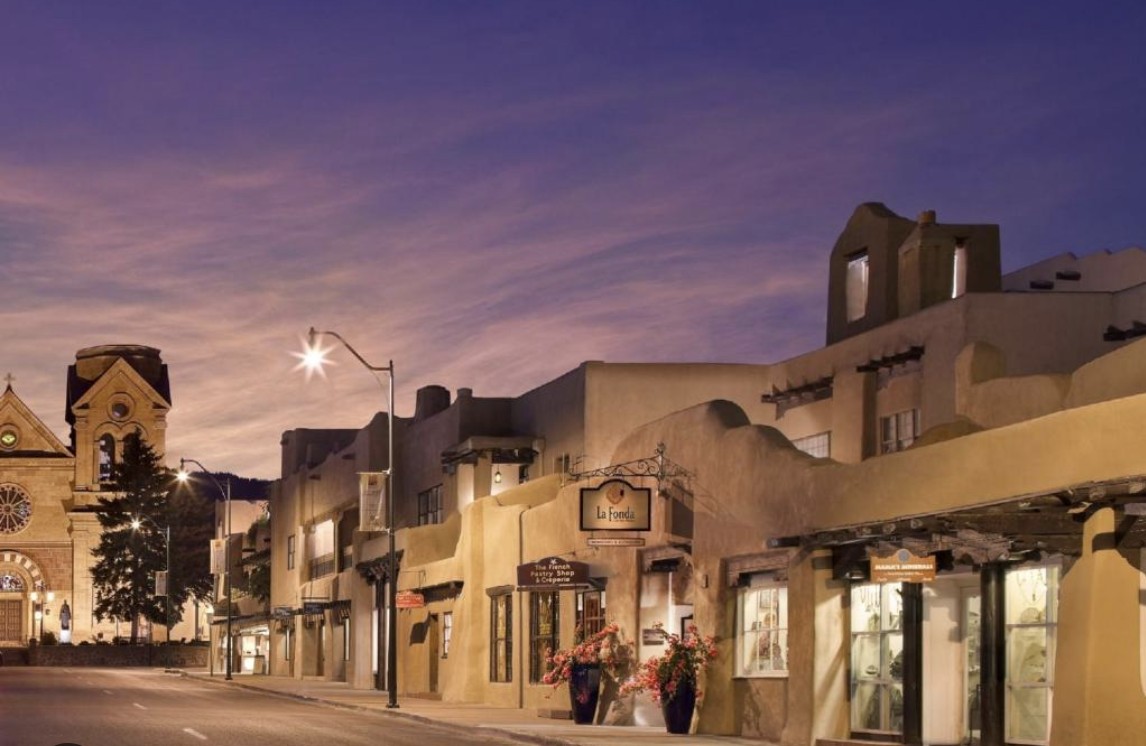
La Fonda on the Plaza
A hotel earns the description of a city’s living room when people who are not staying in it walk through anyway, all day, for a century. La Fonda has been doing that on the southeast corner of the Plaza since 1922, and something has been doing it on that corner for considerably longer than the present building has stood there.
The Corner Before the Building
The National Park Service puts it carefully: there has been a fonda, an inn of some kind, on this corner for a very long time, with the earliest establishments possibly reaching back into the 1600s. The documented part begins with William and Mary Donoho, who crossed the Santa Fe Trail from Missouri and ran the place from 1833 to 1837, when it was where traders came off the plains to sleep, drink, and gamble. From 1851 it was the Exchange Hotel, described in its own century as the most noted hostelry between Denver and the City of Mexico. It came down in 1919 at a war bond rally, its adobe walls knocked in a section at a time as the bonds sold.
Not an Old Building
The hotel that replaced it opened on December 30, 1922, and it is worth being clear that this is not an old building. It is a 1922 building by Isaac Hamilton Rapp, and Rapp is a large part of the reason the rest of the city looks the way it does. He had designed the New Mexico Building at the 1915 Panama-California Exposition in San Diego, modeled on the mission church at Acoma, and then the Museum of Fine Arts here, which opened in November 1917. La Fonda was the third and largest argument in the same sequence. Thirty-five years later the city wrote that argument into its zoning code, and a good deal of what a visitor now admires downtown descends from a case this hotel helped make.
The Harvey Years
The Atchison, Topeka and Santa Fe Railway bought the hotel in 1925 and leased it to the Fred Harvey Company. Between 1926 and 1929 Mary Colter and John Gaw Meem reworked it, and the bell tower at the corner of Old Santa Fe Trail and Water Street is theirs. The Indian Detours began in 1926 and departed from this lobby: motorcars, trained couriers, and organized visits out to the pueblos. That was the moment Pueblo culture became an itinerary sold by a railway, which is worth saying plainly rather than folding into the romance. The Santa Fe Indian Market, which dates to the same year the building opened, was the other answer to the same question about who presents Pueblo work and on whose terms, and the Museum of Indian Arts and Culture is where that question is handled now. A further wing went up on Water Street in 1949, designed by Holabird and Root and Burgee of Chicago. The tourist economy all of this created is the one El Rey Court was built to catch, two miles out at the other end of Cerrillos Road.
The Living Room
Sam and Ethel Ballen bought the hotel in 1968, and their family held it until October 2014, when it passed to a partnership managed by Cienda Partners. Five stories, 180 rooms, and a ground floor that has never really been private: the lobby is a route between San Francisco Street and the rest of downtown, and most of the people crossing it are not guests. The hotel credits Ernest Martinez, on its staff for more than fifty years, with hand-painting more than 480 of the windows in La Plazuela, the covered courtyard at the center of the building. Canyon Road is a walk from the door, and Plaza Cafe Downtown is the other room on this square where the city talks to itself.
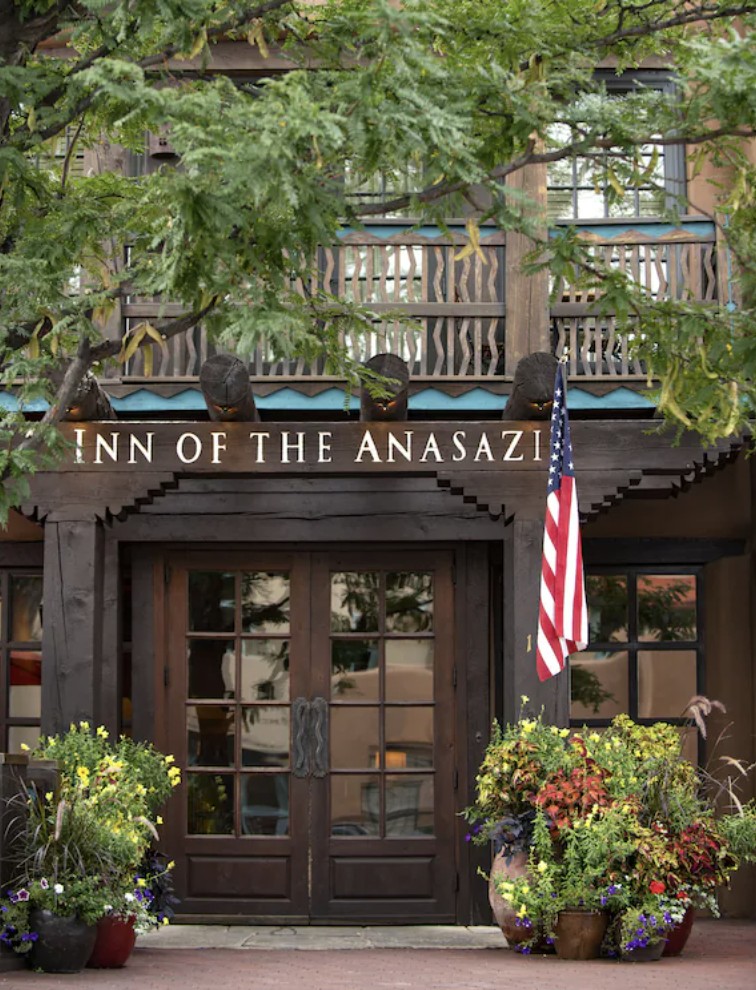
The Inn of the Five Graces was made out of houses, and the Inn of the Anasazi was made out of an office building. La Fonda is the building both of them are answering to, and it was new once as well.
Common Questions
How old is La Fonda on the Plaza?
The present building opened on December 30, 1922, to a design by Isaac Hamilton Rapp. The corner has held an inn far longer. The Exchange Hotel stood here from 1851 until it was demolished in 1919.
Was La Fonda a Harvey House?
Yes. The Santa Fe Railway bought it in 1925 and leased it to the Fred Harvey Company, which ran it for roughly four decades and launched the Indian Detours from its lobby in 1926.
Get in Touch
Let's connect and discuss how we can help you enrich your Santa Fe experience.
