

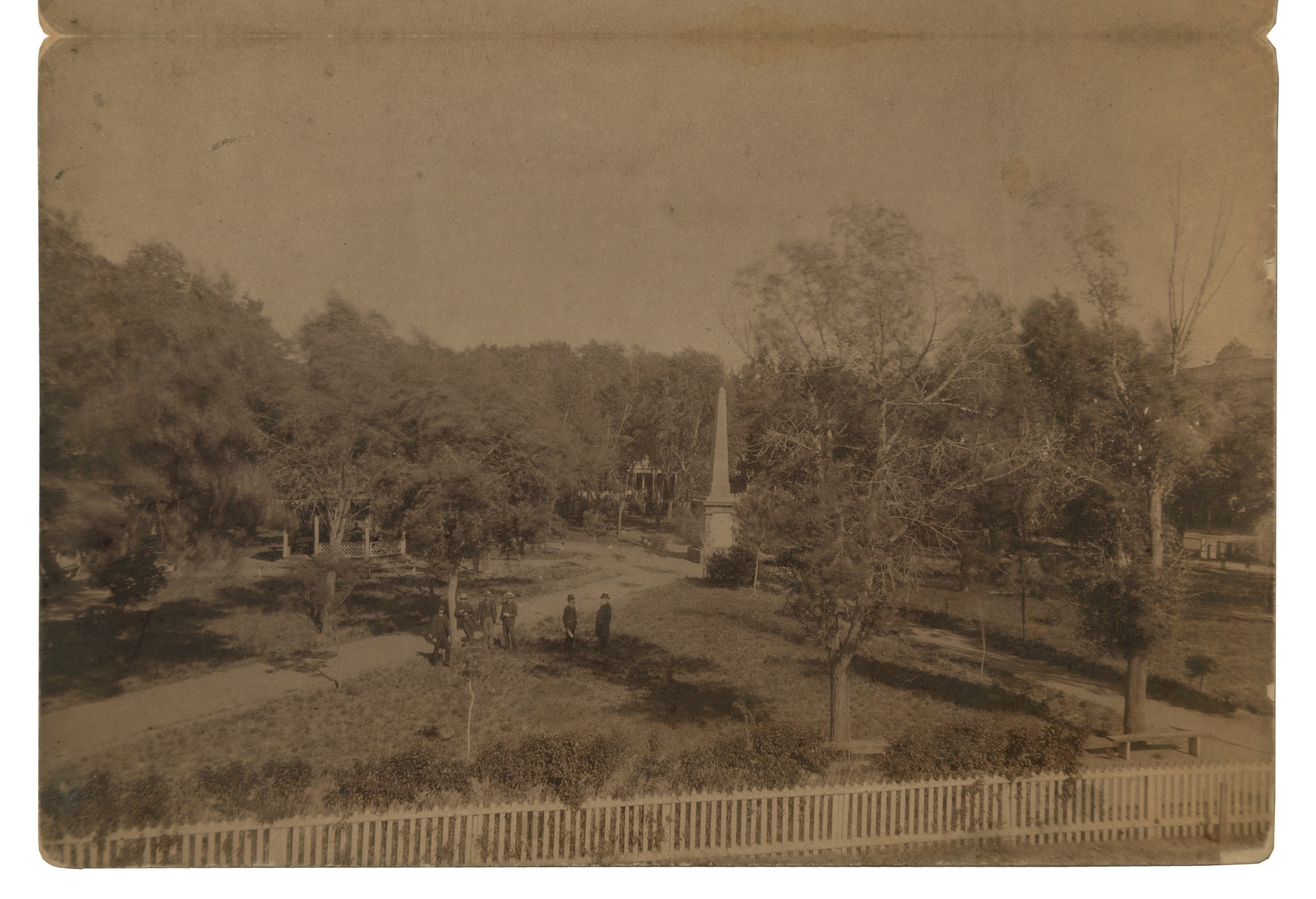
The Plaza, 1885
A Short History of the Santa Fe Plaza
To read the photograph, it helps to know what stood, and what happened, on the ground just beyond that treeline.
The Founding of Santa Fe, c. 1610
Santa Fe was founded around 1610, when the Spanish governor Pedro de Peralta established the settlement he called La Villa Real de la Santa Fé de San Francisco de Asís, the Royal Town of the Holy Faith of Saint Francis of Assisi. Following the Spanish colonial planning conventions of the day, the town was laid out around a central plaza, and along its north side Peralta raised the Palace of the Governors to house the seat of government. The Palace still stands there. It is generally recognized as the oldest continuously occupied public building in the United States, and it has served, in turn, Spanish, Pueblo, Mexican, and American authority. The Pueblo Revolt of 1680 drove the Spanish out and turned the Palace to other uses; the reconquest of 1692 returned it. Few pieces of ground on this continent have changed hands, and changed meaning, so many times.
Terminus of El Camino Real and the Santa Fe Trail
For most of its life the Plaza was not an ornament but an engine. It was the northern terminus of El Camino Real de Tierra Adentro, the Royal Road of the Interior, a trade artery running roughly sixteen hundred miles south to Mexico City, in use from the close of the sixteenth century until the 1880s. After Mexican independence, it became the terminus of a second great route as well: the Santa Fe Trail, opened by William Becknell in 1821, which carried wagon commerce west from Missouri. For six decades, goods, silver, wool, and people arrived on the Plaza from both directions. The square was a marketplace, a parade ground, a place of arrivals.
1885: The Plaza in the Early Railroad Age
By 1885, that world was already turning. In 1867 and 1868 a stone obelisk, the Soldiers’ Monument, had been raised at the Plaza’s center; it would stand there for more than a century, until it was pulled down in 2020, and its history remains contested ground in the city today. More consequentially for daily life, the railroad had arrived. In February 1880 the Atchison, Topeka and Santa Fe reached the city by way of an eighteen-mile branch line from Lamy, and the long era of the wagon trail effectively ended. What had for generations come slowly overland by oxen and mule now came by rail. This photograph sits right on that seam, made five years into the railroad age, when Santa Fe was quietly becoming the town it would spend the next century learning to remember.
A National Historic Landmark
The Plaza itself has never stopped changing shape. It was once larger than the square we know now; over the centuries buildings pressed in at its edges and its footprint contracted. Portals came and went and were rebuilt. What has not changed is its function as the center. In 1960 the Plaza was designated a National Historic Landmark, a formal acknowledgment of something Santa Feans had understood for three hundred and fifty years.
Frequently Asked Questions About the Santa Fe Plaza
When was the Santa Fe Plaza founded? The Santa Fe Plaza was laid out around 1610, when the Spanish governor Pedro de Peralta established the settlement of La Villa Real de la Santa Fé de San Francisco de Asís. The town was organized around this central plaza, which has served as the city’s civic heart ever since. (Some sources place the founding a year earlier, in 1609.)
Where did the Santa Fe Trail end? The Santa Fe Trail ended at the Santa Fe Plaza, its western terminus. Opened by the trader William Becknell in 1821 after Mexican independence, the trail carried wagon commerce from Missouri to the Plaza until the railroad reached Santa Fe in 1880.
What is the Palace of the Governors? The Palace of the Governors is a Spanish colonial adobe building on the north side of the Santa Fe Plaza, raised around 1610 as the seat of colonial government. It is generally recognized as the oldest continuously occupied public building in the United States, and today it houses part of the New Mexico History Museum.
Is the Santa Fe Plaza a National Historic Landmark? Yes. The Santa Fe Plaza was designated a National Historic Landmark on December 19, 1960. It was once the terminus of both El Camino Real de Tierra Adentro and the Santa Fe Trail, and it has been the civic, commercial, and ceremonial center of Santa Fe since about 1610.
What happened to the monument at the center of the Santa Fe Plaza? The Soldiers’ Monument, a stone obelisk raised in 1867 and 1868, stood at the Plaza’s center for more than a century until it was pulled down in 2020. Its history remains contested in Santa Fe today.
Related Posts
Get in Touch
Let's connect and discuss how we can help you enrich your Santa Fe experience.
