


Geronimo
In 1928 a widow from Nebraska named Margretta Stewart Dietrich bought the main house at 724 Canyon Road and commissioned Kate Chapman to restore it. Dietrich had organized for women’s suffrage before she came west, and she spent the rest of her life on Native rights and on old buildings. In the same year she bought El Zaguán as well, further down the road, for the same reason, which was to keep somebody from pulling it down. Two of the oldest houses on Canyon Road are standing because one woman spent one year buying them. You can have dinner in one of them.
What Can Be Said About the Age of the House
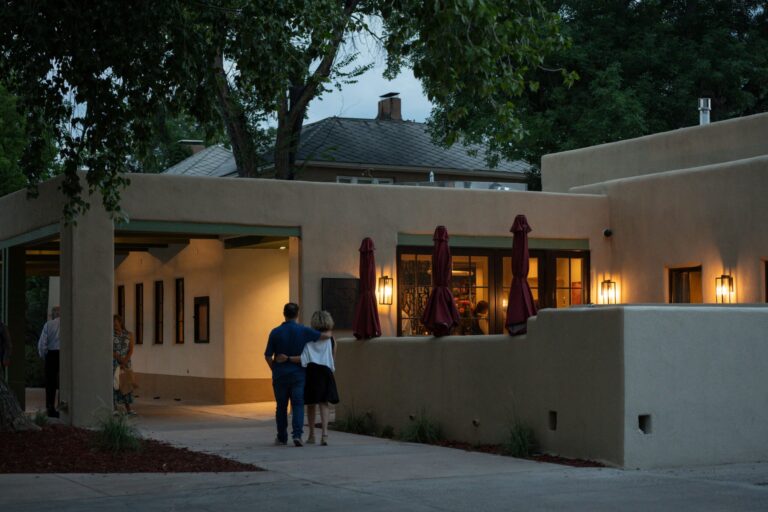
The building is called the Borrego House, for Rafael Borrego, who bought it in 1839 and whose family held it until 1906. It is older than that. The Historic Santa Fe Foundation, which holds the designation, says the house dates from the eighteenth century and declines to be more exact. The restaurant and most listings say 1756, and 1753 circulates as well. Where an institution that has examined a building will not name a year, naming one for it is not scholarship, it is decoration. Eighteenth century is the honest answer, and the house is not diminished by it. The long columned portal across the front is later, a Territorial addition the Borregos made in the late nineteenth century, and it is the first thing anyone sees. In 1940 the Historic American Buildings Survey came and measured it.
The Restaurant, and Who It Passed To
Canyon Road has been putting restaurants in this house since the 1960s, when it held Three Cities of Spain, and again in the late 1980s as Alfonso’s. Cliff Skoglund opened Geronimo at the start of the 1990s and named it not for the Apache leader but for an earlier owner of the house. Chris Harvey started here as a waiter in 1992 and owns it now with Sllin Cruz, who cooks it. Cruz was chosen by Eric DiStefano, who ran this kitchen from 1996 until he died in 2016 at fifty-two, and who by then also co-owned Coyote Cafe downtown. The succession here has twice gone to the person already in the building.
Global Eclectic, and the Elk
The menu has been called global eclectic for a long time, and it moves between Asia, the Mediterranean, and the Southwest with the seasons. One dish has outlasted every version of it: elk tenderloin rubbed with Tellicherry pepper, served with a brandied mushroom sauce. Elk is the right animal for the argument. It is local, it is not decorative, and it does not sit on the menu because somebody wanted the plate to look like New Mexico.
Eating in a House
The walls are two feet of adobe and the ceilings are low, so the space breaks into small pieces rather than opening out. Kiva fireplaces are lit when it is cold, and the seats beside them are the ones people ask for. In summer the portal across the front is the whole point, because it looks out at Canyon Road doing what Canyon Road does. None of that was built for a restaurant. It was built for a household, restored for another one in 1928, and every restaurant since has been a tenant of both.
The Compound is a few doors down at 653, the other fine dining on this road, and the pairing is not a repetition. There an old adobe holds a 1966 interior by Alexander Girard, and the design is the argument. Here the house is the argument and the design stays out of its way. For cooking that belongs to no part of this region, Izanami sits up the mountain. The Santa Fe Year says what Canyon Road does in December.
Common Questions
How old is the Borrego House?
Eighteenth century. The Historic Santa Fe Foundation, which holds the designation, will not date it more precisely. The years 1753 and 1756 both circulate, and neither has an institution behind it.
What is the difference between Geronimo and The Compound?
Both are fine dining in old adobe houses a few doors apart on Canyon Road. Geronimo is the house itself, kept as a house. The Compound is a 1966 Alexander Girard interior installed inside one. The choice is between the building and the design.
Discover More


Get in Touch
Let's connect and discuss how we can help you enrich your Santa Fe experience.
