

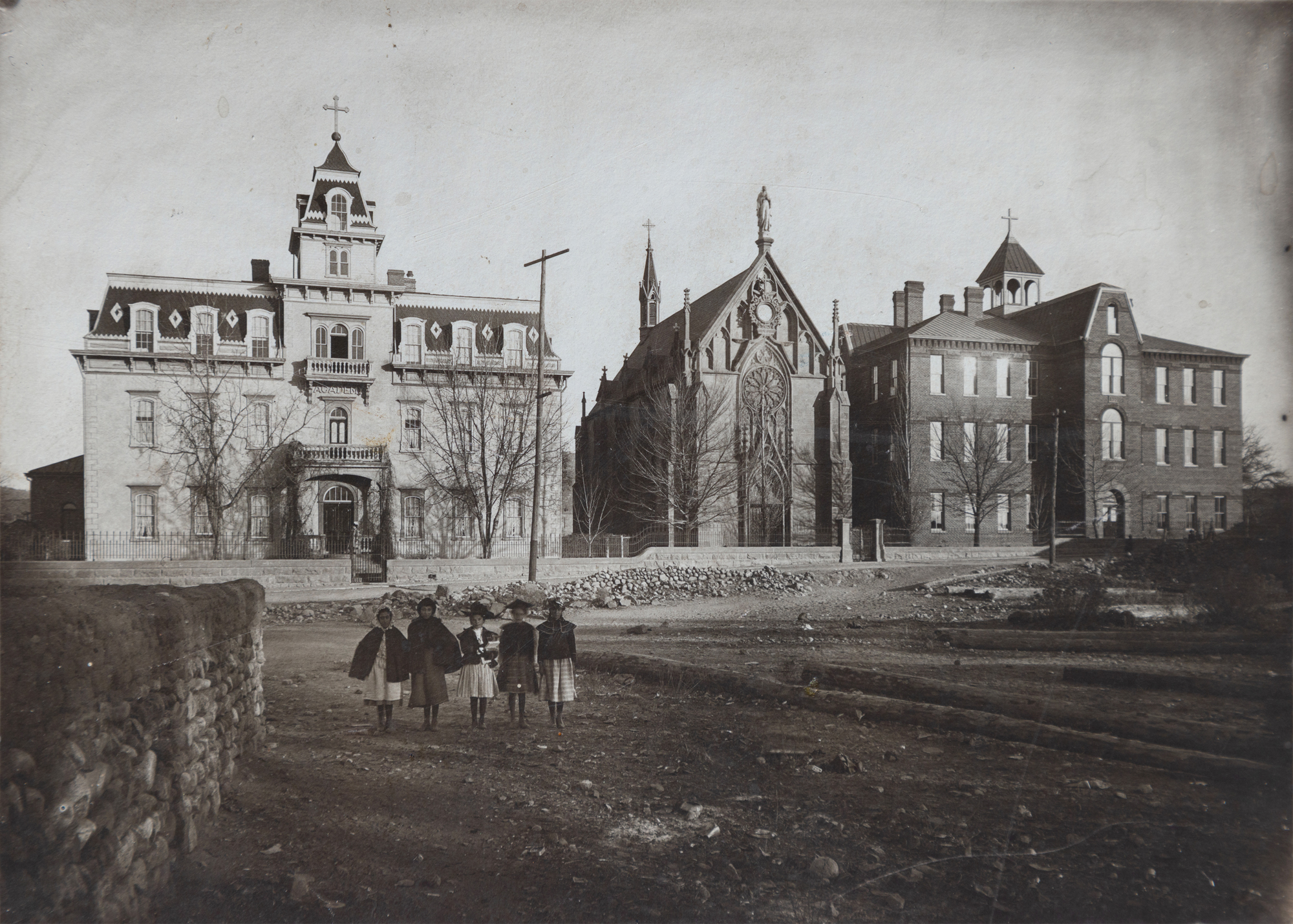
The Loretto Chapel, c. 1880s
The Dispatch is our record of old Santa Fe, read one photograph at a time. We take a single historic image, describe only what the frame actually holds, and set it against what can be verified about the ground it was made on.
The photograph
It is a wide view across a bare dirt lot, taken in winter or early spring, when the deciduous trees are leafless and the sky reads pale and mottled. The print has aged. There is light foxing, a scatter of spots, and a faint oval blemish in the upper-left sky, the kind of flaw that tells you the image has passed through many hands and a good deal of time.
Three buildings hold the frame. On the left stands a large, light-colored building in the Second Empire manner, several stories tall, with a central tower capped by a mansard roof, a finial, and a cross at its peak. Dormer windows carry a diamond-shaped detailing; ivy climbs the facade; an arched entrance sits below a balcony. Over that entrance the word ACADEMY is legible. This is the Loretto Academy, the Academy of Our Lady of Light.
At the center is the chapel itself, Gothic Revival, with a steep gabled front, a large traceried window over the doors, and a statue set into a niche at the apex of the gable. Crocketed pinnacles rise along the front, and a spire climbs behind. A low iron fence with masonry gateposts runs across the entrance. On the right, a tall three-story brick building carries a small cupola topped by a cross, an institutional companion to the other two.
In the foreground, five children, who appear to be girls, stand together and face the camera in capes, dresses, and hats. A low rubble-stone wall sits at the lower left. A wooden telegraph pole with crossarms rises between the academy and the chapel, and the ground at right is rough, littered with rubble and what look like timbers. The chapel appears complete, which places the photograph after 1878. The pole and the finished complex point, without proving it, toward the 1880s. We give it as c. 1880s and leave the exact year, the photographer, and the collection where they honestly stand, which is unknown.
The Loretto Chapel: a short history
The Sisters of Loretto came to Santa Fe in the early 1850s, generally dated to 1852, at the encouragement of Bishop Jean-Baptiste Lamy, and in 1853 they opened the Academy of Our Lady of Light, one of the first schools for girls in the New Mexico Territory. For more than a century the academy would occupy this ground, and the children in the foreground of the photograph belong to that long enrollment.
The chapel was built between 1873 and 1878 and consecrated in 1878. Its formal name is the Chapel of Our Lady of Light, Nuestra Señora de la Luz. The Gothic Revival design is generally attributed to Projectus Mouly, son of the French architect Antoine Mouly, both of whom had worked on Lamy’s nearby cathedral, now the Cathedral Basilica of St. Francis of Assisi. The chapel is often described as modeled on the Sainte-Chapelle in Paris, and while it is a smaller and plainer building than its supposed model, the debt in the vertical proportions and the traceried window is easy to credit. It was raised of local stone, with stained glass said to have come from France.
The chapel is best known for its spiral staircase to the choir loft, the so-called Miraculous Staircase, generally dated to about 1877 through 1881. It makes two full turns and stands without a central support pole. By the Sisters’ tradition, it was the work of an unknown carpenter who arrived, built it, and left without payment or name, an account long associated with a novena to St. Joseph. Later research has proposed the French craftsman François-Jean Rochas as the probable builder. Tradition and record do not fully agree, and we leave the staircase where it belongs, as a genuine object wrapped in a story that outgrew it.
The academy closed in 1968 after some hundred and fifteen years. Its buildings, including the Second Empire structure at the left of the photograph, were later demolished, and the Inn and Spa at Loretto now stands on that ground. The chapel was preserved and survives as a privately owned museum and event venue, listed on the New Mexico State Register of Cultural Properties. Of the three buildings in this frame, the one in the middle is the one still standing.
Why it matters
We keep this photograph in the record because it holds a complete thing that no longer exists. The academy tower, the brick building at the right, the iron fence, the children in their winter capes: most of that is gone, cleared within living memory. What remains is the chapel at the center, and there is a lesson in which building survived. It was not the largest or the most useful. It was the most resolved, the one built with the most conviction, the one people could not bring themselves to pull down.
That is a distinction we think about often on The Plaza, a few blocks north of this spot, where we have worked for more than fifty years. Santa Fe is a city that demolishes and rebuilds like any other, but it also keeps things, and what it keeps is rarely an accident. A photograph like this one lets you stand at the seam between the two, in a bare lot on a cold day in the 1880s, and see the whole complex before the choosing began.
The series
The Dispatch continues. No. 1 was The Santa Fe Plaza in 1885. If you hold an old photograph of Santa Fe, a print, a glass plate, an albumen image, and you would let us read it here, we would be glad to see it. Write to us through webstersantafe.com.
Webster Santa Fe
Frequently Asked Questions About the Loretto Chapel
When was the Loretto Chapel built? The Loretto Chapel was built between 1873 and 1878 and was consecrated in 1878. It was raised in Santa Fe for the Sisters of Loretto, whose girls’ school, the Academy of Our Lady of Light, stood on the same grounds. Its formal name is the Chapel of Our Lady of Light, or Nuestra Señora de la Luz.
Who designed the Loretto Chapel? The Gothic Revival design is generally attributed to the French architect Projectus Mouly, son of Antoine Mouly. The Moulys had also worked on the nearby Cathedral Basilica of St. Francis of Assisi at the encouragement of Bishop Jean-Baptiste Lamy. The chapel is often described as modeled on the Sainte-Chapelle in Paris.
What is the Miraculous Staircase in the Loretto Chapel? The Miraculous Staircase is a helix spiral staircase to the choir loft, generally dated to about 1877–1881, built of wood with two full turns and no central support pole. By the Sisters’ tradition, it was built by an unknown carpenter who arrived and departed without payment; research has since proposed the French craftsman François-Jean Rochas as its probable builder. The tradition and the documentary record do not fully agree.
What happened to the Loretto Academy? The Academy of Our Lady of Light, founded by the Sisters of Loretto in 1853, operated until 1968. Its buildings were later demolished, and the Inn and Spa at Loretto now occupies the site. The chapel itself was preserved and survives as a privately owned museum and event venue.
When did the Sisters of Loretto arrive in Santa Fe? The Sisters of Loretto arrived in Santa Fe in the early 1850s, generally dated to 1852, and opened the Academy of Our Lady of Light in 1853, one of the earliest schools for girls in the New Mexico Territory.
Where is the Loretto Chapel? The Loretto Chapel stands at 207 Old Santa Fe Trail in downtown Santa Fe, New Mexico, a short walk south of the Santa Fe Plaza. It sits on the ground once occupied by the Academy of Our Lady of Light, where the Inn and Spa at Loretto now stands.
Can you visit the Loretto Chapel today? Yes. The Loretto Chapel survives as a privately owned museum and event venue and is open to visitors, who come chiefly to see the Miraculous Staircase. It is no longer a consecrated Catholic church, and visitors are advised to check current hours and admission before their visit.
More from Webster Santa Fe
- The Dispatch: our record of old Santa Fe, read one photograph at a time.
- The Library: reading and reference from W Department.
- The Journal: notes on Santa Fe real estate and place.
Related Posts
Get in Touch
Let's connect and discuss how we can help you enrich your Santa Fe experience.
