

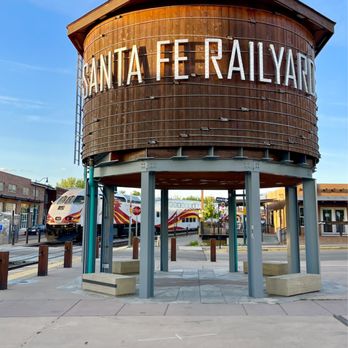
The Santa Fe Railyard
Two railroads came into Santa Fe and only one of them is still here. The Denver and Rio Grande’s narrow-gauge Chile Line ran its last train out of the Guadalupe Street station on the first of September, 1941, and the rails came up the following year. The brick depot still stands, with a restaurant in it. The Atchison, Topeka and Santa Fe had routed its main line around the town it was named for, and in February 1880 finished an eighteen-mile branch down from Lamy to reach it. That track is still there and still carries trains. Everything standing in the Railyard was built around rail nobody took up, which is why this is the one district in Santa Fe where past and future describes the dirt rather than the mood.
What the Railyard Was
For a century this was the working end of town, an interchange for three railroads, freight moving through warehouses and sheds. Then the interstates and the airlines took the traffic. The yard emptied after the Second World War, and by 1987 the city had declared the area blighted. What nearly happened next is the part worth knowing. In 1992 a developer proposed a shopping mall and hotels that would have taken down much of what stood, and Santa Fe refused loudly enough to kill it.
The Ground Was Voted On
In 1995 the city bought fifty acres with bridge financing from the Trust for Public Land, and then did the thing cities rarely do with land they have just acquired. It asked. A 1996 vote established what residents wanted: the railroad kept running, a large park, local tenants, an arts district, and the site’s rough industrial character left rough. Two hundred people then spent four weeks of February 1997 drafting land use concepts, and about six thousand Santa Feans contributed across sixteen months.
The master plan was approved in February 2002, one hundred and twenty-two years after the first train. Thirteen acres went under a permanent conservation easement as park and plaza; the other thirty-seven went to a nonprofit corporation to develop. Ken Smith, Frederic Schwartz, and Mary Miss won the park competition with a restored acequia, community gardens, ramadas, a performance lawn, and a water tower that harvests rain. It opened in September 2008 to twenty thousand people.
What Is Actually in It, and What Is Not
The district runs from Paseo de Peralta at the north end down to Cerrillos Road, with Guadalupe Street along one flank and the rail corridor through the middle, about seven blocks southwest of the Plaza. Fifty acres, walkable end to end.
Inside the boundary: the depot, northern terminus of the Rail Runner. The farmers market pavilion, opened in 2008 on an eighty-year lease, running year round and fullest at harvest. SITE Santa Fe, in a former beer warehouse. The New Mexico Museum of Art’s Vladem Contemporary, open since September 2023 in what was the state records center and before that the Charles Ilfeld mercantile warehouse. El Museo Cultural. The galleries trading as the Railyard Arts District, among them LewAllen, Blue Rain, and Charlotte Jackson. The eleven-screen cinema that opened as the Violet Crown in 2015 and is now Sky Railyard. Second Street Brewery, REI, independent shops, apartments, and Tomasita’s in the old Chile Line depot at the south end. La Choza sits at the south tip of the park, one block east of St. Francis, which every Santa Fean calls Railyard and a surveyor might not.
Outside it, whatever a listicle says. Meow Wolf is at 1352 Rufina Circle, a couple of miles southwest. Joseph’s is a short walk away at Agua Fría and Montezuma. Leo’s, which cooks Thai and Malay food, is on Hickox Street in South Capitol. Hotel Santa Fe is on Paseo de Peralta at the district’s edge. The precision matters, because the Railyard is one of the few parts of this city you can do properly on foot, and a guide that stretches the boundary to sound fuller is telling you to drive.
It adds up to a day that needs no planning. Coffee at the market, an hour among the galleries, lunch outside, an afternoon at Vladem or SITE, a film, and dinner within a few blocks of the rest. Every August the plaza takes a free hip hop festival, now in its fourth year, programmed by Raashan Ahmad, which is not a sentence anyone would have written about this city in 1985.
Santa Fe is unusually good at preservation. It has an ordinance, an economy, and a reputation built on it, and Canyon Road, a residential lane that became the gallery street and stayed the gallery street, is the proof. The Railyard makes the other case, and it makes it on ground that was never cleared. Santa Fe is not only about preserving its history. It is also about creating new traditions. Nowhere else here are both literally underfoot.
Common Questions
What counts as the Railyard, and what is only nearby?
The district runs from Paseo de Peralta down to Cerrillos Road. The depot, the farmers market, SITE Santa Fe, Vladem Contemporary, and the park are inside it. Meow Wolf, on Rufina Circle, is not, and neither is anything out on Cerrillos past the park.
Who decided what the Railyard would become?
Santa Feans did. The city bought the land in 1995, residents voted on its uses in 1996, and about six thousand people fed into the plan approved in 2002.
Considering an in-town Santa Fe home? Compare the Railyard with nearby districts in our Santa Fe neighborhoods guide, explore the South Capitol buyer’s guide, or browse current listings.
Discover More


Get in Touch
Let's connect and discuss how we can help you enrich your Santa Fe experience.
