

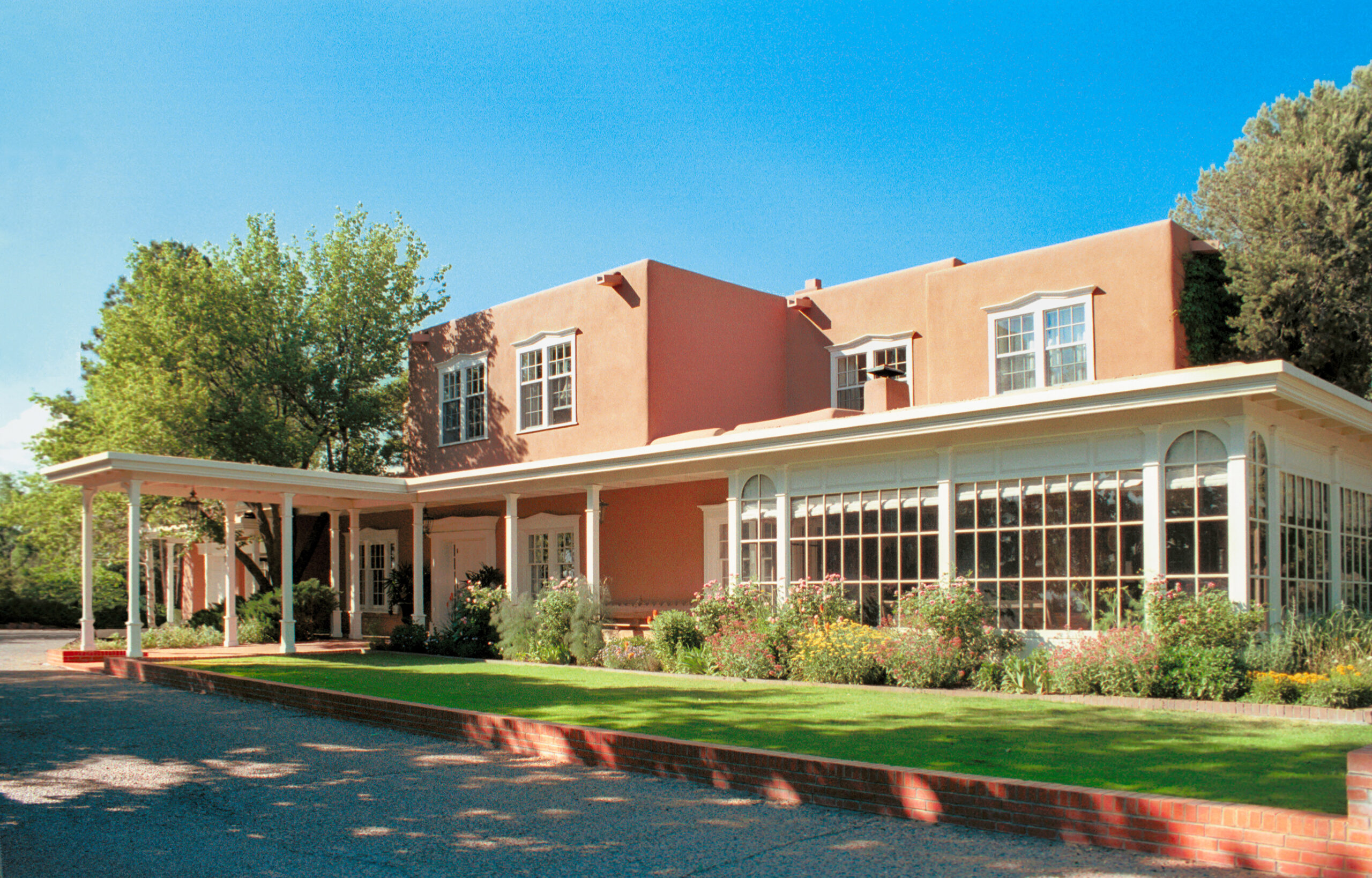
John Gaw Meem
He did not invent the way Santa Fe looks. He arrived after the argument had started, won it, and then made it law.
The Engineer Who Arrived Sick
John Gaw Meem was born in Pelotas, Brazil in 1894 to American missionary parents, and trained as a civil engineer at the Virginia Military Institute. He was working in banking when he contracted tuberculosis, and in the spring of 1920 he came to Sunmount Sanatorium, on the ridge southeast of town, for the cure. He was twenty-five and had never designed a building. He stayed for the rest of his life, and died in 1983.
What he found here was not a timeless city. It was a city eight years into a deliberate campaign to look like one. In 1912 the city planning board, with Edgar Lee Hewett and Sylvanus Morley behind it, issued a plan promoting what its authors called the New-Old Santa Fe style, and that November the museum staged an exhibition of drawings, photographs, and models to sell the idea to anyone building. The Palace of the Governors lost its Territorial front and got its present portal in 1913. Isaac Rapp’s Museum of Fine Arts, now the New Mexico Museum of Art, opened in 1917, and La Fonda followed in 1922. The vocabulary was assembled, argued for, and standing before Meem drew anything.
What Is His Here, and What Is Not
He opened a Santa Fe office in 1924 and practiced for more than thirty years. The local list is substantial: the 1931 Laboratory of Anthropology building, now part of the Museum of Indian Arts and Culture; the rework of La Fonda with Mary Colter between 1926 and 1929, including the bell tower; Cristo Rey at the top of Canyon Road, dedicated in June 1940 and built from something like 150,000 adobes made and laid by men from the surrounding blocks; the Museum of International Folk Art in 1953; and, the same year, the hospital on Palace Avenue that is now a hotel. Then the houses, several dozen of them, most on the historic east side and along Camino del Monte Sol, where he built his own. We keep a separate guide to Meem houses because attribution here is claimed more often than it can be documented.
A great deal of his best work is not in this city at all. Roughly forty buildings at the University of New Mexico in Albuquerque are his, and the Fine Arts Center he built in Colorado Springs in 1936 is poured concrete with Art Deco metalwork, which is worth knowing before deciding he only spoke one language.
The Rule He Wrote
By the 1950s he was worried about downtown street widening, and he formed a committee with Oliver La Farge and Irene von Horvath to stop it. What they produced was the 1957 Historic Zoning Ordinance, which required new construction in the downtown and east side districts to be Spanish-Pueblo or Territorial. Not encouraged. Required. He helped found the Historic Santa Fe Foundation in 1962, and he was still sitting on the review board in the mid-1970s when it passed a four-story hotel that calls itself a recreation of Taos Pueblo. We wrote about that building at the Inn and Spa at Loretto. The man who wrote the rule judged a building submitted under it, and let it through.
Listening Is the Comfortable Half
The generous account of Meem is that he listened to a place and handed it back to itself. It is not wrong. He measured old mission churches, spent years on the restoration of San Esteban del Rey at Acoma, and said he wanted to evoke a mood rather than produce an archaeological imitation. He meant it, and the buildings prove it.
But listening is half of what he did. The other half is that he wrote down what he heard and made it compulsory. The forms came from Pueblo and Hispano builders who had worked that way for centuries out of climate and necessity, and who were not asked whether their necessity should become someone else’s code. Inside the districts, every other answer became illegal.
Both halves are true, and holding them together is the only honest way to look at him. Stand inside Cristo Rey, which is genuinely great, then walk back down the road past eighty years of buildings obliged to agree with it. He was among the last people here who built in the language because he wanted to rather than because he had to.
Common Questions
What did John Gaw Meem build in Santa Fe?
Cristo Rey Church, the 1931 Laboratory of Anthropology building, the Museum of International Folk Art, the La Fonda bell tower with Mary Colter, and several dozen east side houses. Around forty more are his at the University of New Mexico in Albuquerque.
Did John Gaw Meem invent Santa Fe style?
No. The revival was under way by 1912, before he arrived, and Isaac Rapp had built in it by 1917. Meem refined it, then made it compulsory downtown through the 1957 ordinance.
Evaluating a Meem residence or another architecturally significant property? Read Webster Estates’ Santa Fe architecture guide, browse current homes and estates, or meet Christopher Webster III.
Discover More
Get in Touch
Let's connect and discuss how we can help you enrich your Santa Fe experience.
