

Zozobra
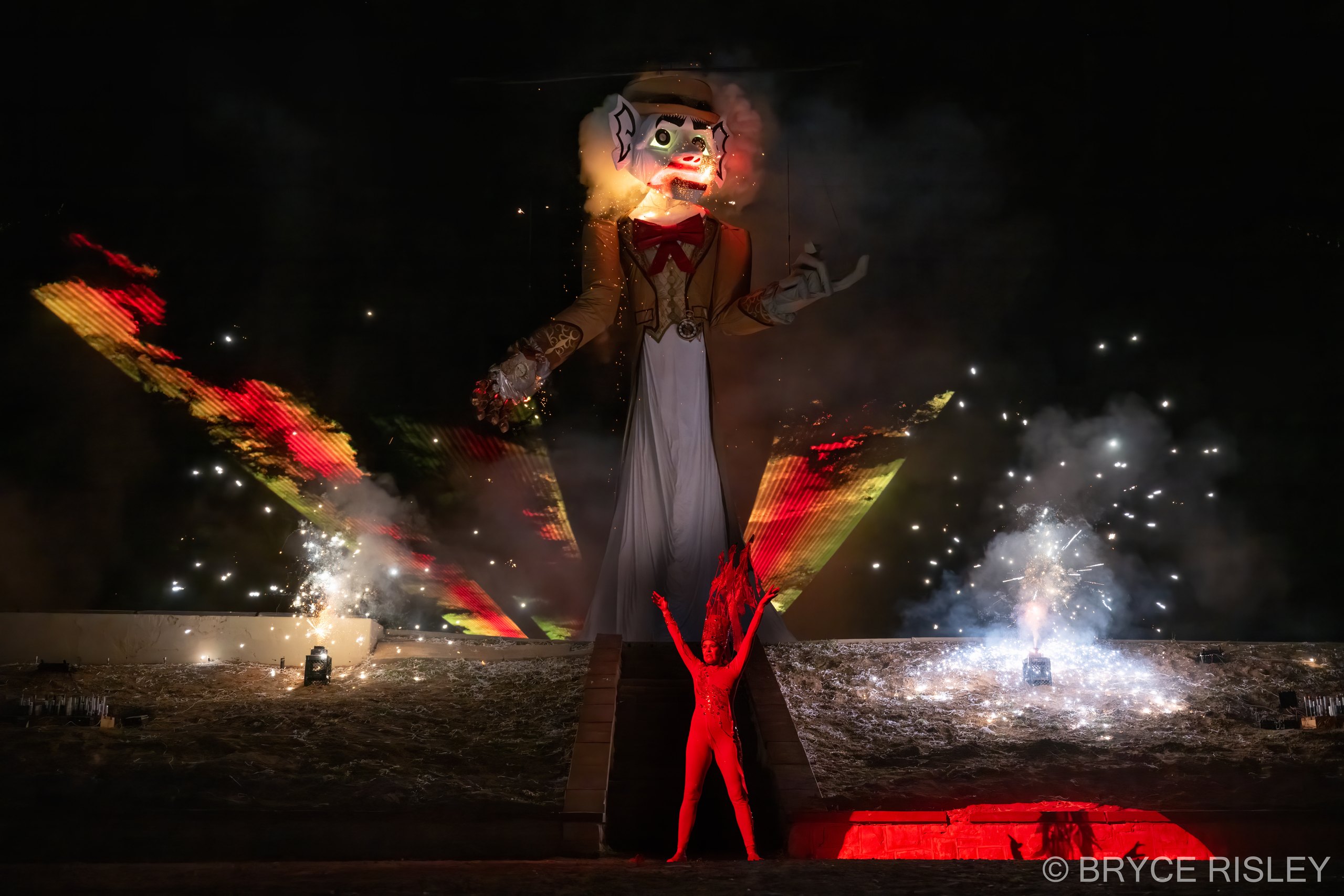
Old Man Gloom does not go quietly. For a while before he burns, a fifty-foot marionette at the north end of Fort Marcy Park groans, waves his arms, and rolls his head over a field of fifty thousand people, and then a dancer in red drives him into the flame. Santa Fe has been doing this since 1924. It is the strangest thing the city does, and the thing it is least willing to give up.
What Happens
Zozobra stands fifty feet six inches and weighs around three thousand pounds by the night of the burn, which makes him one of the largest working marionettes anywhere. He is built new every year from Will Shuster’s original drawings, out of wood, wire, poultry netting, cotton cloth, plywood, pizza pans, and duct tape, and then stuffed with shredded paper. His arms move. His head turns. He makes a sound.
The evening runs long before anything catches. Bands, food, a field filling while it is still light. After dark a performer called the Fire Spirit comes out in red with torches and dances him down. The fire starts in his paper hair and comes off him like a waterfall, and then he is gone, and then there are fireworks. The Kiwanis Club of Santa Fe, which has run the event since 1964, is precise about what he is not: not a political figure, not a religious symbol, not a demon, not a villain. He is gloom. That is all he is.
Where He Came From
Not from anywhere ancient. In 1924 Will Shuster, a Pennsylvania painter sent west in 1920 with a year or two to live, built a six-foot figure and burned it at a backyard party for the artists he ran with, the five who put up their own adobe houses on Camino del Monte Sol, off Canyon Road. He had watched a Yaqui community in Mexico carry an effigy through town on Good Friday and set it alight, and the Christmas before, he and his friends had burned slips of paper with their worries written on them. He put the two together. The newspaper editor E. Dana Johnson found the name in a Spanish dictionary: zozobra, which holds anguish, anxiety, and the sense of being shipwrecked in one word.
The first public burning was on September 2, 1926, in an open lot behind City Hall, and he was twenty feet tall. The crowd outgrew the lot, he moved to Fort Marcy in the 1930s, and Shuster signed all rights over to the Kiwanis Club in 1964. So this is an invented tradition, made by an art colony in the 1920s, and a hundred years of repetition is what turned the invention into a rite. Santa Fe is unusually good at that. Shuster’s own work hangs a few blocks away in the New Mexico Museum of Art.
The Glooms
This is the part that makes it more than a bonfire. In the weeks beforehand people write down what they want rid of and drop it in a gloom box, and it goes inside the figure with the shredded paper. Divorce decrees, medical reports, eviction notices, hospital bracelets, photographs, tax returns, and a wedding dress. Some are funny. Some are not. Nobody reads them. There are boxes around town, a tent at the field on the day itself, and an online portal for everyone else, and all of it burns at once.
The idea is older than the effigy. It is a Christmas Eve paper burning from 1923, scaled up to a city. Whatever you make of the spectacle, standing in the dark while fifty thousand people put something down at once is not nothing.
Going
The 102nd burning falls on Friday, September 4, 2026, at Fort Marcy Park, a few blocks north of the Plaza and walkable from most of downtown. The date moves. Since 2014 the burn has been held on the Friday before Labor Day, which set it a week clear of the Fiesta de Santa Fe, the September celebration it was attached to for most of its life. Zozobra runs on its own now.
Tickets are sold in advance and the field is capped at fifty thousand. Bags are restricted to a clear plastic one of a stated size, which catches people out every year. Do not plan on parking near the field, and walk in instead. Santa Feans build the whole evening around it, dinner downtown first at Cafe Pasqual’s or Plaza Café Downtown, then the climb up. And it sits where it sits deliberately. Summer here ends in a sequence: Indian Market in August, the last nights at the Santa Fe Opera, then a fifty-foot man on fire, and the Santa Fe year turns over into autumn.
Common Questions
When is Zozobra?
The Friday before Labor Day, at Fort Marcy Park. The 102nd burning falls on September 4, 2026. Confirm with the Kiwanis Club of Santa Fe before you travel for it.
What are the glooms?
Written worries, and often the documents themselves, submitted in the weeks beforehand and packed inside the figure with the shredded paper that fills him. Nobody reads them. They burn with him.


Get in Touch
Let's connect and discuss how we can help you enrich your Santa Fe experience.
