

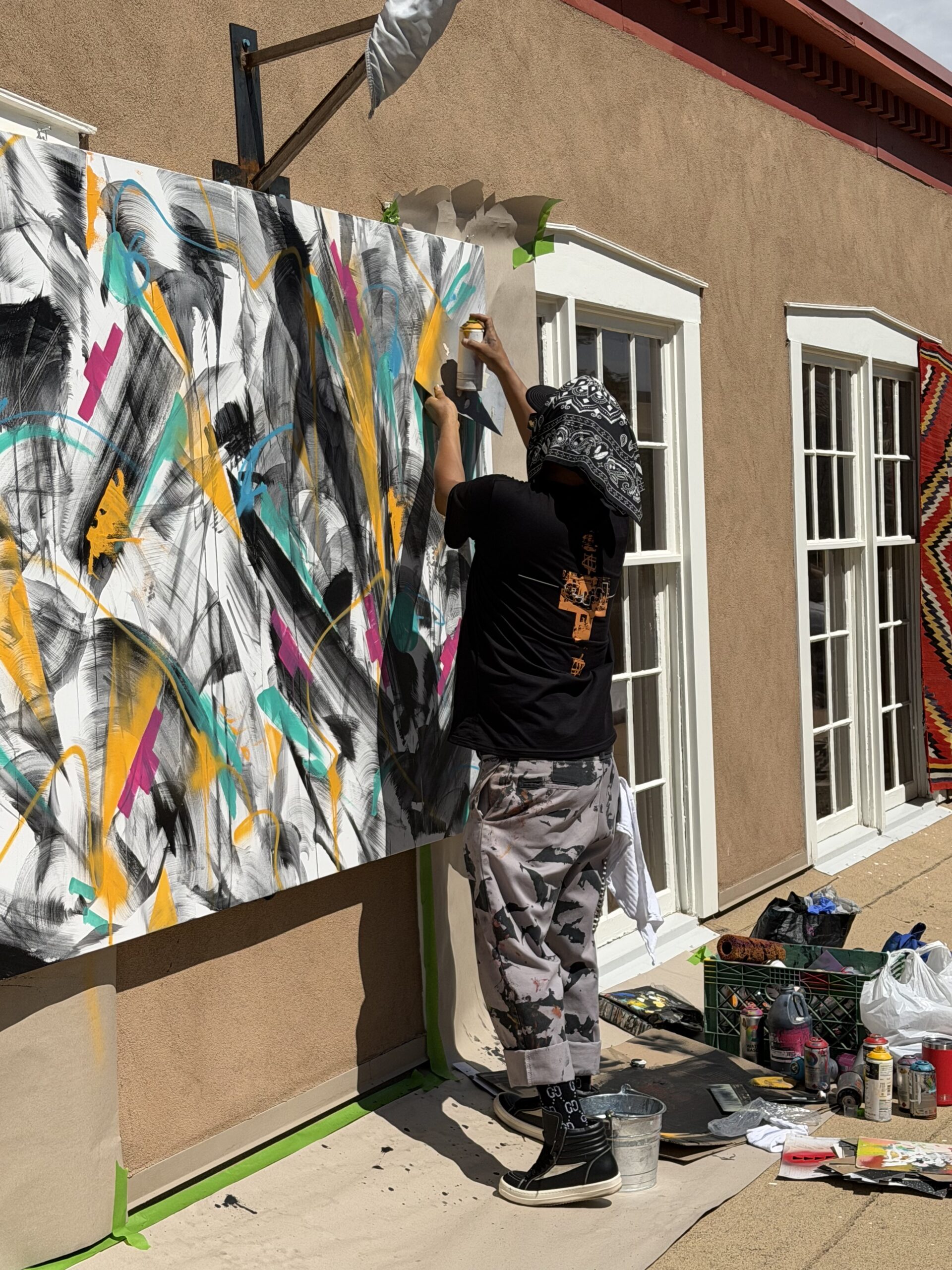
Carrier Wave: Randy L. Barton and Cloudface at Webster Collection
Two days of Indian Market weekend given over to watching the work come into being rather than looking at it finished.
Some exhibitions begin long before the opening reception. Carrier Wave unfolded across Indian Market weekend at Webster Collection, and what there was to see was not only finished work but the act of making it.
Randy L. Barton and Cloudface built the exhibition in public, over two days, in two settings that could not have been less alike. The first was indoors, at 54½ Lincoln Avenue. The second was the roof above our portal, with the Plaza directly below.
Friday: Sound and Image, Traded Back and Forth
The exhibition opened on the evening of Friday, August 14, with both artists working at once.
Barton is Diné, from Winslow, Arizona, and moves between painting, design, dance, and music production with an ease that is difficult to convey until you have watched him do it. His work carries hip hop and graffiti in it alongside Navajo teaching, and he has spent years painting live, in front of people, which is its own discipline. Cloudface works in sound. Across the evening the two of them took turns, one building the soundscape while the other painted, then trading, then trading again, both of them working on a single canvas.
By the end of the night a portrait had emerged: a young Hopi woman, grounded and quietly powerful. No one had announced her in advance. She arrived because two people spent an evening listening to each other closely enough to agree on where the next mark went.
Saturday: Five by Twelve Feet, Above the Portal
On Saturday the project moved outdoors and up. The artists worked on the rooftop above the portal, on a canvas five feet by twelve, with Indian Market running on the Plaza beneath them.
The building matters here. A Santa Fe portal is a working piece of architecture, a shaded edge where the street and the interior negotiate, and the roof above it is one of the few places downtown where you can stand at the height of the treetops and see the whole weekend at once. Below them were something close to a thousand Native artists under white canopies, from more than two hundred tribal nations, in the market’s hundred and fourth year. Above them, two artists building a painting in layers of gesture and symbol, slowly, in real time, in full view of a city that was itself full of artists that day.
Nothing about it was quick. That was the point.
Collaboration Treated as Conversation
Most collaborations are divisions of labor. One person handles this, another handles that, and the pieces are fitted together at the end. Carrier Wave was not built that way. Neither artist had a lane. Sound answered paint, paint answered sound, and the canvas was where the two of them replied to each other in public.
That is a harder thing to do than it looks, and it is the reason the paintings hold. They carry the record of a real exchange, including the parts where the direction changed. Collaboration treated as conversation leaves evidence.
What the Weekend Was For
Indian Market fills the third weekend of the Santa Fe year with more art than any one person can take in, nearly all of it finished, framed, cased, and ready. That is the nature of a market, and it is a good nature. But it does mean that the weekend hands you a great many endings and very few middles.
Carrier Wave offered the middle. What made it worth doing was not the two paintings, though we are glad to have them. It was the experience of standing near two artists while the work was still undecided, when it could have gone several ways and had not yet chosen. We have been showing art on this block since 1972, and the thing we keep relearning is that a finished object is the smaller part of the story.
Sometimes the most meaningful encounter with a work of art happens while it is still coming into being.
Christopher and Paisley Webster
Webster Santa Fe
Frequently Asked Questions
What is Carrier Wave?
Carrier Wave is an exhibition at Webster Collection, made by Randy L. Barton and Cloudface in public and in real time across Indian Market weekend 2026. It opened on the evening of Friday, August 14, with the two artists trading between sound and paint on a single canvas, and continued on Saturday, August 15, on the rooftop above the gallery’s portal, where they made a painting five feet by twelve in view of the Plaza.
Who are Randy L. Barton and Cloudface?
Randy L. Barton is a Diné artist, designer, dancer, and music producer from Winslow, Arizona, known for abstract painting and for live painting performance. His work is held by the Autry Museum of the American West and the Navajo Nation Museum, among others, and he is one of the organizers of Sovereign Santa Fe. Cloudface is an artist working in sound, and he built the audio side of both days of Carrier Wave.
When is Santa Fe Indian Market?
Santa Fe Indian Market is held on the Plaza on the third weekend of August each year, with related programming beginning that Friday. In 2026 it falls on Saturday, August 15, and Sunday, August 16. It is the largest Indigenous art market in the world, drawing roughly a thousand artists from more than two hundred tribal nations, and the outdoor market on the Plaza is free and open to everyone.
More from Webster Santa Fe
- The Dispatch: dispatches from the Plaza and the life of the city.
- Fine Art: Webster Collection, at 54½ Lincoln Avenue since 1972.
Get in Touch
Let's connect and discuss how we can help you enrich your Santa Fe experience.
