

The Last Night of Review Santa Fe
Review Santa Fe moves around the city for four days. Only the last two hours of it happened at 54½ Lincoln Avenue, which turns out to be a useful place to stand and explain what a portfolio review is.
CENTER’s Review Santa Fe does not take place in a building. It takes place in a city. The 2026 edition ran from Friday, October 23 through Monday, October 26, and before it was finished it had used CENTER’s own space out on Pacheco Street, two halls at La Fonda on the Plaza, and the Market Pavilion in the Railyard.
The last two hours of it, the private closing reception on Monday evening, were held at Webster Collection on the west side of the Plaza, which is exactly where CENTER’s published schedule said they would be. It was a great deal of fun, which is the right outcome for a last night and is not, by itself, worth a dispatch.
The four days in front of it are. A portfolio review is a specific and slightly strange structure, rarer than it sounds and more consequential than it looks, and most people who love photographs have never been inside one. We went to the public half of it on Saturday night and hosted the end of it on Monday, and between them those two evenings give a fair view of what the weekend is for.
What CENTER Is
CENTER is a Santa Fe nonprofit, founded in 1994, that exists to support lens-based projects through education, public platforms, funding, and partnerships. It has carried three names. It took its 501(c)(3) incorporation as the Santa Fe Center for Visual Arts in 1995, became the Santa Fe Center for Photography in 2003, and became CENTER, in capitals, in December 2006. The capitals are its own and they are not a design affectation somebody added later.
Its best-known program is Review Santa Fe, which held its first edition in 2001 and which CENTER now runs as a four-day photo symposium. By CENTER’s own count, 2026 was the twenty-fifth year. The organization describes it as one of the country’s original juried portfolio review events, and the juried part is the part that matters. Photographers apply from all over the world and a panel decides who comes, which means the work that arrives in town for that weekend has already been through a filter.
The Weekend Moves Around the City
Friday opened with an exhibition of CENTER’s award and grant recipients at CENTER Space, the organization’s own space on Pacheco Street, well south of downtown.
Saturday came to the Plaza. Check-in, opening remarks, and a project presentation at La Fonda during the afternoon, and then everyone went out to the Railyard in the evening for the Portfolio Walk.
Sunday and Monday went back to La Fonda for the reviews themselves. Three sessions, all of them private, in the Lumpkins Ballroom: one long one on Sunday, two more on Monday. At half past five on Monday the reviewers took a public panel in the New Mexico Room, and at seven the symposium was finished and walked across the Plaza to us.
That last part is the only part that happened at 54½ Lincoln Avenue. The review is CENTER’s, it is held in CENTER’s venues, and what we had was the end of it.
Saturday Night at the Farmers Market Building
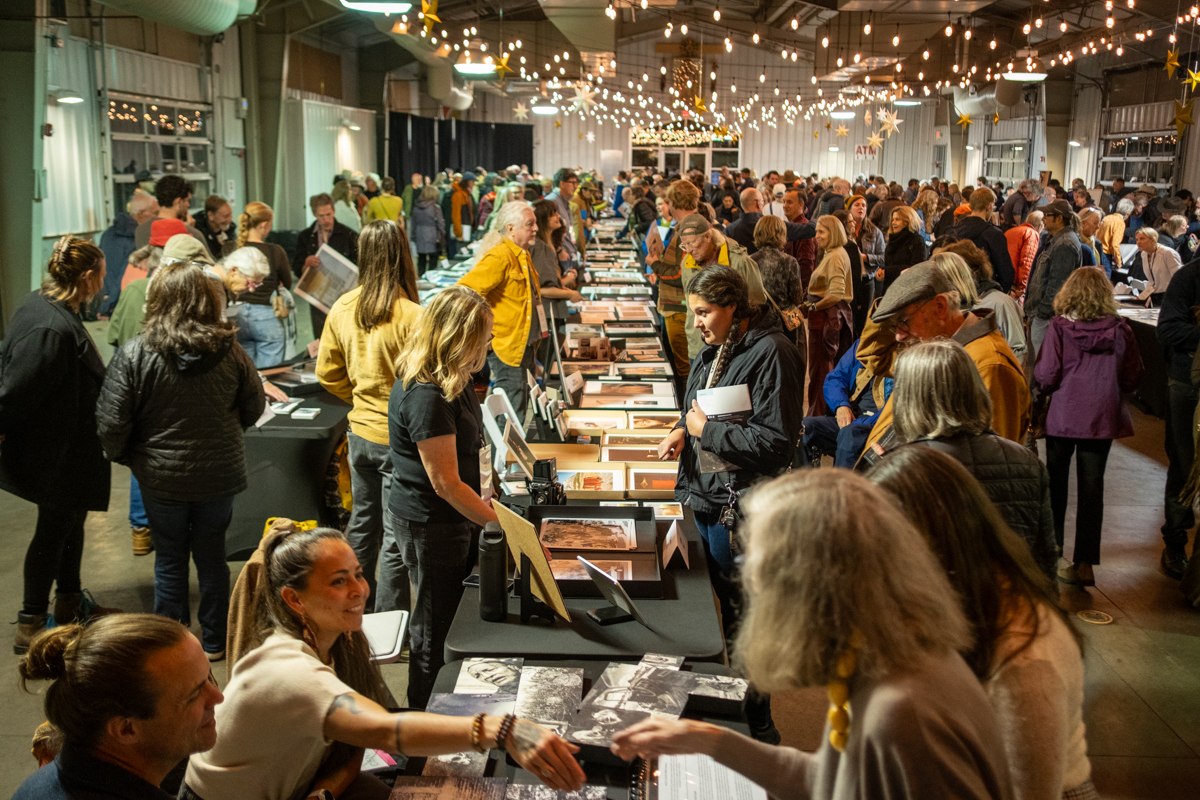
The Portfolio Walk is the one evening of the four that anybody can attend. It is free, it is open to the public, and it is held at the Market Pavilion on Paseo de Peralta, which everybody in town calls the farmers market building. Christopher and Paisley went on Saturday night.
For that one evening the pavilion becomes an exhibition. Every photographer selected for the symposium shows the project they came with, all of it in one place at one time, and the photographers stand with their work and talk to whoever stops. Much of what is up is unfinished and most of it is unpublished, because the entire weekend is organized around advancing projects rather than displaying completed ones. You are looking at photography a year or two before anybody else will.
That is an unusual thing to be able to walk into for nothing, and the contrast with Monday is worth stating plainly, because it is the useful information in this piece. CENTER’s schedule lists the Portfolio Walk as open to the public and the closing reception as private. Anybody who wants into Review Santa Fe wants the Saturday, not the Monday, and they can go next year without knowing a soul.
What Happens at a Portfolio Review
The Portfolio Walk is the public face of the weekend. The reviews are private, they happen behind a closed door at La Fonda, and they are the reason everybody came.
The mechanics are easy to describe and considerably harder to sit through. A photographer arrives with a project. Not a portfolio in the old sense of best work gathered over a career, but a body of work with an argument inside it, usually unfinished, usually something the photographer has been living with for years. Over two days that photographer sits down one-on-one with a run of reviewers: museum curators and directors, gallerists, editors, book publishers, people who run nonprofit spaces. CENTER aims to give each participant nine of those meetings, and it says plainly in its own materials that it cannot guarantee any particular reviewer, because reviewers change at the last minute and a cancellation gets rebooked with somebody else.
Nine meetings. Each one is a stranger giving your work their undivided attention and then telling you what they think of it.
That is the thing worth understanding about the format. Photographers work alone and show rarely. The ordinary condition of a serious photographic project is that almost nobody has looked at it properly, and the people best placed to look at it properly are unreachable by any normal route. A review weekend inverts that for two days. It also works in the other direction, because it is one of the few occasions on which a curator or an editor sees a large quantity of unpublished work in sequence, selected by a jury rather than by an algorithm or a mailing list. Nothing about it is guaranteed to produce an exhibition or a book. Quite often it produces something more useful, which is an accurate account of what the work is doing and what it is not yet doing.
Two generations of the family were in this year’s edition, in different capacities and in different buildings. Chris Webster sat as a reviewer, and appears on CENTER’s published 2026 reviewer list under Exhibiting and Collecting. Those sessions were at La Fonda, like all of them, and not here. Paisley often reviews and skipped this year.
Monday Night
Christopher and Paisley had the gallery open on Monday evening, and the last event of the symposium happened in it.
Plaza Cafe Downtown catered. It came up the stairs from 54 Lincoln Avenue, directly below us, where a restaurant has operated since 1905. There were lots of people, and the useful detail is who those people were: photographers who had spent two days being looked at closely, and reviewers who had spent two days looking. By seven o’clock both groups were done with the part that has a clock on it.
Why the Last Night Is Worth Hosting
A review meeting is a short, formal, consequential conversation with a timer running. That is its virtue, and it is also the reason a closing night does more work at this event than a party usually does, because it is the only part of the weekend where the same people meet one another with nothing scheduled.
A gallery suits that for an unglamorous reason. It is a place built for looking at pictures slowly, and it is already full of somebody else’s work, which means nobody’s portfolio is on the table. Whatever gets said on the last night gets said in front of art that belongs to neither party.
We have been showing art on this block since 1972, and most nights we are in the business of selling it. Monday was not that. Hosting the end of somebody else’s event, in a city that is not short of events, is one of the few things a gallery can do with no transaction anywhere in it, and that is precisely the argument for doing it. The photographic community is a real community, it convenes here once a year, and it should have somewhere to end up.
It is a fun weekend for photographers and reviewers. The reason it is fun is that for four days the usual ratio is reversed, and the work gets more attention than it is accustomed to getting.
Frequently Asked Questions
What is Review Santa Fe?
Review Santa Fe is CENTER’s annual photo symposium, built around a juried portfolio review. Photographers apply from around the world, a panel selects who attends, and those selected meet one-on-one with curators, gallerists, editors, and publishers over several days. The first edition was held in 2001. The 2026 edition ran October 23 to 26.
Where does Review Santa Fe take place?
In several locations across Santa Fe rather than at a single venue. In 2026 the main program, including the private portfolio review sessions and a public reviewer panel, was at La Fonda on the Plaza. The opening exhibition was at CENTER Space on Pacheco Street, the public Portfolio Walk was at the Market Pavilion on Paseo de Peralta in the Railyard, and the closing reception was at Webster Collection on the Plaza.
How does a portfolio review work?
A photographer brings a single project, usually unfinished, and presents it across a series of scheduled one-on-one meetings with industry reviewers. CENTER aims to give each participant nine such meetings. It does not guarantee specific reviewers, and it rebooks with a different reviewer if someone has to cancel. The purpose is advancing a project rather than selling prints.
Is any of Review Santa Fe open to the public?
Part of it. The Portfolio Walk, held Saturday evening at the Market Pavilion on Paseo de Peralta, is free and open to everyone, and it is the one night of the symposium when the selected work is all in one place and anyone can look at it. A reviewer panel discussion on the Monday is also public. The portfolio review sessions themselves and the closing reception are private.
What is CENTER?
CENTER is a Santa Fe nonprofit founded in 1994 that supports lens-based projects through education, public platforms, funding, and partnerships. It was incorporated as the Santa Fe Center for Visual Arts in 1995, renamed the Santa Fe Center for Photography in 2003, and took the name CENTER in December 2006. Review Santa Fe is its best-known program.
Continue exploring
- Carrier Wave: Randy L. Barton and Cloudface, an exhibition the gallery made in its own space, which is a different kind of evening from this one.
- An Evening in Stone: Richard Rhodes at the CCA, another night at somebody else’s event across town.
- Why Santa Fe Attracts Creative People, on what keeps bringing artists and writers to this city.
- The Plaza, 1885, the same ground in a photograph from the 1880s.
- Santa Fe Historic Photographs, our collection of early photographs of the city.
- SITE Santa Fe, the contemporary art space a few minutes from the Market Pavilion.
- A Wonderful, Fantastic Night in the Railyard, another evening in the same part of town.
- See and Do, in Discover, our index of what to see and do in and around the city.
- The Dispatch, the rest of the series.
Get in Touch
Let's connect and discuss how we can help you enrich your Santa Fe experience.
