

Above Fort Marcy
The 102nd burning of Zozobra, watched from a hillside, and the part of the evening that does not change.
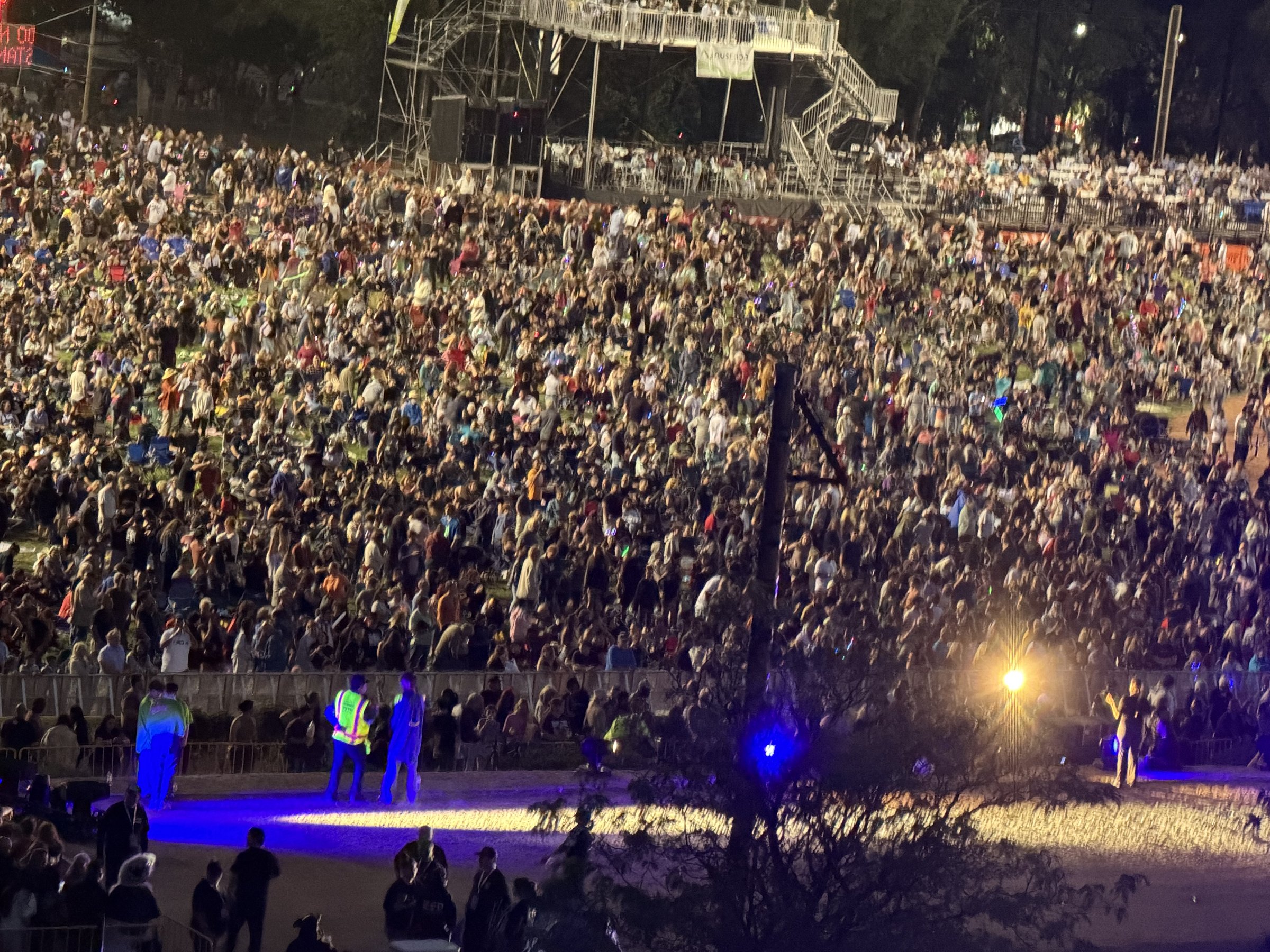
On Friday evening Christopher and I watched Zozobra from a friend’s home above Fort Marcy. From that height, the first thing that caught my attention was not Old Man Gloom. It was the field. Thousands of people were slowly filling it, blankets spread across the grass, kids weaving through the crowd, neighbors stopping to greet each other as the light softened over the Sangre de Cristos.
This was the 102nd burning. Will Shuster made the first one in 1924, a six-foot effigy set alight in his own backyard for a party of friends and fellow artists, and he handed the rights to the Kiwanis Club of Santa Fe in 1964. The figure moved to Fort Marcy in the 1930s, above the old neighborhoods north of the Plaza, and now stands fifty feet, filled each year with the glooms that people write down and send in: the divorce decrees, the medical reports, and the things they would rather not carry into autumn. This year the Kiwanis Club dressed him as King George III under the theme “The Tyranny of Gloom vs. the Spirit of ’76,” a nod to the country’s 250th anniversary.
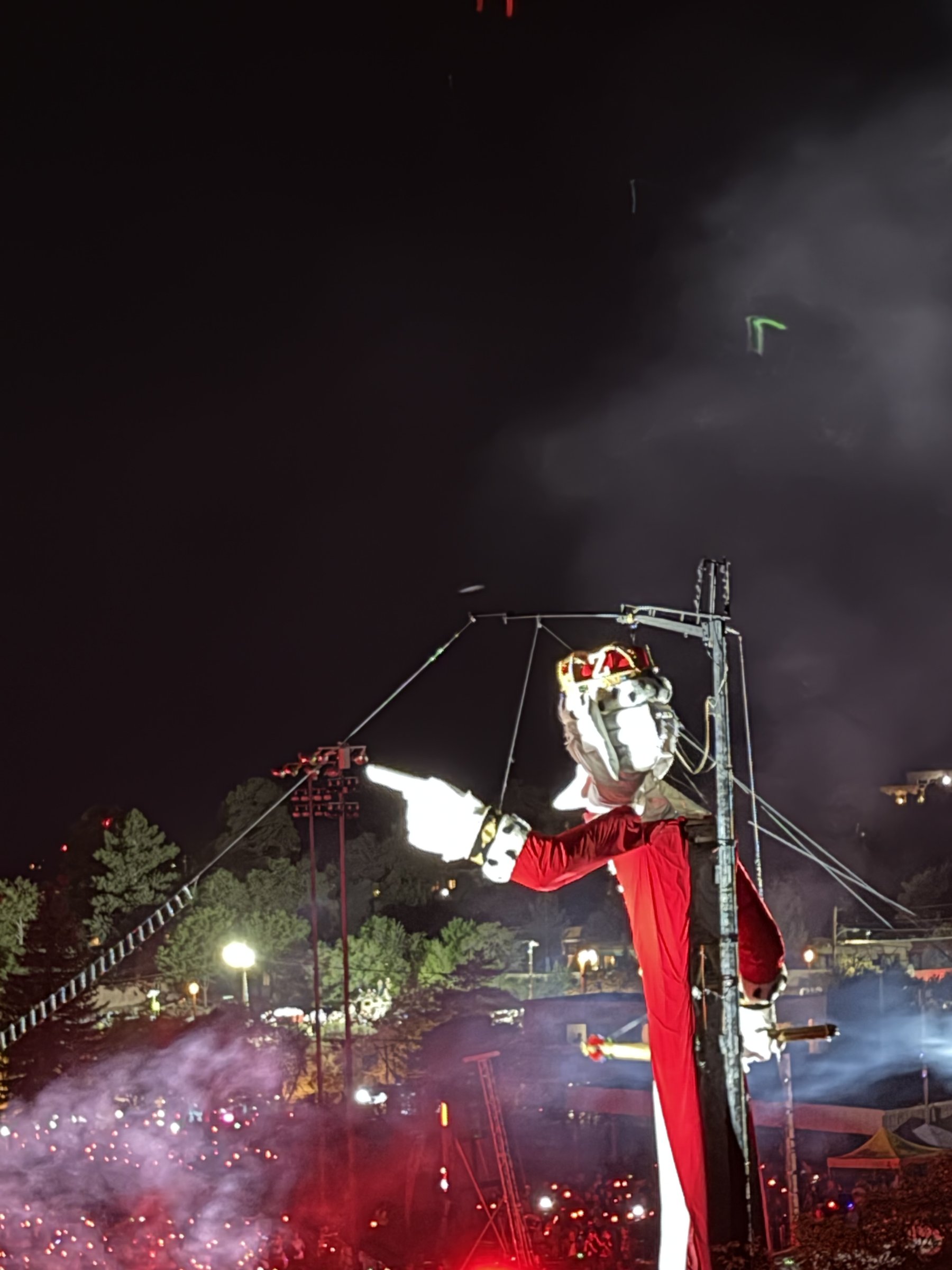
I have been to more Zozobras than I can count. Childhood memories are stitched into this night, and still, the act of seeing the community gather holds weight.
Watching from above changes the proportions. Down in the field, Zozobra is all there is, fifty feet of groaning marionette and a wall of sound. From a hillside, he is one bright figure at the top of a much larger picture, and the picture is mostly people.
For visitors, it is a date on the calendar. For locals, it marks a turning. Summer loosens its grip, the days shorten, and Santa Fe slowly becomes itself again. The opera closes, Indian Market packs up off the Plaza, the roasters start running in the parking lots, and the calendar tilts back toward the people who live here.
Traditions shift over time. Productions grow, technology changes, and the event feels different in some ways: larger, more carefully managed, and separated now from the Fiestas. That separation is real. Since 2014 Zozobra has held its own date, the Friday before Labor Day, with Fiestas de Santa Fe following the week after. A field that holds fifty thousand people is not what Shuster built in his yard. People argue about all of it every year, which is itself a Santa Fe tradition. And all of it is true.
But standing above it, the part that felt continuous was not the spectacle. It was the people. Thousands gathered in one place, in the dark, sharing a moment that links generations. Some of them were watching their first burning. Some of them, like me, could not put a number on their own.
That is what I have always loved about Zozobra. You do not just watch something burn. You put something into it. You stand shoulder to shoulder with people who were here long before you and people who will be here long after, and for one evening an entire city agrees to share the same thing together. The fire is the occasion. The gathering is the tradition.
Continue exploring
- Zozobra, in Discover
- The Santa Fe Year, on seasons and the turn toward autumn
- Santa Fe Annual Calendar of Major Events
- The Plaza, 1885
- The Dispatch
Get in Touch
Let's connect and discuss how we can help you enrich your Santa Fe experience.
