

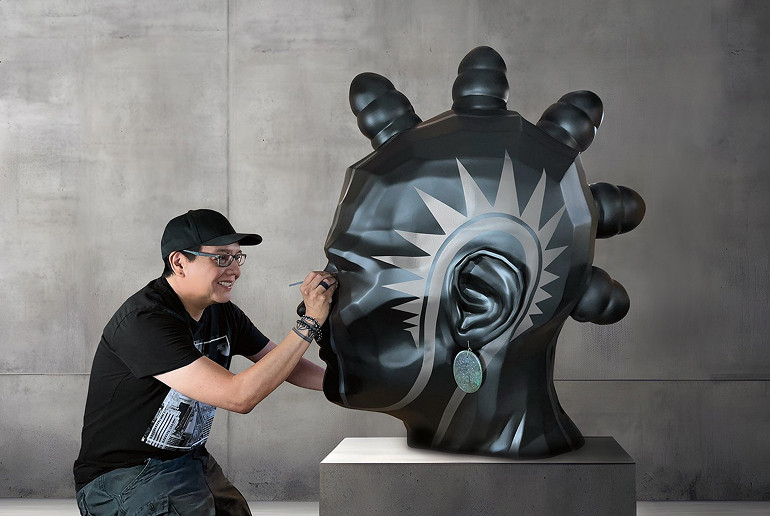
Time in the Clay: Virgil Ortiz at the New Mexico School for the Arts
Virgil Ortiz at the New Mexico School for the Arts, on a material that keeps its own calendar.
Virgil Ortiz began with clay. Not the finished vessel and not the figures, but the vein of clay near Cochiti Pueblo that his family returns to.
Ortiz is a Cochiti Pueblo artist whose work has carried well past New Mexico. He was speaking on Friday, August 28, at the New Mexico School for the Arts, in conjunction with his exhibition at Vladem Contemporary, the New Mexico Museum of Art’s contemporary space and a short walk down Montezuma Avenue from the school. He is a friend of the gallery, and we went to listen. What he laid out was a process measured less in hours than in seasons.
Nearly a Year Before the Clay Is Ready
Harvesting the clay is a family undertaking. Once it is collected, nearly a year passes before it is ready to use. The black pigment begins as wild spinach, gathered by hand and reduced slowly over weeks. Burn the mixture at the wrong moment, Ortiz explained, and weeks of work are gone. Long before a figure is sculpted or a vessel is painted, the work has already asked for patience.
Tradition Remembered Rather Than Taught
The most compelling turn of the evening came when he described his early experiments with figurative ceramics. As a teenager he began making forms unlike anything his family remembered creating. It was not until a gallerist showed them historic Cochiti figures in a museum collection that they understood those forms had existed generations before. His family spoke of Clay Mother as a guiding presence. Tradition, in that telling, is sometimes remembered rather than taught. It can arrive as instinct before it arrives as knowledge.
That story reframed everything that followed. The fiberglass and the resins, the automotive paints, the digital fabrication, the fashion, and the collaborations with artists working in enamel, glass, and custom paint: none of it reads as a departure. The materials have changed. The discipline, the curiosity, and the respect for process have not.
Santa Fe talks about tradition and innovation as though they were opposites. Ortiz’s practice suggests something more generous. Tradition is not a boundary drawn around the work. It is the ground the work stands on, and the reason it can keep moving.
Craft is rarely defined by the object alone. It is defined as much by the time, the memory, and the quiet rituals that make the object possible long before it reaches the kiln.
Continuum: Blindfall, First Strike, by Virgil Ortiz and Eric F. Garcia, is at Vladem Contemporary through October 18, 2026.
Continue exploring
- An evening in stone: Richard Rhodes at the Center for Contemporary Arts, another Dispatch account of an artist on the material he works in and the long apprenticeship it asks of him.
- Carrier Wave: Randy L. Barton and Cloudface making work in public at Webster Collection, two days of Indian Market weekend given over to watching a painting come into being rather than looking at it finished.
- The Carrier Wave exhibition page at Webster Collection, with the works themselves.
- The First Moderns, from the 48th Whitehawk Antique Indian and Ethnographic Art Show, on a wall of Navajo Germantown weavings and the argument it makes about the weavers who made them.
- North American Indian art at Webster Collection, the field the gallery has worked in since 1972.
- Zoë Urness, the Tlingit photographer whose portraits show Native tradition as ongoing rather than past.
- Charles Loloma, the Hopi jeweler from Hotevilla.
- Navajo and Diné weaving, the upright loom, and Churro wool.
- The Museum of Indian Arts and Culture on Museum Hill, the public face of the state’s research collection of Southwestern Native art and material culture.
- The Wheelwright Museum of the American Indian.
- The Railyard, the district where Vladem Contemporary stands.
- Santa Fe Indian Market, and what August does to this city.
- The architecture of daily life in Santa Fe, on adobe, portals, and the way a house here is actually lived in.
- Why creative people choose Santa Fe.
- The Dispatch, the full series.
Get in Touch
Let's connect and discuss how we can help you enrich your Santa Fe experience.
